


An EV every 2 sec from world’s largest 2-wheeler plant
Products

An EV every 2 sec from world’s largest 2-wheeler plant

Ola, an Indian mobility company, has announced that it will manufacture electric scooters in India. The ride sharing provider signed a Rs 2,400 crore memorandum of understanding (MoU) with the Tamil Nadu government in December, to form the largest two wheeler manufacturing plant in the world, and completed a 500 acre land acquisition for the plant in January 2021.

Ola has also partnered with Siemens for the upcoming electric vehicle manufacturing facility. Ola told the media that the factory is to be operational in the next few months. The factory is scheduled to produce an electric scooter every two seconds, media reports said citing Ola officials.

Ola Cabs acquired the Netherlands based electric scooter company Etergo last year. The upcoming Ola electric scooter is expected to be based on Etergo AppScooter powered by a swappable high energy density battery and is claimed to be capable of running 240 km on a single charge. The Etergo AppScooter is claimed to be accelerating 0-45 kmph in 3.9 seconds. The e-scooter has an under seat storage capacity of 50 litres.


4th Indian Cement Review Conference 2021

17-18 March 

Click for event info


The company said that the factory would be its global manufacturing hub for its electric scooters and two wheelers that will be retailed not only in India but international markets as well.

It will offer an initial annual production capacity of two million units in the first phase.

Ola’s electric two wheeler factory will be able to roll out 20 lakh electric scooters in the initial phase, the company claimed. The electric two wheelers will be sold across India and exported to international markets like Australia, Europe, New Zealand and Latin America.

The facility will be 90% automated, and Ola will control the core technology and engineering. Ola said that the plant would be powered by its own artificial intelligence (AI) engine and technology stack that will be deeply integrated into all factory operations.

The company will also be designing, engineering, manufacturing its own battery pack, vehicle computers, and the software components that would be incorporated into the factory.

The factory will be powered by Ola’s own proprietary AI engines and tech stacks that will be integrated into all its systems. Ola Electric will also be hiring over 10,000 people to work in the factory.

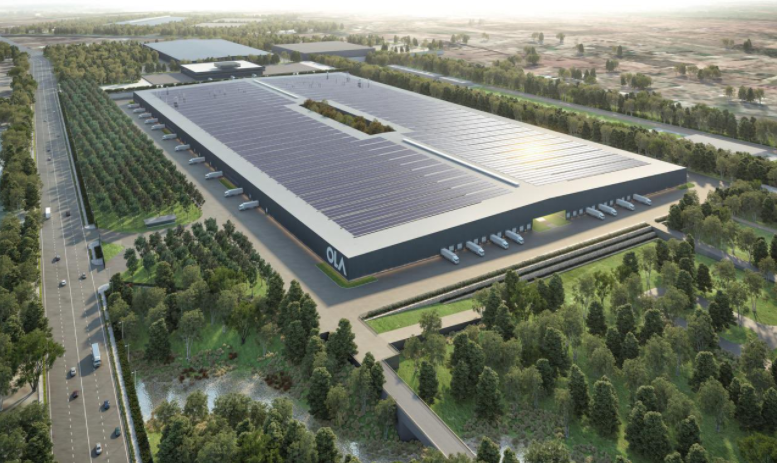
Image: Representative image as shared by Bhavish Aggarwal, Co-founder, Ola cabs


Also read: Li-ion battery production starts in Chennai

Also read: TN Cabinet approves projects worth Rs 52k crore

Ola, an Indian mobility company, has announced that it will manufacture electric scooters in India. The ride sharing provider signed a Rs 2,400 crore memorandum of understanding (MoU) with the Tamil Nadu government in December, to form the largest two wheeler manufacturing plant in the world, and completed a 500 acre land acquisition for the plant in January 2021. Ola has also partnered with Siemens for the upcoming electric vehicle manufacturing facility. Ola told the media that the factory is to be operational in the next few months. The factory is scheduled to produce an electric scooter every two seconds, media reports said citing Ola officials. Ola Cabs acquired the Netherlands based electric scooter company Etergo last year. The upcoming Ola electric scooter is expected to be based on Etergo AppScooter powered by a swappable high energy density battery and is claimed to be capable of running 240 km on a single charge. The Etergo AppScooter is claimed to be accelerating 0-45 kmph in 3.9 seconds. The e-scooter has an under seat storage capacity of 50 litres.4th Indian Cement Review Conference 202117-18 March Click for event info The company said that the factory would be its global manufacturing hub for its electric scooters and two wheelers that will be retailed not only in India but international markets as well. It will offer an initial annual production capacity of two million units in the first phase. Ola’s electric two wheeler factory will be able to roll out 20 lakh electric scooters in the initial phase, the company claimed. The electric two wheelers will be sold across India and exported to international markets like Australia, Europe, New Zealand and Latin America. The facility will be 90% automated, and Ola will control the core technology and engineering. Ola said that the plant would be powered by its own artificial intelligence (AI) engine and technology stack that will be deeply integrated into all factory operations. The company will also be designing, engineering, manufacturing its own battery pack, vehicle computers, and the software components that would be incorporated into the factory. The factory will be powered by Ola’s own proprietary AI engines and tech stacks that will be integrated into all its systems. Ola Electric will also be hiring over 10,000 people to work in the factory. Image: Representative image as shared by Bhavish Aggarwal, Co-founder, Ola cabs Also read: Li-ion battery production starts in Chennai Also read: TN Cabinet approves projects worth Rs 52k crore

Next Story
Infrastructure Transport

Vizhinjam Port to launch Phase 2 expansion from mid-January

The second phase of expansion at Vizhinjam International Port is set to begin in the second week of January, marking a major milestone in the port’s rapid scale-up as a global transshipment hub. Kerala Ports Minister V N Vasavan announced the development following a review meeting, adding that the exact start date will be finalised after consultations with Chief Minister Pinarayi Vijayan and the Adani Group.Preparatory work for the upcoming construction phases has already been completed. The expansion is part of a Rs 10,000-crore investment by Adani Ports and Special Economic Zone Ltd. (APSE..

Next Story
Infrastructure Transport

MoPSW Secretary inaugurates Rs 1.93 bn projects at Kandla Port

Vijay Kumar, Secretary, Ministry of Ports, Shipping and Waterways (MoPSW), inaugurated and laid the foundation stone for multiple developmental projects worth Rs 1.93 billion at Deendayal Port Authority (DPA), Kandla, marking a significant step towards strengthening port infrastructure and operational efficiency.During his visit, Sushil Kumar Singh, IRSME, Chairman, Deendayal Port Authority, briefed the Secretary on the port’s strong operational performance, recent achievements, and ongoing as well as upcoming initiatives focused on enhancing capacity, efficiency and sustainability. Vijay Ku..

Next Story
Infrastructure Energy

PNGRB Rolls out unified natural gas tariff from January 2026

The Petroleum and Natural Gas Regulatory Board (PNGRB) has notified a new unified tariff structure for natural gas transportation, marking a major consumer-focused reform aimed at boosting the adoption of cleaner fuels across India. The revised framework will come into effect from January 1, 2026, and is expected to significantly lower transportation costs for Compressed Natural Gas (CNG) and Piped Natural Gas (PNG) consumers.Under the new regime, PNGRB has rationalised the existing tariff structure by reducing the number of tariff zones from three to two—up to 300 km and beyond 300 km. In a..

Advertisement

Subscribe to Our Newsletter

Get daily newsletters around different themes from Construction world.

STAY CONNECTED

Advertisement

Advertisement

Advertisement

Advertisement

Open In App