Geopolymers Emerge as Colourable, Low-Carbon Cement Alternatives
Cement

Geopolymers Emerge as Colourable, Low-Carbon Cement Alternatives

Geopolymers are increasingly gaining attention in the construction industry as a low-carbon alternative to traditional cement-based concrete. Widely used in the manufacture of construction products, these materials are seen as a key solution for reducing the carbon footprint of buildings and infrastructure. However, questions have remained around their suitability for colouring, an important requirement as customers demand more customised and visually appealing products.

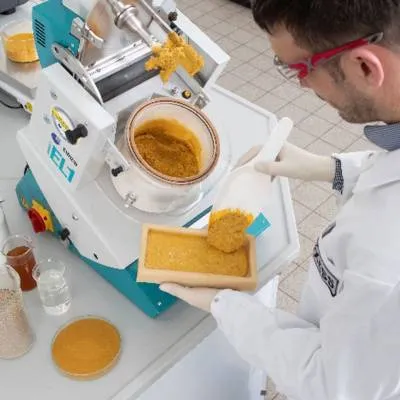
To address concerns around colour performance and durability, pigment specialists from LANXESS and Harold Scholz & Co. GmbH, together with Rhein-Chemotechnik GmbH, recently undertook a joint research project examining the colouring behaviour of geopolymer systems. The study focused on the use of iron oxide pigments and compared results across alkali-activated materials, specialised geopolymers and conventional cement-based products.

The research highlighted key differences between calcium-rich alkali-activated materials and low-calcium geopolymers produced from metakaolins. While alkali-activated systems form calcium silicate hydrate phases that allow strong electrostatic binding of pigments, geopolymers develop a three-dimensional network structure that interacts differently with colourants. Despite these chemical differences, test results showed that all binder systems could be coloured effectively and durably.

Samples produced under DIN EN 12878 standards demonstrated stable coloration, even after exposure to natural and accelerated weathering. Although variations were observed in mixing, processing and curing behaviour, the durability and visual quality of the colouring remained consistent across all systems.

The findings confirm that geopolymers and alkali-activated materials can meet aesthetic demands without compromising performance. Further research, involving the Technical University of Dresden, is planned to examine structural characteristics and long-term technical performance in greater detail.

Geopolymers are increasingly gaining attention in the construction industry as a low-carbon alternative to traditional cement-based concrete. Widely used in the manufacture of construction products, these materials are seen as a key solution for reducing the carbon footprint of buildings and infrastructure. However, questions have remained around their suitability for colouring, an important requirement as customers demand more customised and visually appealing products. To address concerns around colour performance and durability, pigment specialists from LANXESS and Harold Scholz & Co. GmbH, together with Rhein-Chemotechnik GmbH, recently undertook a joint research project examining the colouring behaviour of geopolymer systems. The study focused on the use of iron oxide pigments and compared results across alkali-activated materials, specialised geopolymers and conventional cement-based products. The research highlighted key differences between calcium-rich alkali-activated materials and low-calcium geopolymers produced from metakaolins. While alkali-activated systems form calcium silicate hydrate phases that allow strong electrostatic binding of pigments, geopolymers develop a three-dimensional network structure that interacts differently with colourants. Despite these chemical differences, test results showed that all binder systems could be coloured effectively and durably. Samples produced under DIN EN 12878 standards demonstrated stable coloration, even after exposure to natural and accelerated weathering. Although variations were observed in mixing, processing and curing behaviour, the durability and visual quality of the colouring remained consistent across all systems. The findings confirm that geopolymers and alkali-activated materials can meet aesthetic demands without compromising performance. Further research, involving the Technical University of Dresden, is planned to examine structural characteristics and long-term technical performance in greater detail.

Next Story
Infrastructure Urban

Assam Poised as Act East Gateway, Sonowal tells Guwahati Dialogue

Union Minister of Ports, Shipping and Waterways Sarbananda Sonowal on Tuesday said Assam is uniquely positioned to emerge as a regional growth hub under India’s Act East Policy, calling on entrepreneurs to leverage the state’s strategic geography, improving connectivity and governance reforms to drive inclusive development across the Northeast.Delivering the keynote address at the second Guwahati Dialogue, Sonowal said Assam has the potential to cater to a market of nearly 800 million people extending from Nepal to Myanmar, as India strengthens economic and logistical integration with Sout..

Next Story
Infrastructure Urban

Industrial Parks Drive Smarter Infrastructure, Stronger Growth

Industrial parks are increasingly emerging as a key instrument in advancing India’s industrialisation and innovation agenda, playing a vital role in strengthening the country’s manufacturing base and economic competitiveness. Developed through collaboration between the government, state authorities and the private sector, these parks are designed to attract investment, enable efficient industrial operations and promote balanced regional development.An industrial park typically comprises a planned and developed tract of land designated for industrial use, often supported by shared infrastru..

Next Story
Infrastructure Urban

CCI Approves Asia II Topco’s Warrant Acquisition in Federal Bank

The Competition Commission of India (CCI) has approved the acquisition of certain warrants of Federal Bank by Asia II Topco XIII, paving the way for a minority investment in the private sector lender.The proposed combination involves Asia II Topco XIII acquiring warrants issued by Federal Bank, with each warrant carrying the right to subscribe to one fully paid-up equity share of the bank. Upon full exercise of these warrants, the acquirer is expected to hold 9.99 per cent of Federal Bank’s paid-up share capital on a fully diluted basis.As part of the transaction, the acquirer will also have..

Advertisement

Subscribe to Our Newsletter

Get daily newsletters around different themes from Construction world.

STAY CONNECTED

Advertisement

Advertisement

Advertisement

Advertisement

Open In App