+
Two-Wheeler Industry Eyes Seven To 9% Growth By FY27
ECONOMY & POLICY

Two-Wheeler Industry Eyes Seven To 9% Growth By FY27

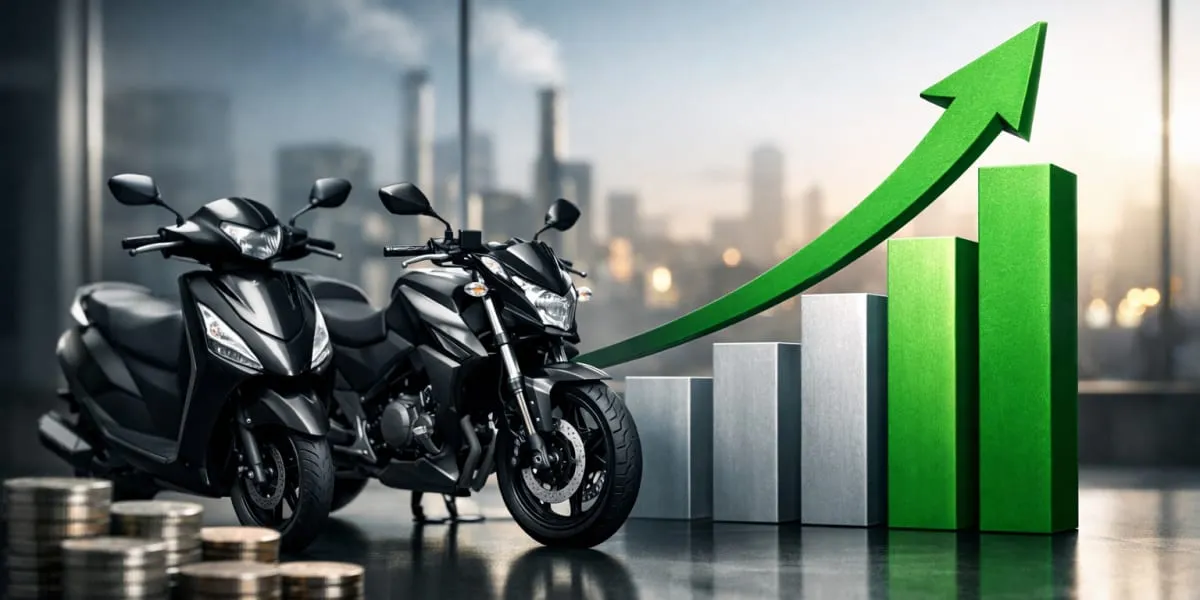
A CRISIL Ratings report forecasts that the two-wheeler industry will expand at a compound rate of seven to nine per cent and reach 29 mn units by fiscal year 2027. The assessment attributes the projected expansion to stabilising demand and gradual recovery in discretionary spending among urban and rural buyers. Manufacturers are expected to benefit from a strengthening domestic market and from easing macroeconomic headwinds compared with recent years. Sales cycles are expected to reflect improving consumer confidence and targeted product launches.

The report indicates that volume growth will be uneven across segments, with scooters and entry-level motorcycles seeing the most consistent demand. Market observers will monitor inventory cycles and dealer sentiment as indicators of near-term momentum. Supply chain disruptions have moderated and production schedules are aligning more closely with retail offtake, supporting steady output growth. Dealership networks are anticipated to play a pivotal role in converting interest into purchases.

Policy measures that improve affordability and tax structures are likely to influence purchase decisions, while financing availability and interest rates will remain important determinants of sales. Electrification is noted as a gradual shift rather than an immediate replacement, with electric two-wheelers gaining share but conventional internal combustion models retaining a significant base. Firms are adapting product portfolios to capture changing consumer preferences. Manufacturers will balance investments in electric technology with enhancements to conventional models to meet diverse needs.

Industry participants may respond by calibrating capacity and investing selectively in technology and distribution reach to sustain competitiveness. Analysts expect that sustained urbanisation and increasing mobility needs will underpin medium-term demand, though cyclical risks remain and could temper growth in specific quarters. The report concludes that, on current trends, reaching 29 mn units by FY27 is plausible under the stated growth trajectory. Margin pressures could persist for some players as competitive intensity remains high.

A CRISIL Ratings report forecasts that the two-wheeler industry will expand at a compound rate of seven to nine per cent and reach 29 mn units by fiscal year 2027. The assessment attributes the projected expansion to stabilising demand and gradual recovery in discretionary spending among urban and rural buyers. Manufacturers are expected to benefit from a strengthening domestic market and from easing macroeconomic headwinds compared with recent years. Sales cycles are expected to reflect improving consumer confidence and targeted product launches. The report indicates that volume growth will be uneven across segments, with scooters and entry-level motorcycles seeing the most consistent demand. Market observers will monitor inventory cycles and dealer sentiment as indicators of near-term momentum. Supply chain disruptions have moderated and production schedules are aligning more closely with retail offtake, supporting steady output growth. Dealership networks are anticipated to play a pivotal role in converting interest into purchases. Policy measures that improve affordability and tax structures are likely to influence purchase decisions, while financing availability and interest rates will remain important determinants of sales. Electrification is noted as a gradual shift rather than an immediate replacement, with electric two-wheelers gaining share but conventional internal combustion models retaining a significant base. Firms are adapting product portfolios to capture changing consumer preferences. Manufacturers will balance investments in electric technology with enhancements to conventional models to meet diverse needs. Industry participants may respond by calibrating capacity and investing selectively in technology and distribution reach to sustain competitiveness. Analysts expect that sustained urbanisation and increasing mobility needs will underpin medium-term demand, though cyclical risks remain and could temper growth in specific quarters. The report concludes that, on current trends, reaching 29 mn units by FY27 is plausible under the stated growth trajectory. Margin pressures could persist for some players as competitive intensity remains high.

Next Story
Equipment

Kabelschlepp India Installs Robotic VMC in Bengaluru

Kabelschlepp India, part of the Tsubaki Group, has installed a state-of-the-art Vertical Machining Center (VMC) integrated with robotic automation at its Bengaluru facility. The inauguration was held in the presence of Henning Preis, President & CEO, Kabelschlepp Group, Jörg Schulz, Vice President – Production, and Srinivas P. Kamisetty, Managing Director, Kabelschlepp India.The high-precision CNC VMC is designed for advanced milling, drilling, tapping and multi-axis machining. Equipped with a vertical spindle orientation, automatic tool changer and intelligent CNC control system, it en..

Next Story
Infrastructure Transport

Highway Delivery Reset!

Project delays and inefficiencies continue to bedevil the progress of India’s National Highways network. A multi-pronged reform agenda is needed to inject greater transparency and accountability at every stage – from planning and procurement to execution, maintenance and oversight. This article offers key recommendations and reform strategies that government stakeholders – from the Ministry of Road Transport & Highways (MoRTH) and the National Highways Authority of India (NHAI) to state agencies and oversight bodies – should pursue to put highway development on a better track.Decen..

Next Story
Infrastructure Transport

MSIDC Executes ₹37,000 Crore Road Programme

With Rs 37,000 crore worth of road projects under execution across Maharashtra, Maharashtra State Infrastructure Development Corporation (MSIDC) is driving one of the state’s largest infrastructure programmes. Dr Brijesh Dixit, Managing Director, discusses the institutional reforms, execution frameworks, financing strategies and technology adoption enabling timely, high-quality delivery, in conversation with PRATAP PADODE, Editor-in-Chief, CW.With over Rs 37,000 crore worth of road projects underway across districts – many under tight timelines – what institutional and executio..

Advertisement

Subscribe to Our Newsletter

Get daily newsletters around different themes from Construction world.

STAY CONNECTED

Advertisement

Advertisement

Advertisement

Open In App