


Delhi Government Forms Panel To Draft Drone Policy
ECONOMY & POLICY

Delhi Government Forms Panel To Draft Drone Policy

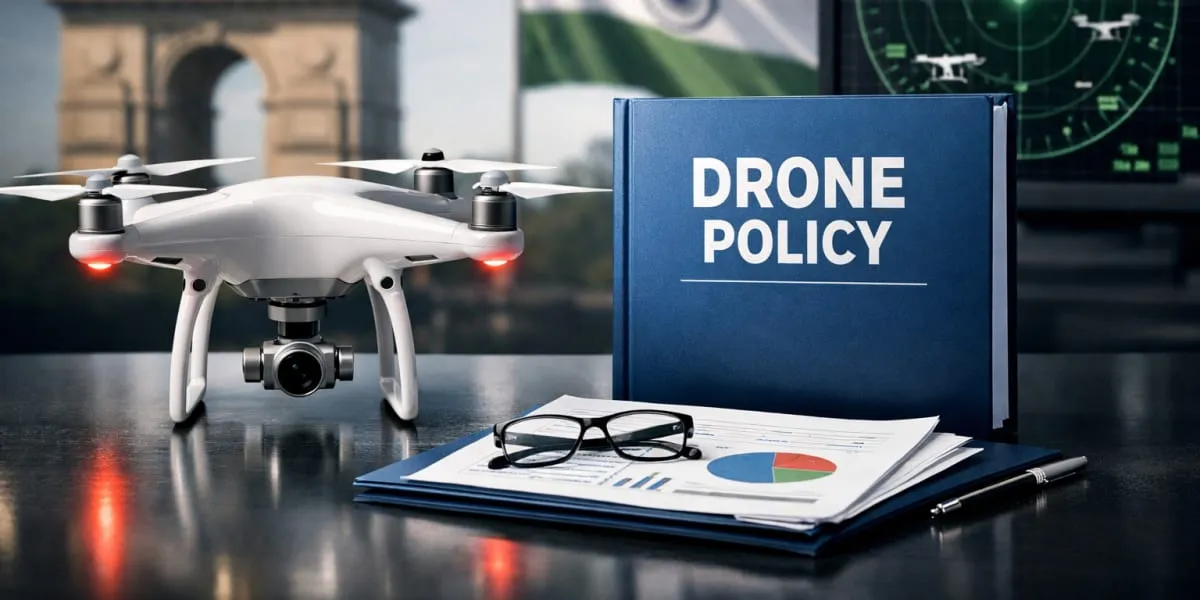
Government of the National Capital Territory of Delhi (GNCTD) has formed a panel to draft a comprehensive drone policy for the capital, with a mandate to consider operational rules and safety frameworks for unmanned aerial vehicles (UAVs). The announcement stated that the panel will review existing regulations and propose city specific measures while coordinating with central agencies. The initiative is intended to address safety, privacy and airspace management concerns as drone use expands across public and commercial domains.

Members of the committee are to include officials from relevant departments, law enforcement and technical experts, and the panel is expected to consult industry stakeholders and civil society to ensure balanced outcomes. It will examine licensing norms, restrictions on sensitive zones, and mechanisms for incident reporting and enforcement. The process aims to harmonise local needs with national regulations and to create clear guidelines for operators of small and large unmanned systems.

Officials have been asked to prepare an initial draft within a defined timeframe and to outline compliance requirements, technical standards and penalties for breaches that could endanger public safety. The panel is also expected to propose measures for integration of drone operations with existing air traffic systems and to recommend technology solutions for monitoring and geofencing in urban settings. Attention will be paid to privacy safeguards and public awareness campaigns to promote responsible use.

The GNCTD will seek coordination with central authorities and aviation regulators to ensure that city level measures are compatible with national policy and safety standards. The panel is set to submit recommendations that could shape commercial and civic drone applications, including emergency response, surveillance and delivery services, while attempting to mitigate risks. Stakeholder engagement and iterative review are expected to underpin the policy drafting process ahead of formal adoption. A public consultation phase will follow the draft.

Government of the National Capital Territory of Delhi (GNCTD) has formed a panel to draft a comprehensive drone policy for the capital, with a mandate to consider operational rules and safety frameworks for unmanned aerial vehicles (UAVs). The announcement stated that the panel will review existing regulations and propose city specific measures while coordinating with central agencies. The initiative is intended to address safety, privacy and airspace management concerns as drone use expands across public and commercial domains. Members of the committee are to include officials from relevant departments, law enforcement and technical experts, and the panel is expected to consult industry stakeholders and civil society to ensure balanced outcomes. It will examine licensing norms, restrictions on sensitive zones, and mechanisms for incident reporting and enforcement. The process aims to harmonise local needs with national regulations and to create clear guidelines for operators of small and large unmanned systems. Officials have been asked to prepare an initial draft within a defined timeframe and to outline compliance requirements, technical standards and penalties for breaches that could endanger public safety. The panel is also expected to propose measures for integration of drone operations with existing air traffic systems and to recommend technology solutions for monitoring and geofencing in urban settings. Attention will be paid to privacy safeguards and public awareness campaigns to promote responsible use. The GNCTD will seek coordination with central authorities and aviation regulators to ensure that city level measures are compatible with national policy and safety standards. The panel is set to submit recommendations that could shape commercial and civic drone applications, including emergency response, surveillance and delivery services, while attempting to mitigate risks. Stakeholder engagement and iterative review are expected to underpin the policy drafting process ahead of formal adoption. A public consultation phase will follow the draft.

Next Story
Infrastructure Urban

MIDC and Ramky Unit Sign Concession for Life Sciences Park

Maharashtra Industrial Development Corporation has signed a concession agreement with Maha Integrated Life Sciences City Limited (MILeS City), a wholly owned subsidiary of Ramky Infrastructure Limited (RIL), to develop a high-tech pharmaceutical park at Dighi Port Industrial Area in Raigad. The project will follow a public-private partnership under a DBFOT model and has an estimated cost of Rs 30 billion (Rs 30 bn). The concession will run for 95 years, including a five-year construction phase, with MILeS City responsible for development and management. The development will occupy approximatel..

Next Story
Real Estate

BuzzWorks Leases Hyderabad Office to MyComplianceOffice

Brigade Group’s managed workspace provider BuzzWorks has leased 550 seats at Mindspace Business Park in Hyderabad to Dublin based MyComplianceOffice, in what is the company’s largest office in India. With this signing, BuzzWorks' total leased office space in Hyderabad stands at zero point one one million (mn) square feet. The new premises will house core functions including product engineering, product management, customer success and global operations. Artificial intelligence enabled compliance technology initiatives will also be part of the local delivery model. BuzzWorks will provide wo..

Next Story
Infrastructure Transport

Jindal Stainless Flags Operational Strain From Middle East Crisis

Jindal Stainless warned that the Middle East war crisis has affected its operations because of dependence on industrial gases such as propane and LPG and on natural gas. The scrap-based production route used by the stainless steel maker does not generate blast furnace or coke oven gases internally, unlike the conventional steel industry. Several plant processes have been adversely impacted and production is being run at rationalised capacity. Disruptions in global shipping routes have resulted in vessel diversions, longer transit times and cargo delays, adding pressure to supply chains and to ..

Advertisement

Subscribe to Our Newsletter

Get daily newsletters around different themes from Construction world.

STAY CONNECTED

Advertisement

Advertisement

Advertisement