Parliament Passes Bill Curbing States' Control Over Minerals
COAL & MINING

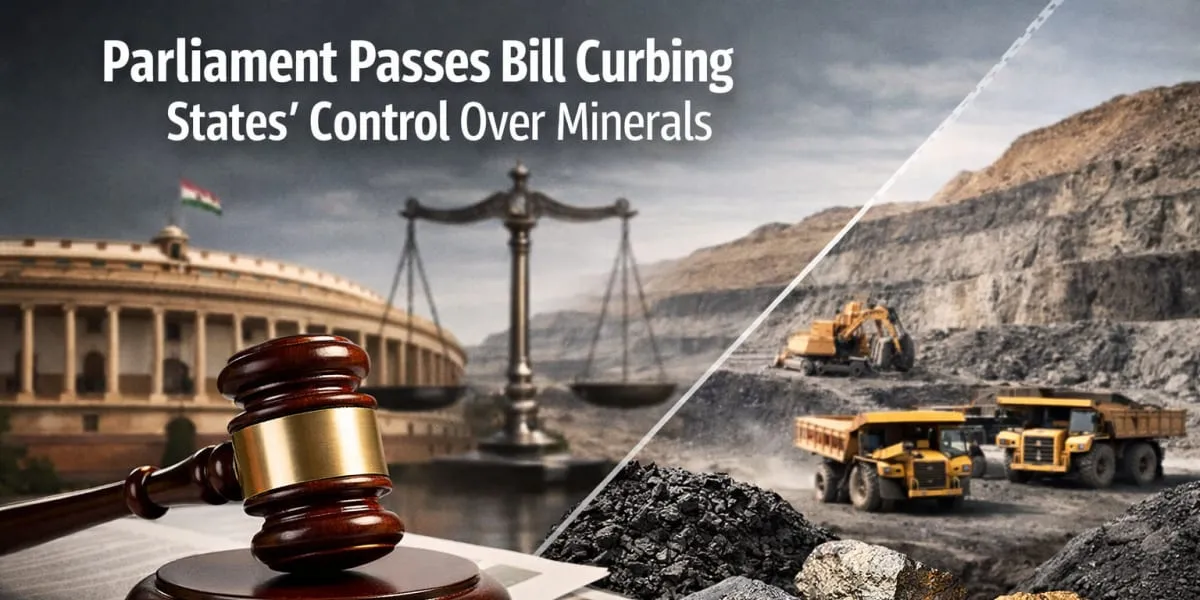
Parliament Passes Bill Curbing States' Control Over Minerals

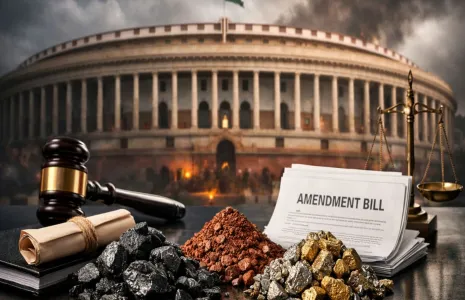
Parliament on 13 August 2026 passed the Mines and Minerals (Development and Regulation) Amendment Bill, 2026, which seeks to restrict the powers of States to levy taxes on mineral rights and mineral-rich lands. The legislation was carried amid criticism from the Opposition that it runs contrary to the fiscal federalism guaranteed by the Constitution. The move prompted sustained debate over the allocation of fiscal authority between the Union and States and over the governance of extractive industries across various jurisdictions.

The Lok Sabha had approved the Bill on 12 August and the Rajya Sabha cleared it on 13 August after brief deliberations. The government declined requests in both Houses to refer the measure to a Parliamentary Standing Committee for detailed scrutiny, a decision that drew sharp protest from Opposition benches. Congress member Praveen Chakravarty moved a notice to disallow the Bill in the Rajya Sabha, and that notice was rejected by Chairman C. P. Radhakrishnan during proceedings presided over by the Vice-President.

Mines Minister G. Kishan Reddy rejected the contention that the Bill interferes with fiscal federalism and framed the amendments as designed to ensure uniform mineral rates across the country. He characterised the changes as part of an effort to standardise the levy framework that governs mineral concessions and related charges, asserting that a coherent national approach would reduce legal fragmentation. The minister defended the government's decision to advance the Bill without committee referral on the basis of policy urgency.

The parliamentary exchanges underscored the political sensitivity of central regulation of natural resources and the broader contest over State revenue streams. Opposition members warned of diminished fiscal space for States and stressed the need to protect local oversight of mining activity. Supporters argued that national uniformity would simplify compliance and administration, while legislative leaders concluded debate and moved the Bill forward.

Parliament on 13 August 2026 passed the Mines and Minerals (Development and Regulation) Amendment Bill, 2026, which seeks to restrict the powers of States to levy taxes on mineral rights and mineral-rich lands. The legislation was carried amid criticism from the Opposition that it runs contrary to the fiscal federalism guaranteed by the Constitution. The move prompted sustained debate over the allocation of fiscal authority between the Union and States and over the governance of extractive industries across various jurisdictions. The Lok Sabha had approved the Bill on 12 August and the Rajya Sabha cleared it on 13 August after brief deliberations. The government declined requests in both Houses to refer the measure to a Parliamentary Standing Committee for detailed scrutiny, a decision that drew sharp protest from Opposition benches. Congress member Praveen Chakravarty moved a notice to disallow the Bill in the Rajya Sabha, and that notice was rejected by Chairman C. P. Radhakrishnan during proceedings presided over by the Vice-President. Mines Minister G. Kishan Reddy rejected the contention that the Bill interferes with fiscal federalism and framed the amendments as designed to ensure uniform mineral rates across the country. He characterised the changes as part of an effort to standardise the levy framework that governs mineral concessions and related charges, asserting that a coherent national approach would reduce legal fragmentation. The minister defended the government's decision to advance the Bill without committee referral on the basis of policy urgency. The parliamentary exchanges underscored the political sensitivity of central regulation of natural resources and the broader contest over State revenue streams. Opposition members warned of diminished fiscal space for States and stressed the need to protect local oversight of mining activity. Supporters argued that national uniformity would simplify compliance and administration, while legislative leaders concluded debate and moved the Bill forward.

Related Stories

Gold Stories

Next Story
Infrastructure Transport

Garuda Aerospace, Goa Partner to Train Women Drone Pilots

Garuda Aerospace has partnered with the Goa Information Technology Development Corporation (GITDC) and the Department of Information Technology, Electronics & Communications (DITE&C) to support the government’s broader ‘Drone Didi’ initiative in Goa.The programme aims to train 100 women every financial year and create 300 certified women drone pilots over three years, subject to statewide approval by DITE&C. The initiative seeks to strengthen rural livelihoods, encourage women-led entrepreneurship and develop a digitally skilled workforce.The first cohort of 12 women, recogni..

Next Story
Infrastructure Urban

Bondada Group Hosts ‘Bharat Unbound’ for Young Entrepreneurs

Bondada Group recently hosted ‘Bharat Unbound – Celebrating the Freedom to Dream, Create & Lead’ in Hyderabad, bringing together students and young entrepreneurs to discuss entrepreneurship, leadership, resilience and emerging opportunities in India.Held at Bondada House as part of the Group’s Independence Day celebrations, the event featured a fireside conversation with Dr Bondada Raghavendra Rao, Chairman and Managing Director, Bondada Group. He shared insights from his entrepreneurial journey and discussed how young people can use their freedom to pursue ideas, create opportunit..

Next Story
Infrastructure Urban

REC Backs Six Mobile Medical Units in Chhattisgarh

REC Limited, under its Corporate Social Responsibility (CSR) initiative, has supported six Mobile Medical Units (MMUs) worth Rs 7.21 crore in Chhattisgarh to strengthen healthcare access in underserved areas.Chhattisgarh Governor Shri Ramen Deka recently flagged off the six MMUs at Lok Bhawan, Chhattisgarh. The ceremony was attended by Shri Satyaban Sahoo, Chief Project Manager, Regional Office Raipur, REC Limited, along with officials from REC Limited and the Indian Red Cross Society (IRCS), Chhattisgarh.The mobile medical units are aimed at bridging healthcare gaps and improving last-mile de..

Advertisement

Subscribe to Our Newsletter

Get daily newsletters around different themes from Construction world.

STAY CONNECTED

Advertisement