Bill to Bar State Taxes on Minerals Tabled in Parliament
COAL & MINING

Bill to Bar State Taxes on Minerals Tabled in Parliament

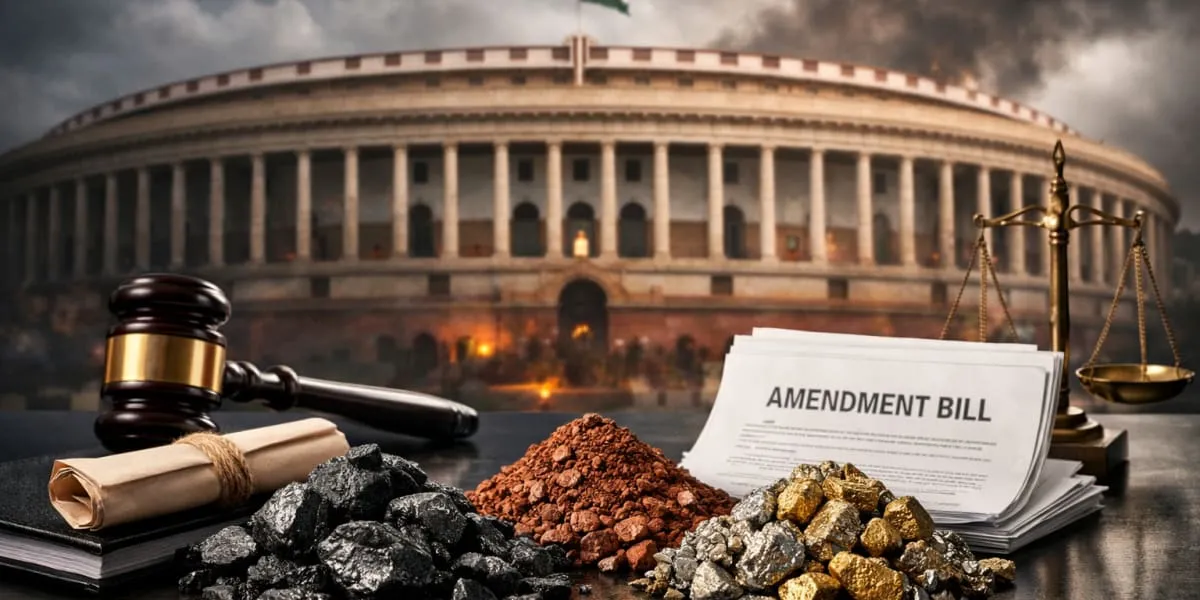
The Union government introduced the Mines and Minerals (Development and Regulation) Amendment Bill, 2026 in the Lok Sabha to bar state governments from imposing taxes, cesses or levies on mineral rights and mineral-bearing lands. The measure was described as necessary to prevent excessive and unpredictable taxation that the government said would make the sector commercially unviable. The bill was tabled during the Monsoon session amid protests.

The amendment seeks to give the Centre greater regulatory command over mines and to extend that reach to mineral-bearing lands for the sustainable and uniform development of minerals. Opposition leaders argued the proposal would undermine state fiscal powers and federalism and urged a detailed scrutiny. A Congress MP asked that the bill be referred to the Parliamentary Standing Committee on Coal, Mines and Steel for closer examination.

The draft follows a July 2024 Supreme Court ruling that upheld the power of states to levy taxes on mineral rights and mineral-bearing lands separate from royalty under the Mines and Minerals (Development and Regulation) Act, 1957 (MMDR Act). The court held that royalty under the Act was not a tax and that the Act did not limit state legislative power to impose levies. The court later permitted states to recover past dues over 12 years beginning April one, 2026 while barring penalties and additional interest.

Industry observers estimated a financial impact in a range of Rs one and a half to two trillion (tn), with public sector undertakings facing a burden of roughly Rs 700 billion (bn). The retrospective recoveries from April one, 2005 have been contested by the Centre and private mining entities and remain subject to litigation. The bill proposes a new section to invalidate state levies that are uncollected or undeposited as of the amendment coming into force while preserving levies already collected.

The amendments also empower the Centre to frame conditions for any state levies and to regulate mineral-bearing lands in accordance with MMDR Act parameters, which the government said would curb unbalanced taxation and supply chain distortion. Critics and environmental experts warned that shifting regulation from mines to mineral-bearing land could constrain state capacity to levy charges for environmental remediation and public health. Lawmakers continue to press for committee review to safeguard state fiscal space and ecological protections.

The Union government introduced the Mines and Minerals (Development and Regulation) Amendment Bill, 2026 in the Lok Sabha to bar state governments from imposing taxes, cesses or levies on mineral rights and mineral-bearing lands. The measure was described as necessary to prevent excessive and unpredictable taxation that the government said would make the sector commercially unviable. The bill was tabled during the Monsoon session amid protests. The amendment seeks to give the Centre greater regulatory command over mines and to extend that reach to mineral-bearing lands for the sustainable and uniform development of minerals. Opposition leaders argued the proposal would undermine state fiscal powers and federalism and urged a detailed scrutiny. A Congress MP asked that the bill be referred to the Parliamentary Standing Committee on Coal, Mines and Steel for closer examination. The draft follows a July 2024 Supreme Court ruling that upheld the power of states to levy taxes on mineral rights and mineral-bearing lands separate from royalty under the Mines and Minerals (Development and Regulation) Act, 1957 (MMDR Act). The court held that royalty under the Act was not a tax and that the Act did not limit state legislative power to impose levies. The court later permitted states to recover past dues over 12 years beginning April one, 2026 while barring penalties and additional interest. Industry observers estimated a financial impact in a range of Rs one and a half to two trillion (tn), with public sector undertakings facing a burden of roughly Rs 700 billion (bn). The retrospective recoveries from April one, 2005 have been contested by the Centre and private mining entities and remain subject to litigation. The bill proposes a new section to invalidate state levies that are uncollected or undeposited as of the amendment coming into force while preserving levies already collected. The amendments also empower the Centre to frame conditions for any state levies and to regulate mineral-bearing lands in accordance with MMDR Act parameters, which the government said would curb unbalanced taxation and supply chain distortion. Critics and environmental experts warned that shifting regulation from mines to mineral-bearing land could constrain state capacity to levy charges for environmental remediation and public health. Lawmakers continue to press for committee review to safeguard state fiscal space and ecological protections.

Related Stories

Gold Stories

Next Story
Infrastructure Transport

Garuda Aerospace, Goa Partner to Train Women Drone Pilots

Garuda Aerospace has partnered with the Goa Information Technology Development Corporation (GITDC) and the Department of Information Technology, Electronics & Communications (DITE&C) to support the government’s broader ‘Drone Didi’ initiative in Goa.The programme aims to train 100 women every financial year and create 300 certified women drone pilots over three years, subject to statewide approval by DITE&C. The initiative seeks to strengthen rural livelihoods, encourage women-led entrepreneurship and develop a digitally skilled workforce.The first cohort of 12 women, recogni..

Next Story
Infrastructure Urban

Bondada Group Hosts ‘Bharat Unbound’ for Young Entrepreneurs

Bondada Group recently hosted ‘Bharat Unbound – Celebrating the Freedom to Dream, Create & Lead’ in Hyderabad, bringing together students and young entrepreneurs to discuss entrepreneurship, leadership, resilience and emerging opportunities in India.Held at Bondada House as part of the Group’s Independence Day celebrations, the event featured a fireside conversation with Dr Bondada Raghavendra Rao, Chairman and Managing Director, Bondada Group. He shared insights from his entrepreneurial journey and discussed how young people can use their freedom to pursue ideas, create opportunit..

Next Story
Infrastructure Urban

REC Backs Six Mobile Medical Units in Chhattisgarh

REC Limited, under its Corporate Social Responsibility (CSR) initiative, has supported six Mobile Medical Units (MMUs) worth Rs 7.21 crore in Chhattisgarh to strengthen healthcare access in underserved areas.Chhattisgarh Governor Shri Ramen Deka recently flagged off the six MMUs at Lok Bhawan, Chhattisgarh. The ceremony was attended by Shri Satyaban Sahoo, Chief Project Manager, Regional Office Raipur, REC Limited, along with officials from REC Limited and the Indian Red Cross Society (IRCS), Chhattisgarh.The mobile medical units are aimed at bridging healthcare gaps and improving last-mile de..

Advertisement

Subscribe to Our Newsletter

Get daily newsletters around different themes from Construction world.

STAY CONNECTED

Advertisement