+
Supreme Court Seeks Reply On Shifting Coal Units From Capital
COAL & MINING

Supreme Court Seeks Reply On Shifting Coal Units From Capital

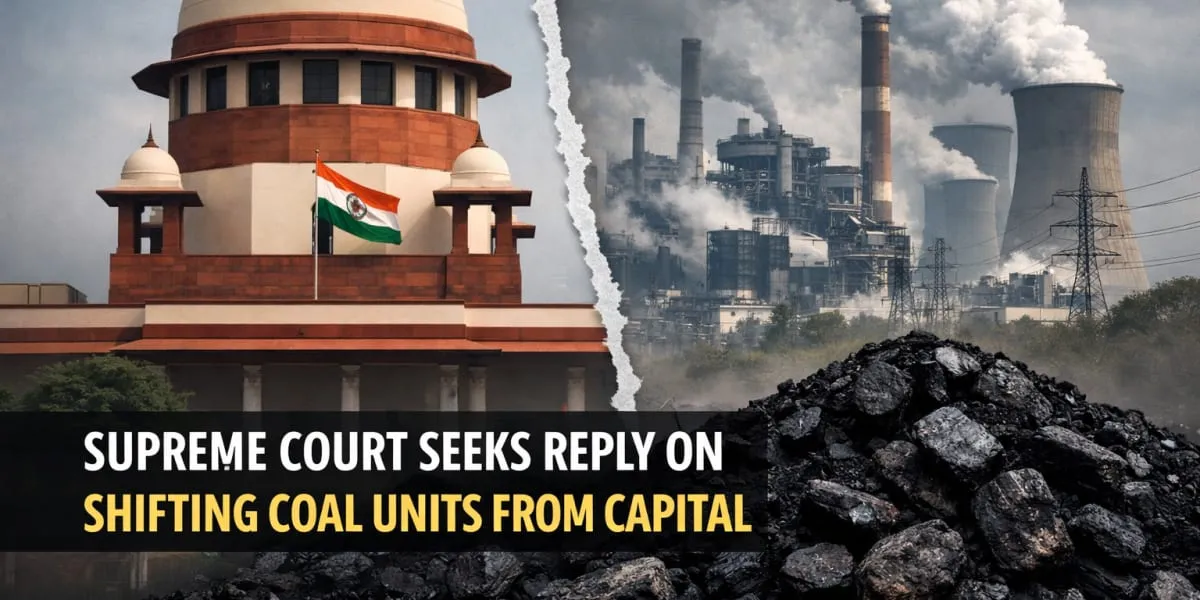
The Supreme Court (SC) has sought a response from the Union Government on a plea seeking the shifting of coal-fired units out of the national capital. The petition has raised concerns about air quality and public health linked to the operation of these installations within the city. The court asked the central authority to address the legal and administrative basis for allowing such units to continue in an urban setting.

The bench has requested a detailed explanation of the feasibility of relocation, including the operational, logistical and environmental implications of moving generation capacity. It has noted the need to reconcile environmental standards with energy security and to identify alternatives for affected power supply. The court also signalled that any plan must consider compliance with statutory pollution norms and safeguards for communities affected by both continued operation and relocation.

Officials and stakeholders are expected to outline timelines, estimated costs and measures to limit disruption to consumers and industries dependent on the units. The Union Government has been asked to indicate whether arrangements for alternate sites or compensatory measures are in place and how regulatory oversight will be enforced during any transition. The plea has prompted the judiciary to scrutinise the manner in which administrative decisions have balanced economic and health considerations.

The matter will be listed for further hearing after the government files its reply, and the court will thereafter determine appropriate directions. Observers expect the proceedings to examine the roles of urban planning authorities and pollution control agencies in preventing recurrence of similar situations. The final outcome will aim to protect public health while ensuring continuity of essential public services.

The Supreme Court (SC) has sought a response from the Union Government on a plea seeking the shifting of coal-fired units out of the national capital. The petition has raised concerns about air quality and public health linked to the operation of these installations within the city. The court asked the central authority to address the legal and administrative basis for allowing such units to continue in an urban setting. The bench has requested a detailed explanation of the feasibility of relocation, including the operational, logistical and environmental implications of moving generation capacity. It has noted the need to reconcile environmental standards with energy security and to identify alternatives for affected power supply. The court also signalled that any plan must consider compliance with statutory pollution norms and safeguards for communities affected by both continued operation and relocation. Officials and stakeholders are expected to outline timelines, estimated costs and measures to limit disruption to consumers and industries dependent on the units. The Union Government has been asked to indicate whether arrangements for alternate sites or compensatory measures are in place and how regulatory oversight will be enforced during any transition. The plea has prompted the judiciary to scrutinise the manner in which administrative decisions have balanced economic and health considerations. The matter will be listed for further hearing after the government files its reply, and the court will thereafter determine appropriate directions. Observers expect the proceedings to examine the roles of urban planning authorities and pollution control agencies in preventing recurrence of similar situations. The final outcome will aim to protect public health while ensuring continuity of essential public services.

Next Story
Infrastructure Urban

Implementation Status of Jal Jeevan Mission

Since August 2019 the Government has implemented Jal Jeevan Mission to provide assured potable water through household tap connections in rural India. At the start of the mission only 32.3 million (mn) rural households, representing 16.7 per cent, were reported to have tap water connections. States and union territories have reported that 125.8 mn additional rural households have since been provided with tap connections. As a result, of about 193.6 mn rural households roughly 158.2 mn, or 81.71 per cent, are reported to have tap water supply at home.\n\nThe State, district and village level st..

Next Story
Infrastructure Urban

Jal Jeevan Mission Reaches Eighty One Per Cent Rural Coverage

The Government reported substantial progress under the Jal Jeevan Mission, launched in August 2019 to provide tap water to every rural household. At launch only 32.3 million (mn) rural households had tap connections and states and Union territories reported provision of 125.8 mn additional households by March 2026. Consequently, out of about 193.6 mn rural households around 158.2 mn, or 81.71 per cent, are reported to have tap water at home. The Finance Minister announced extension of the mission until 2028 in the 2025-26 budget speech. The Swachh Bharat Mission Grameen, launched in October 20..

Next Story
Infrastructure Urban

Empowering Local Governance for Sustainable Rural Water Supply

The Ministry of Jal Shakti has aligned the Jal Jeevan Mission (JJM) with the 73rd Amendment to strengthen village level planning and community ownership of water supply. Gram Panchayats, village water and sanitation committees and Pani Samitis are to plan, implement, manage and maintain piped water systems, with gram sabha processes formalising handover and oversight. Implementation support agencies including non government organisations, community based organisations and self help groups have been empanelled to train local committees and promote women participation. Under JJM, the department ..

Advertisement

Subscribe to Our Newsletter

Get daily newsletters around different themes from Construction world.

STAY CONNECTED

Advertisement

Advertisement

Advertisement