


India Advances Towards Self Reliant Steel Sector
Steel

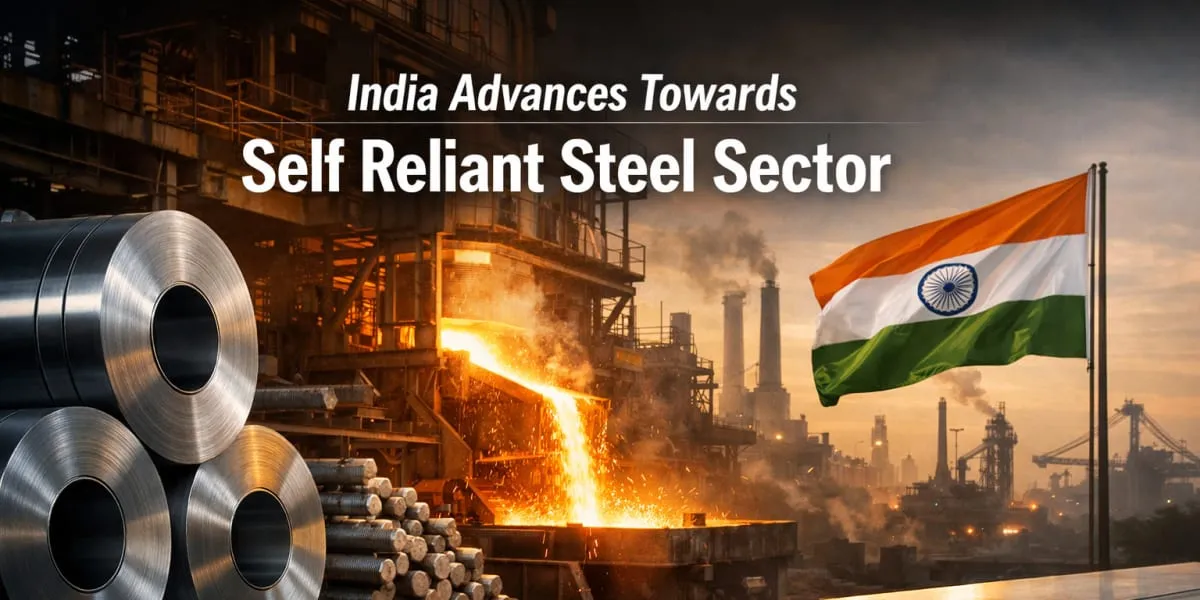
India Advances Towards Self Reliant Steel Sector

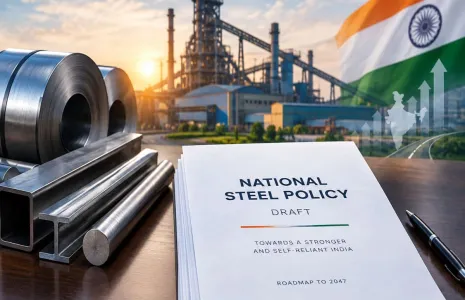
India has been the world's second largest steel producer since 2018, and its share of global crude steel production rose from five point two per cent in 2014 to seven point nine per cent in 2024. Finished steel consumption climbed from 77 million tonnes (mn t) in 2014–15 to 163.7 million tonnes in 2025–26, reflecting infrastructure expansion and urbanisation. These shifts underscore steel's expanding contribution to industrial growth and self-reliance.

Crude steel production reached 168.4 million tons in 2025–26, rising from 127.2 million tons in 2022–23 and 152.2 million tons in 2024–25, with a compounded annual growth rate of approximately nine per cent between 2021–22 and 2025–26. Output in March 2026 increased by two point two per cent year on year, while the cumulative index for fiscal 2025–26 expanded by nine point one per cent. Core segments such as hot metal, pig iron and sponge iron also recorded gains.

Trade flows signalled stronger domestic capacity, with exports up 29.1 per cent in March 2026 and imports down nine point five per cent. The Production Linked Incentive scheme has supported investment and value addition: Rs 230.22 billion (bn) of investment was realised, supporting two point four mn t of speciality steel output and 13,264 direct jobs. Incentives of Rs 2.36 bn have been disbursed, 24 mn t of speciality capacity created and import substitution of Rs 60 bn achieved. The PLI 1.2 round carries committed investments of Rs 118.87 bn and capacity additions of eight point two nine million tons.

Policy measures have reduced import dependence, including zero basic customs duty on key inputs, a 12 per cent safeguard duty on select flat products and reforms to boost scrap recycling and domestic coking coal. Mission Coking Coal targets 140 mn t by fiscal 2029–30, and procurement preferences and quality control orders aim to deepen domestic value chains. With plans to expand capacity towards 500 million tonnes by 2047 and pursue decarbonisation to meet net zero by 2070, the government positions steel at the centre of long-term resilience.

India has been the world's second largest steel producer since 2018, and its share of global crude steel production rose from five point two per cent in 2014 to seven point nine per cent in 2024. Finished steel consumption climbed from 77 million tonnes (mn t) in 2014–15 to 163.7 million tonnes in 2025–26, reflecting infrastructure expansion and urbanisation. These shifts underscore steel's expanding contribution to industrial growth and self-reliance. Crude steel production reached 168.4 million tons in 2025–26, rising from 127.2 million tons in 2022–23 and 152.2 million tons in 2024–25, with a compounded annual growth rate of approximately nine per cent between 2021–22 and 2025–26. Output in March 2026 increased by two point two per cent year on year, while the cumulative index for fiscal 2025–26 expanded by nine point one per cent. Core segments such as hot metal, pig iron and sponge iron also recorded gains. Trade flows signalled stronger domestic capacity, with exports up 29.1 per cent in March 2026 and imports down nine point five per cent. The Production Linked Incentive scheme has supported investment and value addition: Rs 230.22 billion (bn) of investment was realised, supporting two point four mn t of speciality steel output and 13,264 direct jobs. Incentives of Rs 2.36 bn have been disbursed, 24 mn t of speciality capacity created and import substitution of Rs 60 bn achieved. The PLI 1.2 round carries committed investments of Rs 118.87 bn and capacity additions of eight point two nine million tons. Policy measures have reduced import dependence, including zero basic customs duty on key inputs, a 12 per cent safeguard duty on select flat products and reforms to boost scrap recycling and domestic coking coal. Mission Coking Coal targets 140 mn t by fiscal 2029–30, and procurement preferences and quality control orders aim to deepen domestic value chains. With plans to expand capacity towards 500 million tonnes by 2047 and pursue decarbonisation to meet net zero by 2070, the government positions steel at the centre of long-term resilience.

Next Story
Infrastructure Urban

Cabinet Approves Mission For Cotton Productivity

The Union Cabinet has approved Rs 56.59 billion (bn) for the Mission for Cotton Productivity covering the period 2026–27 to 2030–31, with the objective of addressing bottlenecks, reversing declining growth and improving quality in India’s cotton sector. The initiative aligns with the Government of India’s five F vision from farm to foreign and is intended to raise the competitiveness of the textile sector in global markets through coordinated action across ministries and research bodies. The mission will support the development of high-yielding variety (HYV) seeds that are climate resi..

Next Story
Infrastructure Transport

Cabinet Approves Three Rail Multitracking Projects

The Cabinet Committee on Economic Affairs, chaired by the Prime Minister, approved three multitracking projects for the Ministry of Railways at a total cost of Rs 234.37 billion (bn). The projects are Nagda–Mathura third and fourth line, Guntakal–Wadi third and fourth line, and Burhwal–Sitapur third and fourth line. The investment is intended to increase line capacity and improve operational efficiency and service reliability for Indian Railways. The schemes cover 19 districts across Madhya Pradesh, Rajasthan, Uttar Pradesh, Karnataka, Andhra Pradesh and Telangana and will increase the e..

Next Story
Infrastructure Transport

Cabinet Approves Ship Repair Facility At Vadinar

The Cabinet Committee on Economic Affairs has approved the development of a state of the art ship repair facility at Vadinar in Gujarat, to be jointly implemented by Deendayal Port Authority (DPA) and Cochin Shipyard Limited (CSL). The project carries a combined investment of Rs 15.7 billion (Rs 15.7 bn). It is planned as a brownfield facility with a 650 metres jetty, two large floating dry docks, workshops and associated marine infrastructure. Vadinar has a natural deep draft and direct connectivity to major shipping routes and its proximity to ports such as Mundra and Kandla makes it favoura..

Advertisement

Subscribe to Our Newsletter

Get daily newsletters around different themes from Construction world.

STAY CONNECTED

Advertisement

Advertisement

Advertisement