+
TNPGCL Receives 74,000 Tonnes Of Coal For Udangudi Plant
COAL & MINING

TNPGCL Receives 74,000 Tonnes Of Coal For Udangudi Plant

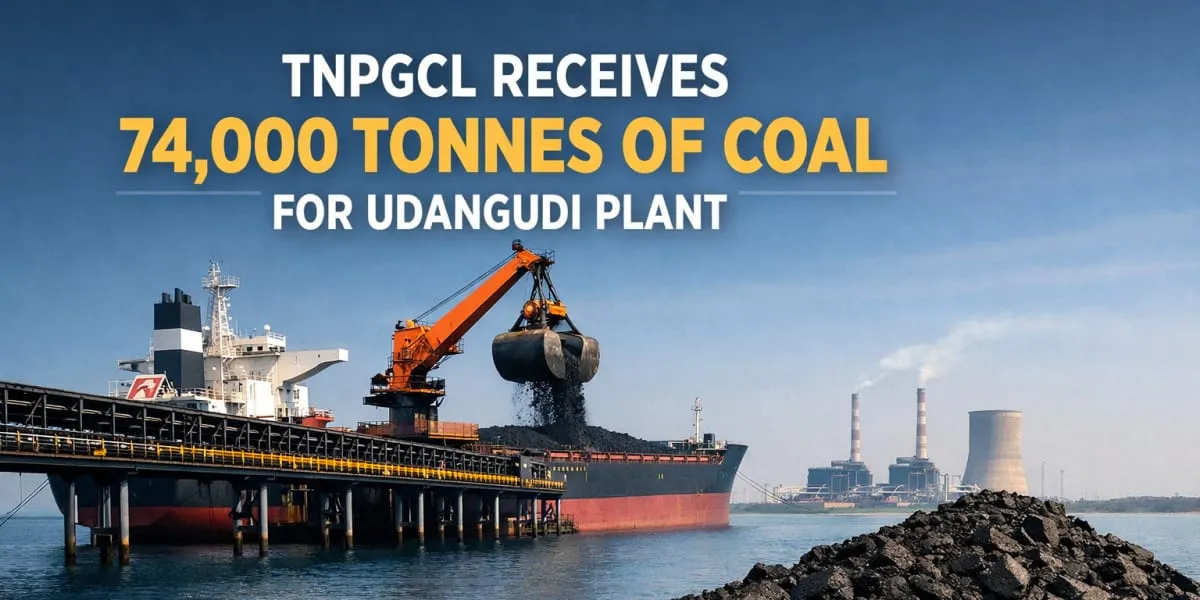
The Tamil Nadu Power Generation Corporation has received the first shipment of coal for the Udangudi supercritical thermal power plant as it prepares for imminent commissioning. A vessel carrying 74,000 tonnes (74,000 t) from Vizag reached the Kallamozhi offshore captive coal jetty on 21 February and was berthed the following day after guidance from the Tamil Nadu Maritime Board and completion of statutory clearances. The shipment marks the start of fuel delivery for final commissioning activities.

The Kallamozhi jetty is Asia's first offshore facility located seven point nine km off the coast and TNPGCL has constructed a 555-metre-long and 24-metre-wide main berth capable of handling two coal-laden vessels. Cargo was unloaded into a hopper that fed a closed conveyor system which delivered coal to the crushing unit within the plant for a test trial. The arrangement is intended to reduce handling time and minimise transfer losses during sustained operations.

A senior TNPGCL official said that over 1200 t per hour was being discharged from the jetty to the plant, which are located eight km apart, and that coal then had to be transported six km from the shore to reach the coal yard. The official added that the actual capacity of the conveyor system was 2,000 t per hour and that the operations team expected to scale throughput as required. Unit one will be inaugurated once power production is stabilised, and electricity production stabilised at 330 megawatt (MW) during the trial run, which was 50 per cent of the unit's total capacity.

The unit was tripped multiple times and restarted to test the functions of boilers, turbines and auxiliary production systems, and engineers carried out repeated cycles to validate performance under varying loads. The team indicated that the load supplied from the coal jetty would be increased in coming days to raise electricity generation progressively. Officials described the facility as a milestone in the power sector for TANGEDCO and TNPGCL, and said the captive jetty and conveyor link would strengthen fuel security and logistics ahead of formal commissioning.

The Tamil Nadu Power Generation Corporation has received the first shipment of coal for the Udangudi supercritical thermal power plant as it prepares for imminent commissioning. A vessel carrying 74,000 tonnes (74,000 t) from Vizag reached the Kallamozhi offshore captive coal jetty on 21 February and was berthed the following day after guidance from the Tamil Nadu Maritime Board and completion of statutory clearances. The shipment marks the start of fuel delivery for final commissioning activities. The Kallamozhi jetty is Asia's first offshore facility located seven point nine km off the coast and TNPGCL has constructed a 555-metre-long and 24-metre-wide main berth capable of handling two coal-laden vessels. Cargo was unloaded into a hopper that fed a closed conveyor system which delivered coal to the crushing unit within the plant for a test trial. The arrangement is intended to reduce handling time and minimise transfer losses during sustained operations. A senior TNPGCL official said that over 1200 t per hour was being discharged from the jetty to the plant, which are located eight km apart, and that coal then had to be transported six km from the shore to reach the coal yard. The official added that the actual capacity of the conveyor system was 2,000 t per hour and that the operations team expected to scale throughput as required. Unit one will be inaugurated once power production is stabilised, and electricity production stabilised at 330 megawatt (MW) during the trial run, which was 50 per cent of the unit's total capacity. The unit was tripped multiple times and restarted to test the functions of boilers, turbines and auxiliary production systems, and engineers carried out repeated cycles to validate performance under varying loads. The team indicated that the load supplied from the coal jetty would be increased in coming days to raise electricity generation progressively. Officials described the facility as a milestone in the power sector for TANGEDCO and TNPGCL, and said the captive jetty and conveyor link would strengthen fuel security and logistics ahead of formal commissioning.

Next Story
Infrastructure Urban

Implementation Status of Jal Jeevan Mission

Since August 2019 the Government has implemented Jal Jeevan Mission to provide assured potable water through household tap connections in rural India. At the start of the mission only 32.3 million (mn) rural households, representing 16.7 per cent, were reported to have tap water connections. States and union territories have reported that 125.8 mn additional rural households have since been provided with tap connections. As a result, of about 193.6 mn rural households roughly 158.2 mn, or 81.71 per cent, are reported to have tap water supply at home.\n\nThe State, district and village level st..

Next Story
Infrastructure Urban

Jal Jeevan Mission Reaches Eighty One Per Cent Rural Coverage

The Government reported substantial progress under the Jal Jeevan Mission, launched in August 2019 to provide tap water to every rural household. At launch only 32.3 million (mn) rural households had tap connections and states and Union territories reported provision of 125.8 mn additional households by March 2026. Consequently, out of about 193.6 mn rural households around 158.2 mn, or 81.71 per cent, are reported to have tap water at home. The Finance Minister announced extension of the mission until 2028 in the 2025-26 budget speech. The Swachh Bharat Mission Grameen, launched in October 20..

Next Story
Infrastructure Urban

Empowering Local Governance for Sustainable Rural Water Supply

The Ministry of Jal Shakti has aligned the Jal Jeevan Mission (JJM) with the 73rd Amendment to strengthen village level planning and community ownership of water supply. Gram Panchayats, village water and sanitation committees and Pani Samitis are to plan, implement, manage and maintain piped water systems, with gram sabha processes formalising handover and oversight. Implementation support agencies including non government organisations, community based organisations and self help groups have been empanelled to train local committees and promote women participation. Under JJM, the department ..

Advertisement

Subscribe to Our Newsletter

Get daily newsletters around different themes from Construction world.

STAY CONNECTED

Advertisement

Advertisement

Advertisement