


+
India Rejigs Crude Imports As Saudi Gains
OIL & GAS

India Rejigs Crude Imports As Saudi Gains

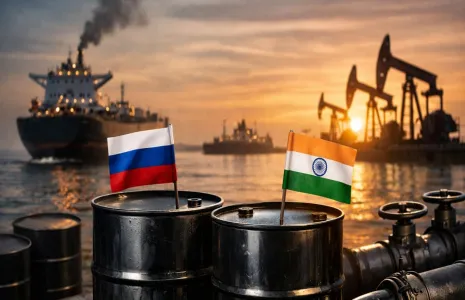
India has begun a calibrated rebalancing of its crude import strategy as Middle Eastern suppliers led by Saudi Arabia regain share while Russian volumes remain significant but constrained by geopolitics and compliance. Ship tracking data indicate that average imports during February one to eighteen were four point eight five million (mn) barrels per day (bpd), down eight per cent from January's five point two five million (mn) bpd. The decline followed US sanctions and the European Union's latest package.

Kpler's lead research analyst, Sumit Ritolia, estimated Russian shipments fell from around one point two eight million (mn) bpd in December 2025 to one point two two million (mn) in January and to about one point zero nine million (mn) in early February, a roughly 10 per cent month-on-month easing. He said Russian crude imports into India were expected to ease further toward eight hundred thousand to one million bpd in March, signalling stabilisation rather than collapse.

As Russian volumes eased, the Gulf filled the gap with Saudi shipments tracking at record levels, with arrivals in February seen at around one million to one point one million (mn) bpd and month-to-date arrivals peaking near one point four million (mn) bpd before expected moderation. On current trends Saudi Arabia was positioned as India's top supplier in February, followed by Russia and Iraq, with combined flows and sanctions risk driving near-term volatility shaped by shipping and logistics rather than pricing alone.

The Vadinar refinery in Gujarat, where Rosneft is the largest shareholder, remains central to flows of Russian grades and now depends on them for its crude needs. Analysts noted that Russian medium sour grades have been valuable for complex refiners and that reducing Russian barrels was likely to raise crude costs by two to three US dollars per barrel, with marginal Venezuelan purchases offsetting some of the impact but not replacing volumes. India is expected to maintain baseline Russian volumes while diversifying supply, keeping a pragmatic balance between operational needs and policy pressures.

India has begun a calibrated rebalancing of its crude import strategy as Middle Eastern suppliers led by Saudi Arabia regain share while Russian volumes remain significant but constrained by geopolitics and compliance. Ship tracking data indicate that average imports during February one to eighteen were four point eight five million (mn) barrels per day (bpd), down eight per cent from January's five point two five million (mn) bpd. The decline followed US sanctions and the European Union's latest package. Kpler's lead research analyst, Sumit Ritolia, estimated Russian shipments fell from around one point two eight million (mn) bpd in December 2025 to one point two two million (mn) in January and to about one point zero nine million (mn) in early February, a roughly 10 per cent month-on-month easing. He said Russian crude imports into India were expected to ease further toward eight hundred thousand to one million bpd in March, signalling stabilisation rather than collapse. As Russian volumes eased, the Gulf filled the gap with Saudi shipments tracking at record levels, with arrivals in February seen at around one million to one point one million (mn) bpd and month-to-date arrivals peaking near one point four million (mn) bpd before expected moderation. On current trends Saudi Arabia was positioned as India's top supplier in February, followed by Russia and Iraq, with combined flows and sanctions risk driving near-term volatility shaped by shipping and logistics rather than pricing alone. The Vadinar refinery in Gujarat, where Rosneft is the largest shareholder, remains central to flows of Russian grades and now depends on them for its crude needs. Analysts noted that Russian medium sour grades have been valuable for complex refiners and that reducing Russian barrels was likely to raise crude costs by two to three US dollars per barrel, with marginal Venezuelan purchases offsetting some of the impact but not replacing volumes. India is expected to maintain baseline Russian volumes while diversifying supply, keeping a pragmatic balance between operational needs and policy pressures.

Next Story
Infrastructure Urban

We’ve cut 50,000 tonnes of carbon emmissions since 2019

MatchLog is challenging a decades-old logistics norm and empty container miles by directly matching import flows with export demand. Indeed, the platform is unlocking measurable cost savings, cutting emissions and driving structural change in landside operations. Dhruv Taneja, Founder and Global CEO, outlines the quantified impact, adoption  journey and the evolving future of container reuse in an exclusive interview with Construction World. MatchLog has partnered with carriers such as Maersk, ONE and HMM in India. Could you share quantified outcomes from one specific corri..

Next Story
Infrastructure Transport

Airports: Capacity is Key

A lotus-inspired terminal design in Navi Mumbai International Airport. A terminal in a garden in Bengaluru’s Kempegowda International Airport. A peacock-inspired canopy in Chhatrapati Shivaji Maharaj International Airport. A nature-inspired terminal in Guwahati’s Lokpriya Gopinath Bordoloi International Airport.Truly, “India’s airports are no longer constrained by architectural ambition,” avers Ravikanth Mididhodi, Chief Technical Officer, J&F, a German-based engineering firm with over 25 years of global legacy in delivering advanced engineering and BIM services for air..

Next Story
Real Estate

In 2025, Amaravati attracted ₹ 28,075 crore in investments

In an exclusive interview with Construction World, Kanna Babu, IAS, Commissioner, Andhra Pradesh Capital Region Development Authority (APCRDA), reveals how Amaravati is entering a decisive new phase of capital city development. With 36 MoUs worth ₹ 45,589 crore, a ₹ 58,000 crore tender pipeline, and rising institutional investments, he explains the strategic execution, infrastructure rollout, and governance framework driving Amaravati’s emergence as a structured, investment-ready, and future-focused capital.APCRDA has recently secured major financial tie-ups, including loans from NA..

Advertisement

Subscribe to Our Newsletter

Get daily newsletters around different themes from Construction world.

STAY CONNECTED

Advertisement

Advertisement

Advertisement

Open In App