+
ACME Explains How BESS Cut Transmission CAPEX by Rs Two Million per MW
POWER & RENEWABLE ENERGY

ACME Explains How BESS Cut Transmission CAPEX by Rs Two Million per MW

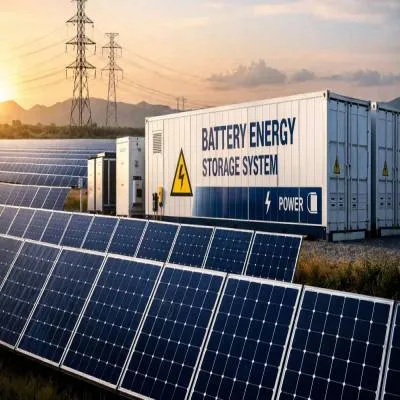
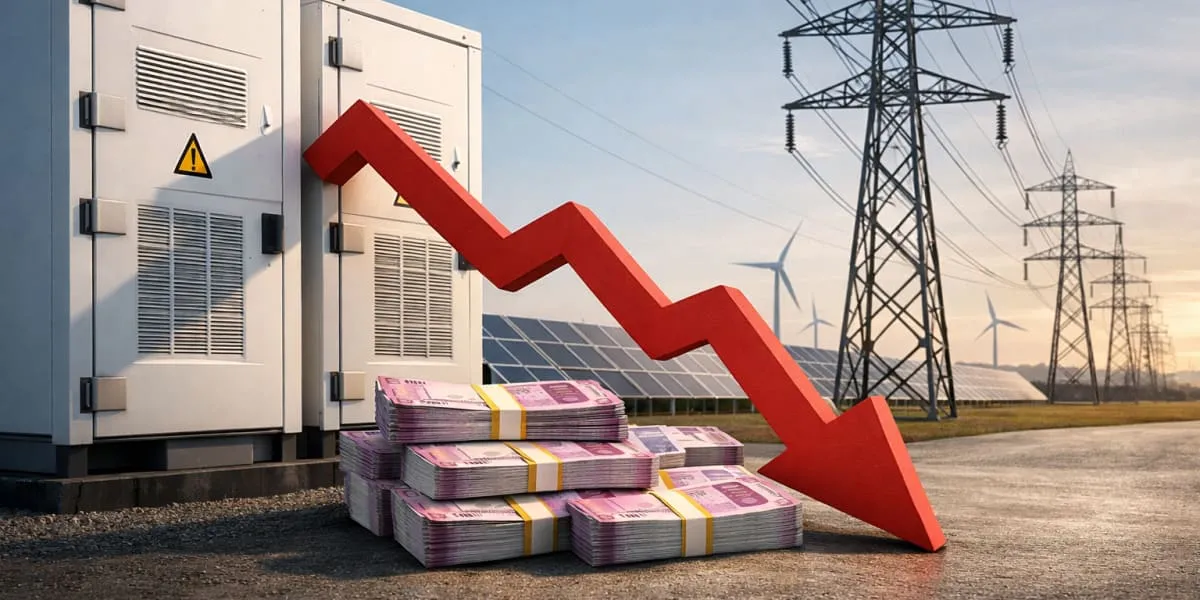
ACME Solar Holdings, the Gurugram based renewable energy developer, said integration of battery energy storage systems (BESS) has reduced transmission capital expenditure by Rs two million (mn) per megawatt (MW) and supported its shift to firm and dispatchable renewable energy. Management said deployment of BESS at existing sites optimises transmission infrastructure and avoids execution and right of way challenges. The approach is expected to enable early cash flow generation and integration with long term power purchase agreements.

The company has raised its storage deployment guidance and plans to operationalise two GWh in Q4 FY26 and another two GWh in Q1 FY27, targeting 10 GWh by the end of calendar year 2027. The portfolio presently stands at 16 GWh of BESS capacity, with about 1,150 MWh delivered to three sites and entering commissioning. To back the FY27 expansion the company said it has secured most battery supply, including an order for five GWh within the planned budget.

Battery integration also reduces inter state transmission system charges and helps mitigate risks from deviation settlement mechanism regulations by improving predictability and stability of output. A standalone solar project may face charges of about one rupee thirty paise to one rupee forty paise per unit, whereas projects with storage can cut this to around eighty paise and FDRE projects to roughly thirty to forty paise per unit. Management said these reductions materially lower delivery costs and improve project economics.

ACME management indicated battery storage could become a meaningful earnings driver and estimated that one GWh can generate roughly Rs 1.7 billion (bn) in annual EBITDA assuming an Rs five per unit arbitrage. The company is deploying BESS to provide base load renewable power comparable with traditional thermal generation and has sought patents for optimising combinations of solar, wind and battery storage to deliver round the clock supply. Procurement typically comes from Chinese suppliers under fixed price short term contracts denominated in US dollars and the company said recent changes to export rebate policies will not affect its current plans.

ACME Solar Holdings, the Gurugram based renewable energy developer, said integration of battery energy storage systems (BESS) has reduced transmission capital expenditure by Rs two million (mn) per megawatt (MW) and supported its shift to firm and dispatchable renewable energy. Management said deployment of BESS at existing sites optimises transmission infrastructure and avoids execution and right of way challenges. The approach is expected to enable early cash flow generation and integration with long term power purchase agreements. The company has raised its storage deployment guidance and plans to operationalise two GWh in Q4 FY26 and another two GWh in Q1 FY27, targeting 10 GWh by the end of calendar year 2027. The portfolio presently stands at 16 GWh of BESS capacity, with about 1,150 MWh delivered to three sites and entering commissioning. To back the FY27 expansion the company said it has secured most battery supply, including an order for five GWh within the planned budget. Battery integration also reduces inter state transmission system charges and helps mitigate risks from deviation settlement mechanism regulations by improving predictability and stability of output. A standalone solar project may face charges of about one rupee thirty paise to one rupee forty paise per unit, whereas projects with storage can cut this to around eighty paise and FDRE projects to roughly thirty to forty paise per unit. Management said these reductions materially lower delivery costs and improve project economics. ACME management indicated battery storage could become a meaningful earnings driver and estimated that one GWh can generate roughly Rs 1.7 billion (bn) in annual EBITDA assuming an Rs five per unit arbitrage. The company is deploying BESS to provide base load renewable power comparable with traditional thermal generation and has sought patents for optimising combinations of solar, wind and battery storage to deliver round the clock supply. Procurement typically comes from Chinese suppliers under fixed price short term contracts denominated in US dollars and the company said recent changes to export rebate policies will not affect its current plans.

Next Story
Infrastructure Urban

Implementation Status of Jal Jeevan Mission

Since August 2019 the Government has implemented Jal Jeevan Mission to provide assured potable water through household tap connections in rural India. At the start of the mission only 32.3 million (mn) rural households, representing 16.7 per cent, were reported to have tap water connections. States and union territories have reported that 125.8 mn additional rural households have since been provided with tap connections. As a result, of about 193.6 mn rural households roughly 158.2 mn, or 81.71 per cent, are reported to have tap water supply at home.\n\nThe State, district and village level st..

Next Story
Infrastructure Urban

Jal Jeevan Mission Reaches Eighty One Per Cent Rural Coverage

The Government reported substantial progress under the Jal Jeevan Mission, launched in August 2019 to provide tap water to every rural household. At launch only 32.3 million (mn) rural households had tap connections and states and Union territories reported provision of 125.8 mn additional households by March 2026. Consequently, out of about 193.6 mn rural households around 158.2 mn, or 81.71 per cent, are reported to have tap water at home. The Finance Minister announced extension of the mission until 2028 in the 2025-26 budget speech. The Swachh Bharat Mission Grameen, launched in October 20..

Next Story
Infrastructure Urban

Empowering Local Governance for Sustainable Rural Water Supply

The Ministry of Jal Shakti has aligned the Jal Jeevan Mission (JJM) with the 73rd Amendment to strengthen village level planning and community ownership of water supply. Gram Panchayats, village water and sanitation committees and Pani Samitis are to plan, implement, manage and maintain piped water systems, with gram sabha processes formalising handover and oversight. Implementation support agencies including non government organisations, community based organisations and self help groups have been empanelled to train local committees and promote women participation. Under JJM, the department ..

Advertisement

Subscribe to Our Newsletter

Get daily newsletters around different themes from Construction world.

STAY CONNECTED

Advertisement

Advertisement

Advertisement