Clean Energy Supplies Over 50 Per Cent of India Peak Demand
POWER & RENEWABLE ENERGY

Clean Energy Supplies Over 50 Per Cent of India Peak Demand

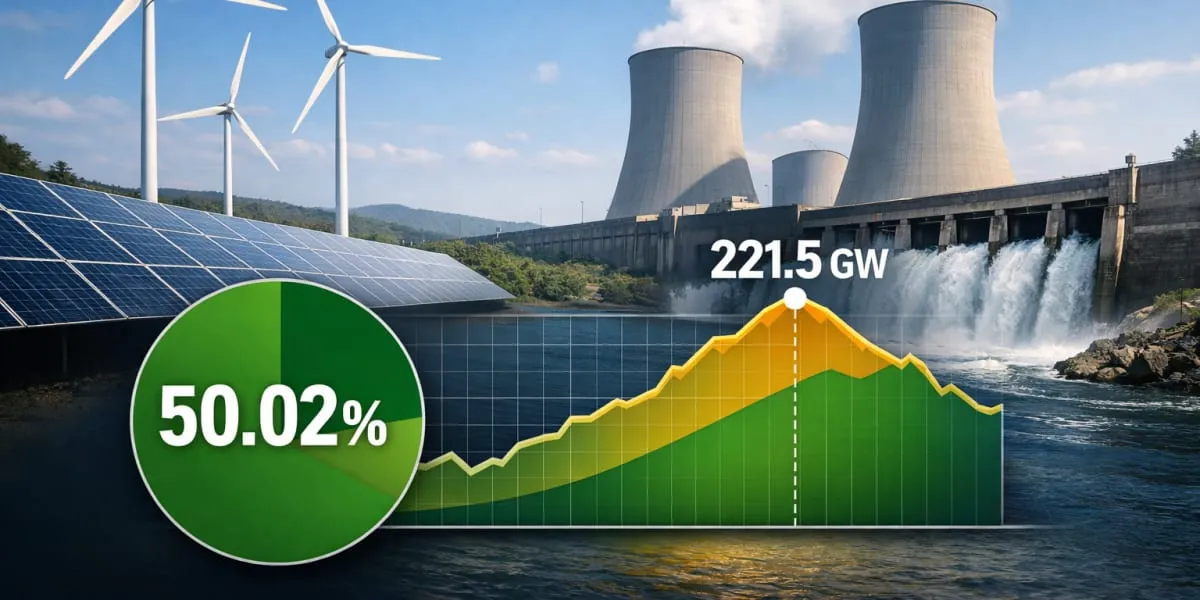
India's electricity grid marked a significant milestone on July 6 when clean energy sources supplied 50.02 per cent of total demand at 11:46, according to Merit Order Despatch of Electricity for Rejuvenation of Income and Transparency (MERIT) data. At that moment total demand stood at 221.5 gigawatt (GW), constituting the second consecutive year that clean sources met more than half of peak demand. The statistic referred to combined output from renewables, hydropower and nuclear generation.

Data showed that clean sources had momentarily supplied over 45 per cent of total electricity demand for 50 days since May, a fellow at the Council on Energy, Environment and Water (CEEW) said. The fellow said this pattern signalled a lasting change in the supply mix and that scaling flexible energy storage alongside large scale and distributed renewable systems would be the next frontier to serve rising evening loads with low cost renewable power. The expert added that policy and investment shifts would be necessary to preserve system reliability as shares grow.

Peak power demand eased to 222.5 GW on July 6 as widespread rainfall moderated temperatures, data from the state run Grid Controller of India showed. The following day peak demand rose to 230 GW while the recent high remained well below the all time maximum of 270.8 GW recorded in May. Officials noted that peak demand reached 243 GW in June 2025 and that government estimates put peak demand around 271 GW in 2026.

India's total installed capacity stood at 542.3 GW as of May 31, with thermal capacity at 250.8 GW and renewable capacity at 282.7 GW. While peak demand typically occurs in the mid afternoon, system stress was said to shift to evening hours when solar generation becomes unavailable and flexibility is required from other resources. A partner at Deloitte India warned that scaling storage and demand side measures would be crucial to address these evening shortfalls.

Forecasters cautioned that the development of an El Niño between June and August could lead to harsher summer conditions and higher power demand. El Niño was described as a period of warmer than normal sea surface temperatures in the central and eastern Pacific that typically lasts nine to 12 months and alters global rainfall and temperature patterns, increasing the risk of extreme weather.

"Join industry leaders at RAHSTA Expo, India's premier platform for roads, highways and traffic infrastructure. Register now to explore innovations, network with experts and shape the future of mobility."

India's electricity grid marked a significant milestone on July 6 when clean energy sources supplied 50.02 per cent of total demand at 11:46, according to Merit Order Despatch of Electricity for Rejuvenation of Income and Transparency (MERIT) data. At that moment total demand stood at 221.5 gigawatt (GW), constituting the second consecutive year that clean sources met more than half of peak demand. The statistic referred to combined output from renewables, hydropower and nuclear generation. Data showed that clean sources had momentarily supplied over 45 per cent of total electricity demand for 50 days since May, a fellow at the Council on Energy, Environment and Water (CEEW) said. The fellow said this pattern signalled a lasting change in the supply mix and that scaling flexible energy storage alongside large scale and distributed renewable systems would be the next frontier to serve rising evening loads with low cost renewable power. The expert added that policy and investment shifts would be necessary to preserve system reliability as shares grow. Peak power demand eased to 222.5 GW on July 6 as widespread rainfall moderated temperatures, data from the state run Grid Controller of India showed. The following day peak demand rose to 230 GW while the recent high remained well below the all time maximum of 270.8 GW recorded in May. Officials noted that peak demand reached 243 GW in June 2025 and that government estimates put peak demand around 271 GW in 2026. India's total installed capacity stood at 542.3 GW as of May 31, with thermal capacity at 250.8 GW and renewable capacity at 282.7 GW. While peak demand typically occurs in the mid afternoon, system stress was said to shift to evening hours when solar generation becomes unavailable and flexibility is required from other resources. A partner at Deloitte India warned that scaling storage and demand side measures would be crucial to address these evening shortfalls. Forecasters cautioned that the development of an El Niño between June and August could lead to harsher summer conditions and higher power demand. El Niño was described as a period of warmer than normal sea surface temperatures in the central and eastern Pacific that typically lasts nine to 12 months and alters global rainfall and temperature patterns, increasing the risk of extreme weather.

Next Story
Real Estate

Paradigm Realty secures Rs 1 billion for Chembur project

Paradigm Realty Group has secured Rs 1 billion in funding from Arnya RealEstates Fund for its flagship residential project, 71 Midtown, in Chembur, Mumbai.The institutional investment will be used to support the completion of Phases 1 and 2 of the development, with the financing aligned to the project's construction and delivery schedule.Spread across approximately 4.5 acres, the gated residential community comprises one- and two-bedroom apartments. Located near Sindhi Society in Chembur, the project offers connectivity to the Bandra Kurla Complex (BKC) and is expected to benefit from infrastr..

Next Story
Real Estate

PCPL delivers 1.4 million sq ft, eyes 2.1 million sq ft pipeline

Pranav Constructions (PCPL) has delivered more than 1.4 million sq ft of redeveloped residential space across Mumbai as of March 2026, while outlining a future pipeline exceeding 2.1 million sq ft across key redevelopment markets.Over the past decade, the Mumbai-based developer has completed 28 redevelopment projects, benefiting more than 2,450 families across the city's western suburbs, including Borivali, Kandivali, Malad and Goregaon. Since 2023, the company has expanded into neighbourhoods such as Santacruz, Bandra, Andheri and Vile Parle, while also entering heritage precincts including M..

Next Story
Products

Shalimar Paints launches premium Xtra Tough Hi-Sheen

Shalimar Paints has expanded its premium product portfolio with the launch of Xtra Tough Hi-Sheen, a new exterior emulsion developed to provide enhanced weather protection and a high-sheen finish for residential buildings.The company said the product is designed to address growing consumer demand for exterior coatings that combine aesthetics with long-term durability. Suitable for both new construction and renovation projects, the emulsion is formulated to withstand varied climatic conditions, including heat, rain, humidity and pollution.Xtra Tough Hi-Sheen features a dust-repellent coating in..

Advertisement

Subscribe to Our Newsletter

Get daily newsletters around different themes from Construction world.

STAY CONNECTED

Advertisement

Advertisement

Advertisement