NHAI Upgrades Toll Monitoring To Support Barrier-less Nationwide Rollout
ROADS & HIGHWAYS

NHAI Upgrades Toll Monitoring To Support Barrier-less Nationwide Rollout

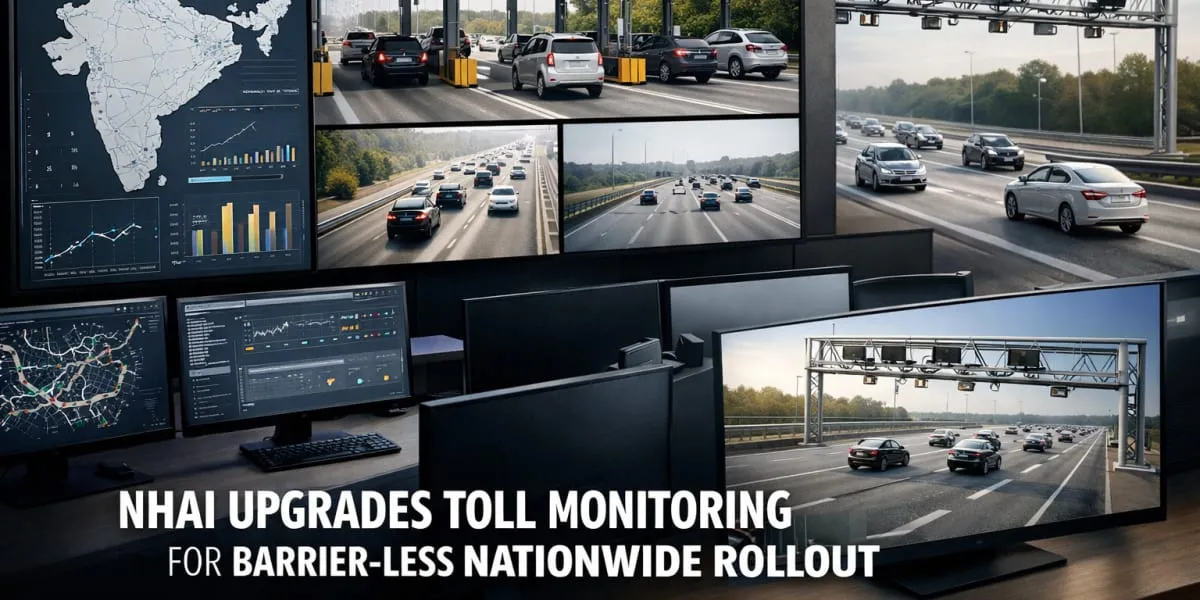
The National Highways Authority of India is upgrading its central toll monitoring system to support a nationwide shift to barrier-less toll collection on national highways. The Indian Highways Management Company Limited, the NHAI arm responsible for electronic toll collection, is converting the Toll Monitoring and Control Centre into a centralised digital command platform labelled TMCC 2.0 to oversee both the current FASTag tolling system and the upcoming Multi-Lane Free Flow tolling regime. The move accompanies government plans to accelerate the MLFF rollout across strategic corridors.

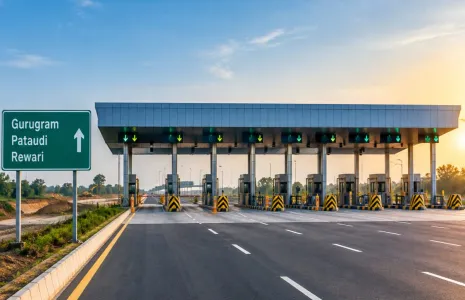
Multi-Lane Free Flow removes physical toll plazas and barriers, allowing vehicles to be charged while travelling at highway speeds through overhead gantries fitted with RFID readers and Automatic Number Plate Recognition cameras. MLFF is operational on a pilot basis at 17 locations and the first phase of expansion proposes introducing barrier-less tolling at 105 locations across several states. Officials said the upgraded command centre is intended to support the phased implementation and to manage the transition from plaza-based to barrier-less operations.

TMCC 2.0 will provide real-time monitoring of toll transactions, revenue collection, equipment performance, enforcement actions, financial reconciliation and service-level compliance across more than 1,200 toll plazas. A centralised automated reconciliation system will compare transaction logs generated at plazas with payment data from acquiring banks and the National Payments Corporation of India and will flag discrepancies in real time. For MLFF corridors the platform will reconcile vehicle detection records, toll computation, payment settlement and enforcement data to create an end-to-end audit trail for each journey.

The upgraded system will also function as a nationwide health-monitoring platform for tolling infrastructure, tracking RFID readers, cameras, lane controllers, communication links and MLFF gantry equipment through a central dashboard. This capability is designed to detect faults promptly, drive rapid remediation and improve system uptime while enabling automated enforcement and financial transparency. Officials said the more sophisticated technology backbone is necessary to handle high-volume, real-time data and to support automated enforcement at scale.

The National Highways Authority of India is upgrading its central toll monitoring system to support a nationwide shift to barrier-less toll collection on national highways. The Indian Highways Management Company Limited, the NHAI arm responsible for electronic toll collection, is converting the Toll Monitoring and Control Centre into a centralised digital command platform labelled TMCC 2.0 to oversee both the current FASTag tolling system and the upcoming Multi-Lane Free Flow tolling regime. The move accompanies government plans to accelerate the MLFF rollout across strategic corridors. Multi-Lane Free Flow removes physical toll plazas and barriers, allowing vehicles to be charged while travelling at highway speeds through overhead gantries fitted with RFID readers and Automatic Number Plate Recognition cameras. MLFF is operational on a pilot basis at 17 locations and the first phase of expansion proposes introducing barrier-less tolling at 105 locations across several states. Officials said the upgraded command centre is intended to support the phased implementation and to manage the transition from plaza-based to barrier-less operations. TMCC 2.0 will provide real-time monitoring of toll transactions, revenue collection, equipment performance, enforcement actions, financial reconciliation and service-level compliance across more than 1,200 toll plazas. A centralised automated reconciliation system will compare transaction logs generated at plazas with payment data from acquiring banks and the National Payments Corporation of India and will flag discrepancies in real time. For MLFF corridors the platform will reconcile vehicle detection records, toll computation, payment settlement and enforcement data to create an end-to-end audit trail for each journey. The upgraded system will also function as a nationwide health-monitoring platform for tolling infrastructure, tracking RFID readers, cameras, lane controllers, communication links and MLFF gantry equipment through a central dashboard. This capability is designed to detect faults promptly, drive rapid remediation and improve system uptime while enabling automated enforcement and financial transparency. Officials said the more sophisticated technology backbone is necessary to handle high-volume, real-time data and to support automated enforcement at scale.

Next Story
Infrastructure Transport

Surya Roshni delivers customised lighting for NCRTC RRTS stations

Surya Roshni has supplied customised indoor lighting solutions for 18 elevated stations on the National Capital Region Transport Corporation's (NCRTC) Rapid Rail Transit System (RRTS), strengthening its presence in India's infrastructure lighting segment.The project involved the design and deployment of lighting systems for platforms, concourses, foot overbridges (FOBs) and back-of-house (BOH) areas. According to the company, the luminaires were developed specifically to meet NCRTC's design, operational and performance requirements rather than using standard products.Surya introduced two custo..

Next Story
Real Estate

Hilton debuts Tapestry Collection brand in Vietnam

Hilton has opened NHAAN Resort & Spa Hoi An, Tapestry Collection by Hilton, marking the debut of the Tapestry Collection brand in Vietnam and expanding its lifestyle hospitality portfolio in Southeast Asia.Located along the Co Co River in Cam Thanh village, the 174-key resort provides access to Hoi An Ancient Town, Cua Dai Beach and the Cam Thanh Nipa Forest. The property has been designed by Vietnamese architect Vo Trong Nghia, incorporating biophilic architecture, locally sourced materials and riverfront landscapes.The resort offers a mix of guest rooms and suites, including family-frien..

Next Story
Building Material

Electrent expands lithium energy storage system portfolio

Electrent Energy has expanded its lithium-based energy storage portfolio with the launch of the ESS 850 and ESS 1050, targeting compact and maintenance-free power backup solutions for Indian homes.The new systems integrate a Home UPS and a LiFePO4 lithium battery into a single unit, extending the company's product range following the launch of its ESS 1350 and ESS 2500 models.Designed for apartments and smaller homes, the ESS 850 provides up to 1 hour 15 minutes of backup, while the ESS 1050 offers up to 1 hour 45 minutes on a typical 400 W household load. The systems can power essential appli..

Advertisement

Subscribe to Our Newsletter

Get daily newsletters around different themes from Construction world.

STAY CONNECTED

Advertisement

Advertisement

Advertisement