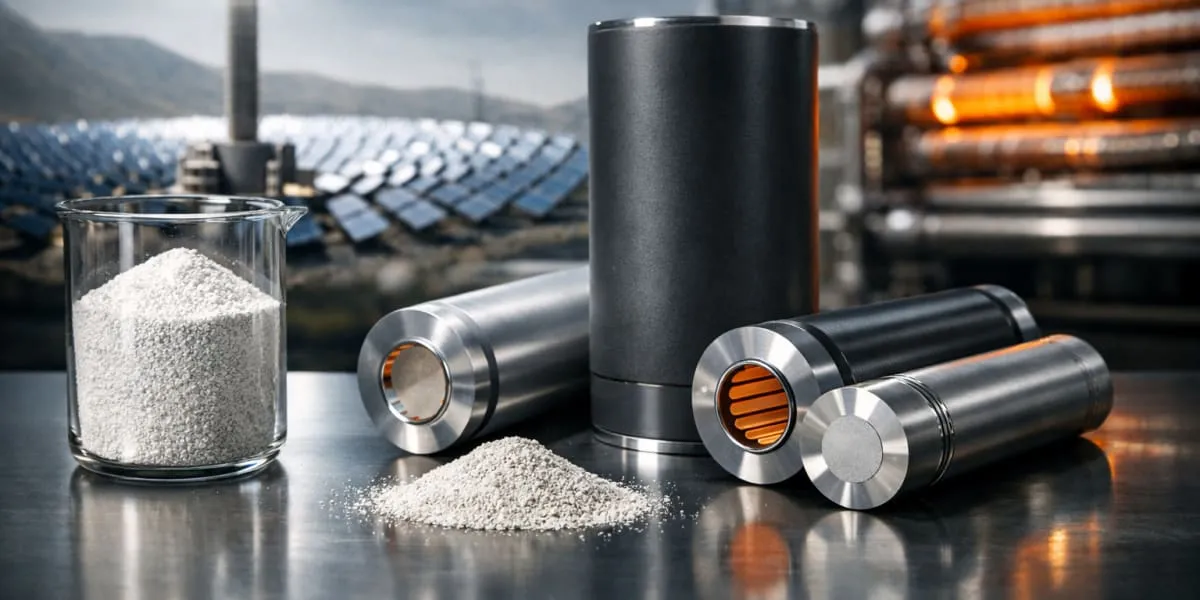
Cost Effective Thermal Battery Material Developed for Clean Energy Storage
POWER & RENEWABLE ENERGY

Cost Effective Thermal Battery Material Developed for Clean Energy Storage

Researchers have developed a cost effective and efficient thermal energy storage material that can improve the performance of thermal batteries used in concentrated solar power plants and for industrial waste heat recovery. The work was carried out at the International Advanced Research Centre for Powder Metallurgy and New Materials (ARCI), an autonomous institution of the Department of Science and Technology (DST), which developed a scalable process to produce spinel nanocomposite phase change material (PCM) with an unprecedented increase in specific heat capacity. The research has been published in Materials Today Chemistry and is presented as aligning with India’s clean energy objectives and the Aatma Nirbhar Bharat initiative.

The ARCI team led by Dr Mani Karthik employed a simple co-precipitation method to produce spinel type metal oxide nanoparticles with controlled particle size and uniform dispersion, yielding materials with excellent thermal stability. These nanomaterials are suitable for producing high performance nanocomposite PCM because they increase specific surface area and promote the formation of a stable spinel oxide layer at the interface. The interfacial layer is reported to raise surface energy, which contributes to the nanocomposite's higher specific heat capacity compared with the base PCM.

The addition of only one per cent spinel oxide nanoparticles to the PCM produced a nanocomposite that showed an increase in specific heat capacity as high as 45 per cent relative to the base material. As a result the material can store more thermal energy per unit mass, improving overall energy storage efficiency within a given volume. Enhanced storage capacity enables smaller tanks and reduced material requirements, which lowers both capital expenditure and operational costs.

The development therefore offers a compact and cost effective thermal energy storage solution that could support next generation systems with superior performance. The scalable production route and the demonstrated property enhancements make the material applicable to concentrated solar power and industrial heat recovery applications where effective thermal energy storage systems are essential. Further adoption is positioned as advancing indigenous capabilities in energy storage material science.

Researchers have developed a cost effective and efficient thermal energy storage material that can improve the performance of thermal batteries used in concentrated solar power plants and for industrial waste heat recovery. The work was carried out at the International Advanced Research Centre for Powder Metallurgy and New Materials (ARCI), an autonomous institution of the Department of Science and Technology (DST), which developed a scalable process to produce spinel nanocomposite phase change material (PCM) with an unprecedented increase in specific heat capacity. The research has been published in Materials Today Chemistry and is presented as aligning with India’s clean energy objectives and the Aatma Nirbhar Bharat initiative. The ARCI team led by Dr Mani Karthik employed a simple co-precipitation method to produce spinel type metal oxide nanoparticles with controlled particle size and uniform dispersion, yielding materials with excellent thermal stability. These nanomaterials are suitable for producing high performance nanocomposite PCM because they increase specific surface area and promote the formation of a stable spinel oxide layer at the interface. The interfacial layer is reported to raise surface energy, which contributes to the nanocomposite's higher specific heat capacity compared with the base PCM. The addition of only one per cent spinel oxide nanoparticles to the PCM produced a nanocomposite that showed an increase in specific heat capacity as high as 45 per cent relative to the base material. As a result the material can store more thermal energy per unit mass, improving overall energy storage efficiency within a given volume. Enhanced storage capacity enables smaller tanks and reduced material requirements, which lowers both capital expenditure and operational costs. The development therefore offers a compact and cost effective thermal energy storage solution that could support next generation systems with superior performance. The scalable production route and the demonstrated property enhancements make the material applicable to concentrated solar power and industrial heat recovery applications where effective thermal energy storage systems are essential. Further adoption is positioned as advancing indigenous capabilities in energy storage material science.

Next Story
Building Material

Dalmia Cement to Acquire 5.2 MnTPA Capacity

Dalmia Cement (Bharat), a wholly owned subsidiary of Dalmia Bharat, has executed a Business Transfer Agreement with Jaiprakash Associates and Adani Infra (India) to acquire cement assets with 5.2 MnTPA capacity in the Central region.The acquisition covers cement plants located at Rewa in Madhya Pradesh, and Churk, Chunar and Sadwa in Uttar Pradesh. The assets include 5.2 MnTPA cement capacity, 3.3 MnTPA clinker capacity, 99 MW thermal power capacity, railway sidings at Rewa and Chunar, and a common railway siding at Churk. The enterprise value of the transaction is Rs 28.5 billion.Following co..

Next Story
Infrastructure Urban

Rampura Agucha Becomes Zinc Mark Certified Mine

Hindustan Zinc’s Rampura Agucha Mine has become India’s first Zinc Mark certified mine, marking a major milestone in responsible zinc production. The mine is the world’s largest underground zinc-lead mine and is operated by Hindustan Zinc, the world’s largest integrated zinc producer.Zinc Mark is a globally recognised assurance framework that validates responsible zinc production against international Environmental, Social and Governance standards, responsible sourcing practices and value chain transparency. The certification strengthens Hindustan Zinc’s ability to offer responsibly ..

Next Story
Infrastructure Urban

Headsup B2B Targets Rs 4 bn Revenue This Fiscal

Headsup B2B, a pan-India procurement and supply chain platform serving the infrastructure, industrial and renewable energy sectors, is targeting Rs 4 billion in revenue for the current fiscal year. The company executed over 2,200 transactions worth Rs 2.5 billion in the previous financial year.Allied infrastructure services contributed nearly 80 per cent of revenue during the period, while renewable energy, industrial automation and road safety solutions emerged as the fastest-growing categories. The company is now expanding its role beyond procurement to support installation, deployment and p..

Advertisement

Subscribe to Our Newsletter

Get daily newsletters around different themes from Construction world.

STAY CONNECTED

Advertisement

Advertisement

Advertisement

-->