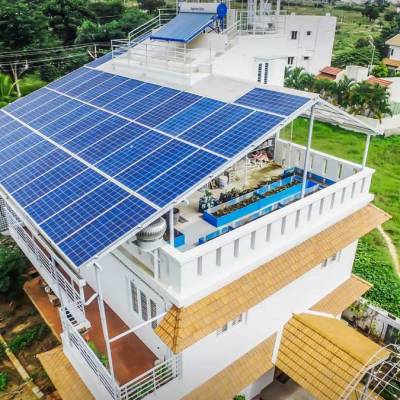
Govt allocates Rs 5 billion for rooftop solar projects under PM-Surya Ghar
POWER & RENEWABLE ENERGY

Govt allocates Rs 5 billion for rooftop solar projects under PM-Surya Ghar

The Ministry of New and Renewable Energy (MNRE) announced guidelines for implementing ‘Innovative Projects’ under the PM-Surya Ghar: Muft Bijli Yojana, allocating Rs 5 billion to promote advancements in rooftop solar technology.

The notification, issued on October 8, 2024, aims to encourage startups, institutions, and industries to develop new solutions such as blockchain-based peer-to-peer solar trading, smart materials, and solar systems integrated with electric vehicles.

The scheme will offer financial assistance covering up to 60 per cent of the project cost or Rs 300 million, whichever amount is lower. The National Institute of Solar Energy (NISE) will function as the Scheme Implementation Agency (SIA). Additionally, MNRE plans to introduce annual innovation awards, with prizes reaching up to Rs 10 million to further incentivize research.

The government intends to increase the share of solar rooftop capacity under the PM-Surya Ghar Yojana, which received approval in February 2024 with a budget of Rs 750.21 billion and is set to be implemented until FY 2026-27. Proposals for innovative projects will be invited by MNRE, promoting joint research and international collaborations.

The Ministry of New and Renewable Energy (MNRE) announced guidelines for implementing ‘Innovative Projects’ under the PM-Surya Ghar: Muft Bijli Yojana, allocating Rs 5 billion to promote advancements in rooftop solar technology. The notification, issued on October 8, 2024, aims to encourage startups, institutions, and industries to develop new solutions such as blockchain-based peer-to-peer solar trading, smart materials, and solar systems integrated with electric vehicles. The scheme will offer financial assistance covering up to 60 per cent of the project cost or Rs 300 million, whichever amount is lower. The National Institute of Solar Energy (NISE) will function as the Scheme Implementation Agency (SIA). Additionally, MNRE plans to introduce annual innovation awards, with prizes reaching up to Rs 10 million to further incentivize research. The government intends to increase the share of solar rooftop capacity under the PM-Surya Ghar Yojana, which received approval in February 2024 with a budget of Rs 750.21 billion and is set to be implemented until FY 2026-27. Proposals for innovative projects will be invited by MNRE, promoting joint research and international collaborations.

Next Story
Infrastructure Urban

India Expands Semiconductor Training To 500 Institutions

Under the Chips to Startups programme of the India Semiconductor Mission, the Union minister responsible for Railways, Information and Broadcasting, and Electronics and IT reported notable progress in talent development. He indicated that over the past four years substantial steps have been taken towards a 10-year target of training 85,000 engineers in semiconductor design. World-class EDA tools have been deployed in 315 academic institutions across the country to provide students with practical exposure to chip design. These EDA tools are supported by leading global firms and are accessible t..

Next Story
Infrastructure Urban

Delhi Institutions Support India Semiconductor Mission

The Government of India has prioritised talent development through training, upskilling and workforce development under the Chips to Startups initiative of the India Semiconductor Mission, with officials noting progress in four years towards a 10-year target of training 85,000 engineers in semiconductor design. Electronic design automation tools provided by Synopsys, Cadence, Siemens, Renesas, Ansys and AMD have been deployed in 315 academic institutions, enabling students to gain practical chip design experience. Chips have been fabricated and tested at the Semiconductor Laboratory, Mohali, a..

Next Story
Infrastructure Urban

NHA Announces Winners Of NHCX Hackathon At IIT Hyderabad

The National Health Authority (NHA) has concluded the NHCX Hackathon under the Ayushman Bharat Digital Mission (ABDM) to stimulate innovation around the National Health Claims Exchange (NHCX). The winning teams presented their solutions at the NHCX Innovation Meet held at IIT Hyderabad during a two-day event in March 2026 that also served as the hackathon grand finale. The hackathon itself ran from 22 to 28 February 2026 and aimed to accelerate paperless, transparent claims processing across India. The event was organised with a range of ecosystem partners, including the Insurance Regulatory a..

Advertisement

Subscribe to Our Newsletter

Get daily newsletters around different themes from Construction world.

STAY CONNECTED

Advertisement

Advertisement

Advertisement