+
Haryana Approves Rs 4,020 Million Solar Micro Irrigation Projects
POWER & RENEWABLE ENERGY

Haryana Approves Rs 4,020 Million Solar Micro Irrigation Projects

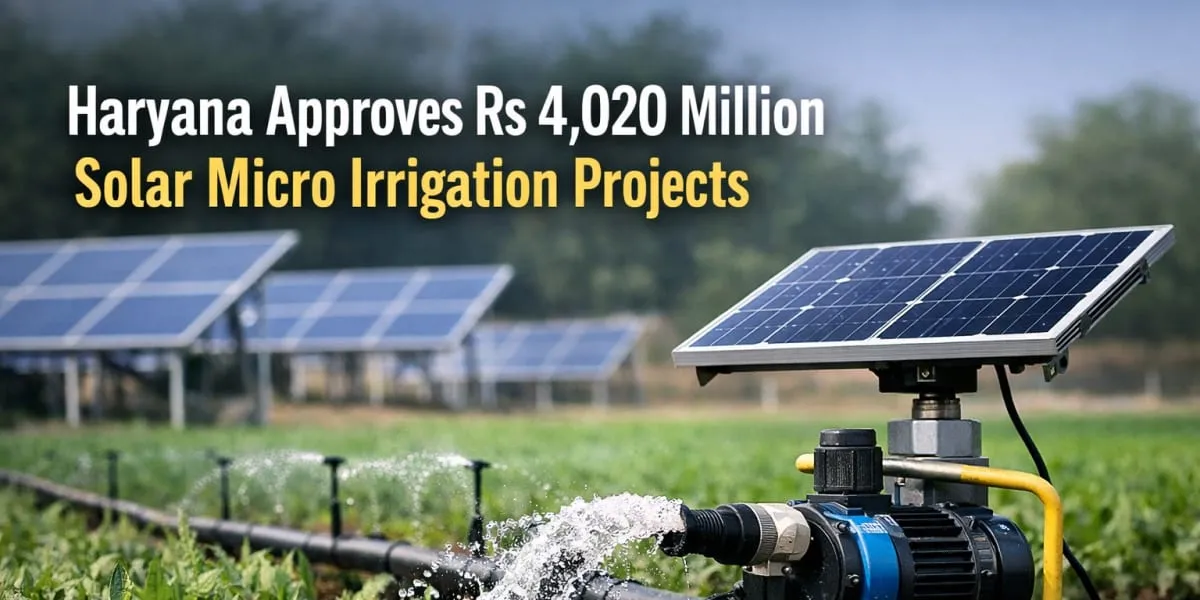
The Haryana government approved solar-powered micro irrigation projects worth Rs 4,020 million (mn) aimed at boosting water-efficient farming across the state.

The figure follows conversion from the originally reported amount of Rs 402 crore, with one crore equating to 10 million.

Officials said that the investments will focus on installation of solar pumps and micro irrigation systems to reduce dependence on grid power and improve crop water use.

The projects form part of a wider push to modernise irrigation and enhance resilience against erratic rainfall patterns.

Implementation will be overseen by the state agriculture and irrigation departments, which will coordinate procurement, installation and farmer support services.

Officials added that prioritisation will be given to water-stressed districts and small and marginal farmers to increase on-farm efficiency and lower cultivation costs.

The move is expected to lower electricity consumption for irrigation and to cut diesel usage by shifting pumps to solar power, delivering recurring cost savings for households and cooperatives.

It is also anticipated to contribute to groundwater conservation and to align with national renewable energy objectives.

Funding structures are likely to combine state allocations with central scheme support and possible low-cost loans, according to administrative outlines.

Machines and systems will be standardised and subject to quality checks, with training provided to farmers on operation and maintenance.

Monitoring mechanisms will track water delivery efficiency and system uptime to ensure value for money and to guide future scale up.

Officials said that phased roll-out is planned to allow learning and to make adjustments to technical specifications and support arrangements.

Public outreach will explain eligibility criteria and application processes so that farmers can participate without delay.

Data from initial sites will inform scaling and will be shared with stakeholders to ensure transparency and accountability.

The scheme is expected to complement other state measures on sustainable agriculture and renewable adoption.

The Haryana government approved solar-powered micro irrigation projects worth Rs 4,020 million (mn) aimed at boosting water-efficient farming across the state. The figure follows conversion from the originally reported amount of Rs 402 crore, with one crore equating to 10 million. Officials said that the investments will focus on installation of solar pumps and micro irrigation systems to reduce dependence on grid power and improve crop water use. The projects form part of a wider push to modernise irrigation and enhance resilience against erratic rainfall patterns. Implementation will be overseen by the state agriculture and irrigation departments, which will coordinate procurement, installation and farmer support services. Officials added that prioritisation will be given to water-stressed districts and small and marginal farmers to increase on-farm efficiency and lower cultivation costs. The move is expected to lower electricity consumption for irrigation and to cut diesel usage by shifting pumps to solar power, delivering recurring cost savings for households and cooperatives. It is also anticipated to contribute to groundwater conservation and to align with national renewable energy objectives. Funding structures are likely to combine state allocations with central scheme support and possible low-cost loans, according to administrative outlines. Machines and systems will be standardised and subject to quality checks, with training provided to farmers on operation and maintenance. Monitoring mechanisms will track water delivery efficiency and system uptime to ensure value for money and to guide future scale up. Officials said that phased roll-out is planned to allow learning and to make adjustments to technical specifications and support arrangements. Public outreach will explain eligibility criteria and application processes so that farmers can participate without delay. Data from initial sites will inform scaling and will be shared with stakeholders to ensure transparency and accountability. The scheme is expected to complement other state measures on sustainable agriculture and renewable adoption.

Next Story
Equipment

Kabelschlepp India Installs Robotic VMC in Bengaluru

Kabelschlepp India, part of the Tsubaki Group, has installed a state-of-the-art Vertical Machining Center (VMC) integrated with robotic automation at its Bengaluru facility. The inauguration was held in the presence of Henning Preis, President & CEO, Kabelschlepp Group, Jörg Schulz, Vice President – Production, and Srinivas P. Kamisetty, Managing Director, Kabelschlepp India.The high-precision CNC VMC is designed for advanced milling, drilling, tapping and multi-axis machining. Equipped with a vertical spindle orientation, automatic tool changer and intelligent CNC control system, it en..

Next Story
Infrastructure Transport

Highway Delivery Reset!

Project delays and inefficiencies continue to bedevil the progress of India’s National Highways network. A multi-pronged reform agenda is needed to inject greater transparency and accountability at every stage – from planning and procurement to execution, maintenance and oversight. This article offers key recommendations and reform strategies that government stakeholders – from the Ministry of Road Transport & Highways (MoRTH) and the National Highways Authority of India (NHAI) to state agencies and oversight bodies – should pursue to put highway development on a better track.Decen..

Next Story
Infrastructure Transport

MSIDC Executes ₹37,000 Crore Road Programme

With Rs 37,000 crore worth of road projects under execution across Maharashtra, Maharashtra State Infrastructure Development Corporation (MSIDC) is driving one of the state’s largest infrastructure programmes. Dr Brijesh Dixit, Managing Director, discusses the institutional reforms, execution frameworks, financing strategies and technology adoption enabling timely, high-quality delivery, in conversation with PRATAP PADODE, Editor-in-Chief, CW.With over Rs 37,000 crore worth of road projects underway across districts – many under tight timelines – what institutional and executio..

Advertisement

Subscribe to Our Newsletter

Get daily newsletters around different themes from Construction world.

STAY CONNECTED

Advertisement

Advertisement

Advertisement

Open In App