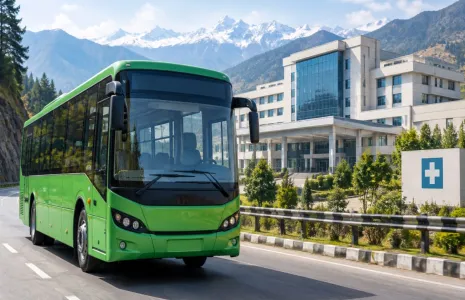
Himachal CM Announces 2 MW Solar Plant in Kaza to Enhance Power Supply
POWER & RENEWABLE ENERGY

Himachal CM Announces 2 MW Solar Plant in Kaza to Enhance Power Supply

Himachal Pradesh Chief Minister Sukhvinder Sukhu announced the installation of a two-megawatt (MW) solar power plant in Kaza, a remote region of the Lahaul-Spiti district. The project aims to strengthen and improve the area's power supply. 

The Chief Minister praised the dedicated efforts of the Himachal Pradesh State Electricity Board Ltd. (HPSEBL) team in setting up the plant. He mentioned that the plant would be fully operational within a few months, with the addition of a one-megawatt-hour (MWh) battery storage system. 

Sukhu emphasised the state's commitment to leveraging solar energy as part of its goal to become a "green state." In line with this vision, electric vehicle (EV) charging stations are being established across the state based on demand. 

The state government has also approved the installation of 18 MW of ground-mounted and rooftop solar plants on vacant land near HPSEBL offices. Additionally, plans are underway to install rooftop solar systems on 50,000 houses by 2026-27. So far, 4,444 applications have been received for this initiative. 

The Chief Minister also outlined efforts to make Himachal Pradesh self-reliant by optimising resource use, including rationalising electricity subsidies and staff. He revealed that power project agreements signed by the electricity board are under review, and loans taken at high-interest rates will be reassessed to lower the debt burden. 

These initiatives aim to support the self-sufficiency of Himachal Pradesh State Electricity Board Limited. Sukhu reaffirmed the government's commitment to safeguarding the interests of employees and ensuring their financial benefits are regularly provided. 

(ET)     

Himachal Pradesh Chief Minister Sukhvinder Sukhu announced the installation of a two-megawatt (MW) solar power plant in Kaza, a remote region of the Lahaul-Spiti district. The project aims to strengthen and improve the area's power supply. The Chief Minister praised the dedicated efforts of the Himachal Pradesh State Electricity Board Ltd. (HPSEBL) team in setting up the plant. He mentioned that the plant would be fully operational within a few months, with the addition of a one-megawatt-hour (MWh) battery storage system. Sukhu emphasised the state's commitment to leveraging solar energy as part of its goal to become a green state. In line with this vision, electric vehicle (EV) charging stations are being established across the state based on demand. The state government has also approved the installation of 18 MW of ground-mounted and rooftop solar plants on vacant land near HPSEBL offices. Additionally, plans are underway to install rooftop solar systems on 50,000 houses by 2026-27. So far, 4,444 applications have been received for this initiative. The Chief Minister also outlined efforts to make Himachal Pradesh self-reliant by optimising resource use, including rationalising electricity subsidies and staff. He revealed that power project agreements signed by the electricity board are under review, and loans taken at high-interest rates will be reassessed to lower the debt burden. These initiatives aim to support the self-sufficiency of Himachal Pradesh State Electricity Board Limited. Sukhu reaffirmed the government's commitment to safeguarding the interests of employees and ensuring their financial benefits are regularly provided. (ET)     

Next Story
Infrastructure Urban

India Expands Semiconductor Training To 500 Institutions

Under the Chips to Startups programme of the India Semiconductor Mission, the Union minister responsible for Railways, Information and Broadcasting, and Electronics and IT reported notable progress in talent development. He indicated that over the past four years substantial steps have been taken towards a 10-year target of training 85,000 engineers in semiconductor design. World-class EDA tools have been deployed in 315 academic institutions across the country to provide students with practical exposure to chip design. These EDA tools are supported by leading global firms and are accessible t..

Next Story
Infrastructure Urban

Delhi Institutions Support India Semiconductor Mission

The Government of India has prioritised talent development through training, upskilling and workforce development under the Chips to Startups initiative of the India Semiconductor Mission, with officials noting progress in four years towards a 10-year target of training 85,000 engineers in semiconductor design. Electronic design automation tools provided by Synopsys, Cadence, Siemens, Renesas, Ansys and AMD have been deployed in 315 academic institutions, enabling students to gain practical chip design experience. Chips have been fabricated and tested at the Semiconductor Laboratory, Mohali, a..

Next Story
Infrastructure Urban

NHA Announces Winners Of NHCX Hackathon At IIT Hyderabad

The National Health Authority (NHA) has concluded the NHCX Hackathon under the Ayushman Bharat Digital Mission (ABDM) to stimulate innovation around the National Health Claims Exchange (NHCX). The winning teams presented their solutions at the NHCX Innovation Meet held at IIT Hyderabad during a two-day event in March 2026 that also served as the hackathon grand finale. The hackathon itself ran from 22 to 28 February 2026 and aimed to accelerate paperless, transparent claims processing across India. The event was organised with a range of ecosystem partners, including the Insurance Regulatory a..

Advertisement

Subscribe to Our Newsletter

Get daily newsletters around different themes from Construction world.

STAY CONNECTED

Advertisement

Advertisement

Advertisement