India And Norway Explore Renewable Energy Cooperation
POWER & RENEWABLE ENERGY

India And Norway Explore Renewable Energy Cooperation

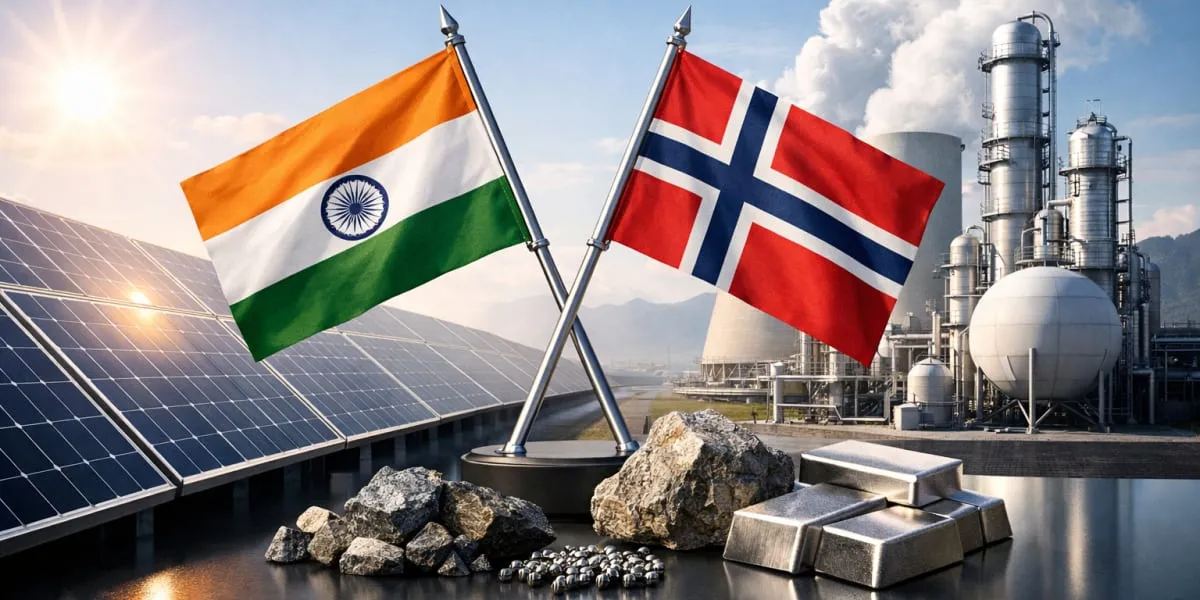
India and Norway advanced discussions on renewable energy cooperation during a bilateral meeting in Oslo on 17 February 2026. Finance Minister Nirmala Sitharaman and Norway Finance Minister Jens Stoltenberg explored collaboration focused on solar power, processing of rare earths and carbon capture and storage. The meeting was described by official sources as aimed at identifying investment and technology pathways. Officials indicated that initial efforts would prioritise scalable initiatives that can be replicated across regions.

Both ministers agreed to leverage the Trade and Economic Partnership Agreement (TEPA) to deepen cooperation in the blue economy and green economy and to facilitate investment flows. They discussed the role of sovereign wealth and pension funds in financing projects and opportunities for Norwegian investors to engage with India's growing energy market. Officials signalled an intent to prioritise projects that combine sustainability with commercial viability. Officials noted that coordination with the private sector would form a key component of implementation.

Norway indicated that a state visit by Prime Minister Narendra Modi later in the year is expected to further strengthen bilateral ties and open space for expanded cooperation across multiple sectors. The discussions were positioned within a broader context of India's economic growth and Norway's interest in long term investments. Both sides highlighted the strategic value of aligning climate action with trade and investment objectives. They also underlined the need for capacity building and skills development to support deployment.

Officials said follow up work will focus on technical cooperation, regulatory alignment and project level due diligence to accelerate deployment of renewable capacity. Areas identified for additional engagement include solar technology transfer, value chain development for critical minerals and joint research on carbon capture and storage. The two governments committed to maintain dialogue through relevant ministries and agencies to translate discussions into concrete initiatives. A timeline for technical exchanges and pilot projects was expected to be worked out through intergovernmental channels.

India and Norway advanced discussions on renewable energy cooperation during a bilateral meeting in Oslo on 17 February 2026. Finance Minister Nirmala Sitharaman and Norway Finance Minister Jens Stoltenberg explored collaboration focused on solar power, processing of rare earths and carbon capture and storage. The meeting was described by official sources as aimed at identifying investment and technology pathways. Officials indicated that initial efforts would prioritise scalable initiatives that can be replicated across regions. Both ministers agreed to leverage the Trade and Economic Partnership Agreement (TEPA) to deepen cooperation in the blue economy and green economy and to facilitate investment flows. They discussed the role of sovereign wealth and pension funds in financing projects and opportunities for Norwegian investors to engage with India's growing energy market. Officials signalled an intent to prioritise projects that combine sustainability with commercial viability. Officials noted that coordination with the private sector would form a key component of implementation. Norway indicated that a state visit by Prime Minister Narendra Modi later in the year is expected to further strengthen bilateral ties and open space for expanded cooperation across multiple sectors. The discussions were positioned within a broader context of India's economic growth and Norway's interest in long term investments. Both sides highlighted the strategic value of aligning climate action with trade and investment objectives. They also underlined the need for capacity building and skills development to support deployment. Officials said follow up work will focus on technical cooperation, regulatory alignment and project level due diligence to accelerate deployment of renewable capacity. Areas identified for additional engagement include solar technology transfer, value chain development for critical minerals and joint research on carbon capture and storage. The two governments committed to maintain dialogue through relevant ministries and agencies to translate discussions into concrete initiatives. A timeline for technical exchanges and pilot projects was expected to be worked out through intergovernmental channels.

Next Story
Infrastructure Urban

Güntner Showcases Cooling Tech at China Expo

Güntner showcased its latest refrigeration and air conditioning innovations at China Refrigeration 2026, highlighting digital intelligence and carbon-neutral solutions.The company presented its aicore™ Controls and IoT platform, designed to optimise energy consumption, enable remote monitoring and enhance lifecycle management of cooling systems. The solution integrates advanced controllers and cloud-based capabilities to improve operational efficiency and reduce energy use.Güntner also demonstrated advancements in heat pump technologies, including its role in projects such as the Ordos Zer..

Next Story
Real Estate

Superb Realty Ties Up with Praan for AI Air Tech

Superb Realty has partnered with Praan to deploy AI-powered autonomous air infrastructure across over one million sq ft of real estate in Mumbai, marking a significant move towards intelligent indoor environments.The rollout will begin at Superb Altura and expand across upcoming residential and mixed-use developments. The initiative aims to integrate real-time sensing, adaptive purification and AI-led optimisation to improve indoor air quality and occupant experience.Praan’s technology is designed to remove ultrafine particles significantly smaller than conventional systems and eliminate har..

Next Story
Technology

DAAKit Raises $138,000 in Pre-Seed Round

DAAKit has raised $138,000 in a pre-seed funding round led by Inflection Point Ventures to expand its hyperlocal fulfilment network and strengthen technology capabilities.The company plans to use the funds to launch 25 new dark stores across Tier I and Tier II cities, enhance its technology infrastructure, and expand its leadership and operations teams. Currently operational in Delhi, Gurugram, Mumbai, Bengaluru and Kolkata, DAAKit is also piloting expansion into Tier II markets through Lucknow.Built on an asset-light, technology-driven model, the platform enables brands to position inventory ..

Advertisement

Subscribe to Our Newsletter

Get daily newsletters around different themes from Construction world.

STAY CONNECTED

Advertisement

Advertisement

Advertisement