+
India Has 39,545 MW Thermal Projects Under Construction
POWER & RENEWABLE ENERGY

India Has 39,545 MW Thermal Projects Under Construction

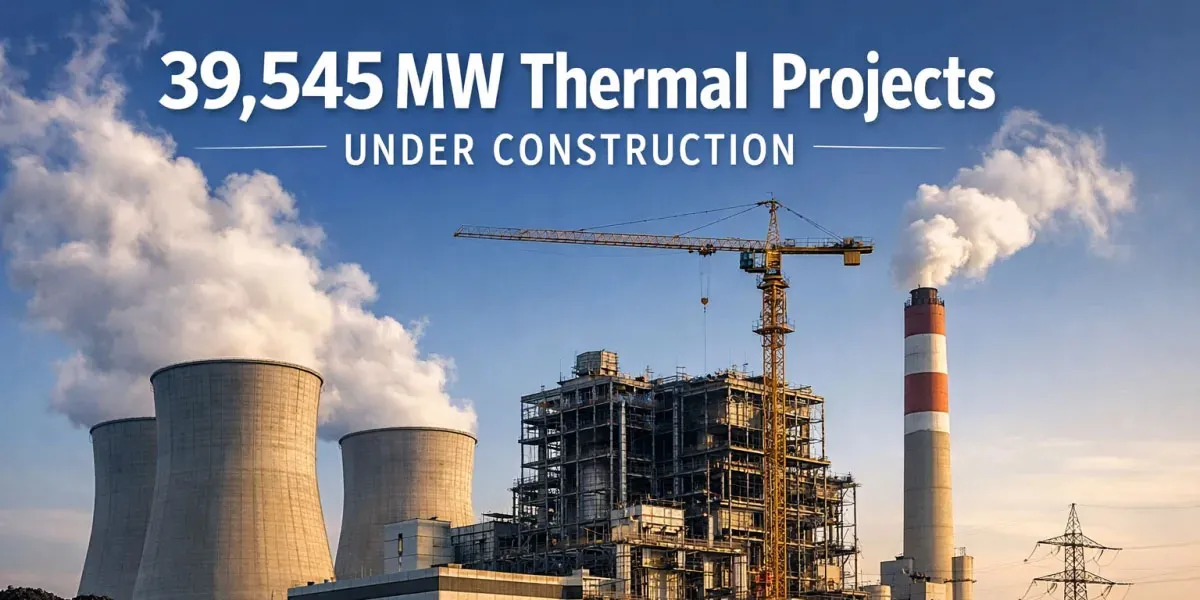
India has 39,545 megawatt (MW) of thermal power projects currently under various stages of construction, the government informed Parliament. The Minister of State for Power, Shripad Naik, provided a written reply to the Rajya Sabha setting out project numbers, costs and plans. The disclosure formed part of an update on the nation’s thermal fleet and the ministry’s approach to meeting future demand for coal and lignite based generation.

Studies indicate projected thermal capacity requirement by 2034–35 of approximately 307,000 megawatt (MW), compared with an installed capacity of 211,855 MW as of March 2023. To meet that requirement the power ministry has envisaged setting up an additional 97,000 MW of coal and lignite based thermal capacity. Contracts for 22,920 MW of projects have been awarded and are due for construction, while a further 24,020 MW of candidate capacity has been identified and is at various planning stages.

Thermal capacities totalling 17,360 MW have been commissioned since April 2023 up to 20 January, and the 39,545 MW currently under construction includes 4,845 MW of stressed thermal projects. The ministry noted that generation costs from coal based plants depend on factors such as plant life, distance from coal mines and type of technology, including sub-critical and super-critical systems. The all-India Weighted Average Rate of Sale of Power (WARSP) for electricity from existing coal based plants over the past three years ranged from Rs 4.36 per kWh to Rs 4.58 per kWh, with the lowest tariff at about Rs 1.52 per kWh.

The tariff discovered for new coal based projects selected through Tariff Based Competitive Bidding (TBCB) was in the range of Rs 5.38 to Rs 6.30 per kWh based on bidding carried out in 2025. Tariff outcomes under Firm and Dispatchable Renewable Energy (FDRE) tenders awarded by the Solar Energy Corporation of India (SECI) in August 2024 were in the range of Rs 4.98 to Rs 4.99 per kWh. The ministry set out these figures in the context of planning and procurement choices.

India has 39,545 megawatt (MW) of thermal power projects currently under various stages of construction, the government informed Parliament. The Minister of State for Power, Shripad Naik, provided a written reply to the Rajya Sabha setting out project numbers, costs and plans. The disclosure formed part of an update on the nation’s thermal fleet and the ministry’s approach to meeting future demand for coal and lignite based generation. Studies indicate projected thermal capacity requirement by 2034–35 of approximately 307,000 megawatt (MW), compared with an installed capacity of 211,855 MW as of March 2023. To meet that requirement the power ministry has envisaged setting up an additional 97,000 MW of coal and lignite based thermal capacity. Contracts for 22,920 MW of projects have been awarded and are due for construction, while a further 24,020 MW of candidate capacity has been identified and is at various planning stages. Thermal capacities totalling 17,360 MW have been commissioned since April 2023 up to 20 January, and the 39,545 MW currently under construction includes 4,845 MW of stressed thermal projects. The ministry noted that generation costs from coal based plants depend on factors such as plant life, distance from coal mines and type of technology, including sub-critical and super-critical systems. The all-India Weighted Average Rate of Sale of Power (WARSP) for electricity from existing coal based plants over the past three years ranged from Rs 4.36 per kWh to Rs 4.58 per kWh, with the lowest tariff at about Rs 1.52 per kWh. The tariff discovered for new coal based projects selected through Tariff Based Competitive Bidding (TBCB) was in the range of Rs 5.38 to Rs 6.30 per kWh based on bidding carried out in 2025. Tariff outcomes under Firm and Dispatchable Renewable Energy (FDRE) tenders awarded by the Solar Energy Corporation of India (SECI) in August 2024 were in the range of Rs 4.98 to Rs 4.99 per kWh. The ministry set out these figures in the context of planning and procurement choices.

Next Story
Infrastructure Energy

Jyoti Structures expands manufacturing capacity in Nashik

The announcement Jyoti Structures (JSL) reported steady operational performance in 2025, supported by stable project execution across its power transmission portfolio. The company commissioned galvanisation operations at its second Nashik manufacturing unit, adding 33,000 MT of annual capacity. This increased aggregate tower manufacturing capability at Nashik to approximately 69,000 MT per annum, aimed at improving fabrication accuracy, scheduling control and delivery predictability. JSL also expanded its workforce to over 750 employees, onboarding more than 70 engineers during the year. C..

Next Story
Infrastructure Energy

TSPL Mega Health Camp Reaches 338 Residents in Mansa

Talwandi Sabo Power (TSPL), Punjab’s largest and North India’s largest private thermal power plant, organised a Mega Health Camp at Village Raipur, Mansa, under its flagship healthcare initiative Project SEHAT. The camp benefitted 338 community members through free consultations and diagnostic services.A team comprising a General Physician, Gynaecologist, Dermatologist and Dentist provided medical advice and treatment. Beneficiaries received free diagnostic tests including BP, HB, blood sugar, malaria, dengue and blood group tests, along with free medicines.The camp was inaugurated by Vill..

Next Story
Infrastructure Transport

Mumbai Coastal Road Musical Path Plays Jai Ho

Mumbai inaugurated India’s first musical path on the Coastal Road that plays the song Jai Ho for motorists. The civic administration said the installation used Hungarian technology and that the intention was to implement the concept of Sangeet Marg in future projects. A senior official suggested implementing a pilot on the Samruddhi Expressway, which connects Mumbai and Nagpur. City officials described the inauguration as a symbolic demonstration of collaboration between municipal authorities and foreign partners. The inauguration was attended by the Consul General of Hungary Ferenc Jari, f..

Advertisement

Subscribe to Our Newsletter

Get daily newsletters around different themes from Construction world.

STAY CONNECTED

Advertisement

Advertisement

Advertisement

Open In App