Piyush Goyal Targets Top Five Global IP Approval System
ECONOMY & POLICY

Piyush Goyal Targets Top Five Global IP Approval System

Addressing the National IP Awards and IP Conference in New Delhi the Union minister called for making India’s intellectual property (IP) approval system among the top five globally in speed, transparency and efficiency. He urged faster disposal of applications for trademarks, patents, copyrights, designs and geographical indications to strengthen the culture of innovation and expedite market entry. He sought broader participation from innovators, startups and micro, small and medium enterprises (MSMEs).

He congratulated award winners and noted contributions from scientists, technocrats, entrepreneurs, agricultural institutes and the Indian Institutes of Technology in driving innovation. He praised the incubation hub at the Indian Institute of Technology Madras and said it could inform upgrades to incubation centres in Tier-2 and Tier-3 cities and in remote regions. He encouraged institutions to replicate successful models to expand entrepreneurial capacity.

He highlighted the Union Budget allocation to establish 50,000 new innovation labs in schools and called for nurturing curiosity and problem solving from an early age. He asked professionals and industry stakeholders to engage with schools through alumni outreach, webinars and virtual interactions. He emphasised the need to integrate women and youth more deeply into the IP ecosystem.

He cited improvements in innovation indicators, noting India’s rise in the Global Innovation Index (GII) from 81 to 38. He said patent filings have grown by nearly 215 per cent in the last decade and that patent filings by women have increased by 345 times over 12 years. He acknowledged work by the Controller General of Patents, Designs and Trade Marks (CGPDTM) and said the government is recruiting staff to clear legacy backlogs.

He noted that IP-related fees have been reduced by about 50 to 80 per cent and that an 80 per cent concession has been proposed for women entrepreneurs, startup innovators and micro and small enterprises, alongside exploration of fast-track mechanisms. He pointed to nine Free Trade Agreements (FTAs) covering 38 countries and preferential access to nearly two thirds of global trade as an opportunity for exporters. He said collective efforts by innovators, institutions and government can transform ideas into products and accelerate the country’s development.

Addressing the National IP Awards and IP Conference in New Delhi the Union minister called for making India’s intellectual property (IP) approval system among the top five globally in speed, transparency and efficiency. He urged faster disposal of applications for trademarks, patents, copyrights, designs and geographical indications to strengthen the culture of innovation and expedite market entry. He sought broader participation from innovators, startups and micro, small and medium enterprises (MSMEs). He congratulated award winners and noted contributions from scientists, technocrats, entrepreneurs, agricultural institutes and the Indian Institutes of Technology in driving innovation. He praised the incubation hub at the Indian Institute of Technology Madras and said it could inform upgrades to incubation centres in Tier-2 and Tier-3 cities and in remote regions. He encouraged institutions to replicate successful models to expand entrepreneurial capacity. He highlighted the Union Budget allocation to establish 50,000 new innovation labs in schools and called for nurturing curiosity and problem solving from an early age. He asked professionals and industry stakeholders to engage with schools through alumni outreach, webinars and virtual interactions. He emphasised the need to integrate women and youth more deeply into the IP ecosystem. He cited improvements in innovation indicators, noting India’s rise in the Global Innovation Index (GII) from 81 to 38. He said patent filings have grown by nearly 215 per cent in the last decade and that patent filings by women have increased by 345 times over 12 years. He acknowledged work by the Controller General of Patents, Designs and Trade Marks (CGPDTM) and said the government is recruiting staff to clear legacy backlogs. He noted that IP-related fees have been reduced by about 50 to 80 per cent and that an 80 per cent concession has been proposed for women entrepreneurs, startup innovators and micro and small enterprises, alongside exploration of fast-track mechanisms. He pointed to nine Free Trade Agreements (FTAs) covering 38 countries and preferential access to nearly two thirds of global trade as an opportunity for exporters. He said collective efforts by innovators, institutions and government can transform ideas into products and accelerate the country’s development.

Related Stories

Gold Stories

Next Story
Infrastructure Urban

KONE Opens India's First Digital Experience Centre in Pune

KONE, a global elevator and escalator manufacturer, has inaugurated its first Digital Experience Centre (DEC) in India, located in Pune. The facility aims to showcase how artificial intelligence (AI), connectivity and data-driven technologies can enhance customer experiences and improve building operations.The centre was inaugurated by Jussi Herlin, Executive Vice Chair, KONE Corporation; Philippe Delorme, President and CEO, KONE; and Nandan Nilekani, Co-founder and Chairman of the Board, Infosys.Designed as an interactive customer environment, the facility demonstrates digital solutions cover..

Next Story
Infrastructure Urban

CII GreenCo Launches Circularity Guidelines for Indian Industry

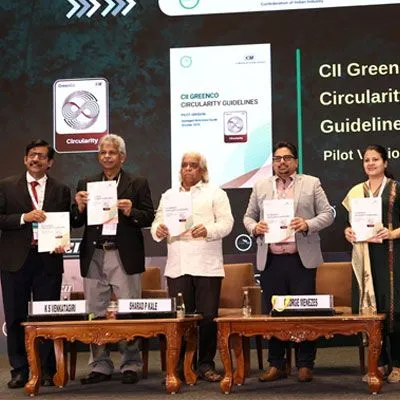
The Confederation of Indian Industry (CII) GreenCo Council has launched the CII GreenCo Circularity Guidelines – Pilot Version at the 17th CII GreenCo Waste & Resource Management Summit 2026 in Chennai. The initiative aims to strengthen resource efficiency, waste reduction and circular economy practices across Indian manufacturing and process industries.The guidelines introduce a structured framework with circularity indices covering raw materials, consumables, packaging and other resource inputs. These indicators will help industries assess existing practices, identify opportunities to ..

Next Story
Infrastructure Energy

Global Electronics Association Launches IPC-1783-CO2E Standard

The Global Electronics Association has introduced IPC-1783-CO2E, a new international standard aimed at improving consistency, transparency and comparability in product carbon footprint reporting across the electronics manufacturing industry.The standard, titled International Standard for Data Collection and Reporting of CO2 Equivalent (CO2e) Emissions for the Electronics Manufacturing Supply Chain, provides industry-specific guidance for collecting, estimating and reporting carbon emissions data.With increasing regulatory requirements and customer expectations, electronics manufacturers face c..

Advertisement

Subscribe to Our Newsletter

Get daily newsletters around different themes from Construction world.

STAY CONNECTED

Advertisement

SPECIAL OFFER
QR Code