+
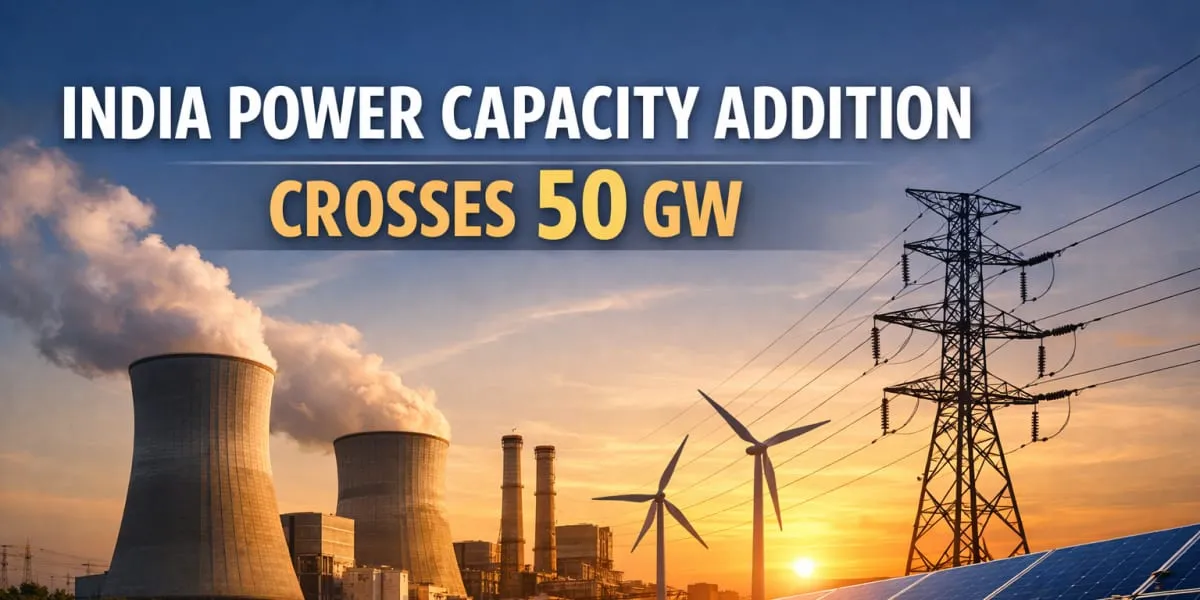
India Power Generation Capacity Addition Crosses 50 GW
POWER & RENEWABLE ENERGY

India Power Generation Capacity Addition Crosses 50 GW

India's power generation capacity addition crossed the 50 gigawatt (GW) mark during the April to January period of the 2025–26 fiscal year, the Ministry of Power said. The advance represents the highest single-year capacity addition on record and surpasses the previous benchmark of 34,054 megawatt (MW) achieved in 2024–25. Official figures show that up to 31 January a total of 52,537 MW of generation capacity from all sources was added. The additions covered utility, captive and distributed generation across regions, reflecting widespread commissioning activity.\n\nRenewable energy contributed the bulk of the increase with 39,657 MW added, including 34,955 MW of solar and 4,613 MW of wind. The renewables additions were driven by accelerated project commissioning and grid integration that increased the pace of new installations. Solar's large share reflected policy support and declining technology costs, while wind contributions improved seasonal balance.\n\nThis implied more than an 11 per cent increase in total installed capacity during 2025–26 up to 31 January. As on 31 January 2026, India's total installed generation capacity stood at 520,510.95 MW, comprising fossil fuel based capacity of 248,541.62 MW and non?fossil capacity of 271,969.33 MW. Nuclear capacity accounted for 8,780 MW while renewable energy sources totalled 263,189.33 MW, indicating that non?fossil generation capacity now exceeds fossil fuel capacity. The reported mix underscores a structural shift in the generation portfolio towards non?fossil sources.\n\nThe ministry said policy support, improved project execution and sustained investment in renewables underpinned the record additions, with particular emphasis on solar and wind. Continued focus on grid stability and evacuation infrastructure was cited as enabling timely commissioning and integration of new capacity. The milestone is expected to inform future planning for capacity augmentation and system operations while supporting the country's transition towards cleaner energy.

India's power generation capacity addition crossed the 50 gigawatt (GW) mark during the April to January period of the 2025–26 fiscal year, the Ministry of Power said. The advance represents the highest single-year capacity addition on record and surpasses the previous benchmark of 34,054 megawatt (MW) achieved in 2024–25. Official figures show that up to 31 January a total of 52,537 MW of generation capacity from all sources was added. The additions covered utility, captive and distributed generation across regions, reflecting widespread commissioning activity.\n\nRenewable energy contributed the bulk of the increase with 39,657 MW added, including 34,955 MW of solar and 4,613 MW of wind. The renewables additions were driven by accelerated project commissioning and grid integration that increased the pace of new installations. Solar's large share reflected policy support and declining technology costs, while wind contributions improved seasonal balance.\n\nThis implied more than an 11 per cent increase in total installed capacity during 2025–26 up to 31 January. As on 31 January 2026, India's total installed generation capacity stood at 520,510.95 MW, comprising fossil fuel based capacity of 248,541.62 MW and non?fossil capacity of 271,969.33 MW. Nuclear capacity accounted for 8,780 MW while renewable energy sources totalled 263,189.33 MW, indicating that non?fossil generation capacity now exceeds fossil fuel capacity. The reported mix underscores a structural shift in the generation portfolio towards non?fossil sources.\n\nThe ministry said policy support, improved project execution and sustained investment in renewables underpinned the record additions, with particular emphasis on solar and wind. Continued focus on grid stability and evacuation infrastructure was cited as enabling timely commissioning and integration of new capacity. The milestone is expected to inform future planning for capacity augmentation and system operations while supporting the country's transition towards cleaner energy.

Next Story
Infrastructure Urban

India Expands Semiconductor Training To 500 Institutions

Under the Chips to Startups programme of the India Semiconductor Mission, the Union minister responsible for Railways, Information and Broadcasting, and Electronics and IT reported notable progress in talent development. He indicated that over the past four years substantial steps have been taken towards a 10-year target of training 85,000 engineers in semiconductor design. World-class EDA tools have been deployed in 315 academic institutions across the country to provide students with practical exposure to chip design. These EDA tools are supported by leading global firms and are accessible t..

Next Story
Infrastructure Urban

Delhi Institutions Support India Semiconductor Mission

The Government of India has prioritised talent development through training, upskilling and workforce development under the Chips to Startups initiative of the India Semiconductor Mission, with officials noting progress in four years towards a 10-year target of training 85,000 engineers in semiconductor design. Electronic design automation tools provided by Synopsys, Cadence, Siemens, Renesas, Ansys and AMD have been deployed in 315 academic institutions, enabling students to gain practical chip design experience. Chips have been fabricated and tested at the Semiconductor Laboratory, Mohali, a..

Next Story
Infrastructure Urban

NHA Announces Winners Of NHCX Hackathon At IIT Hyderabad

The National Health Authority (NHA) has concluded the NHCX Hackathon under the Ayushman Bharat Digital Mission (ABDM) to stimulate innovation around the National Health Claims Exchange (NHCX). The winning teams presented their solutions at the NHCX Innovation Meet held at IIT Hyderabad during a two-day event in March 2026 that also served as the hackathon grand finale. The hackathon itself ran from 22 to 28 February 2026 and aimed to accelerate paperless, transparent claims processing across India. The event was organised with a range of ecosystem partners, including the Insurance Regulatory a..

Advertisement

Subscribe to Our Newsletter

Get daily newsletters around different themes from Construction world.

STAY CONNECTED

Advertisement

Advertisement

Advertisement