Indian Army collaborates with IOCL for green transport solutions
POWER & RENEWABLE ENERGY

Indian Army collaborates with IOCL for green transport solutions

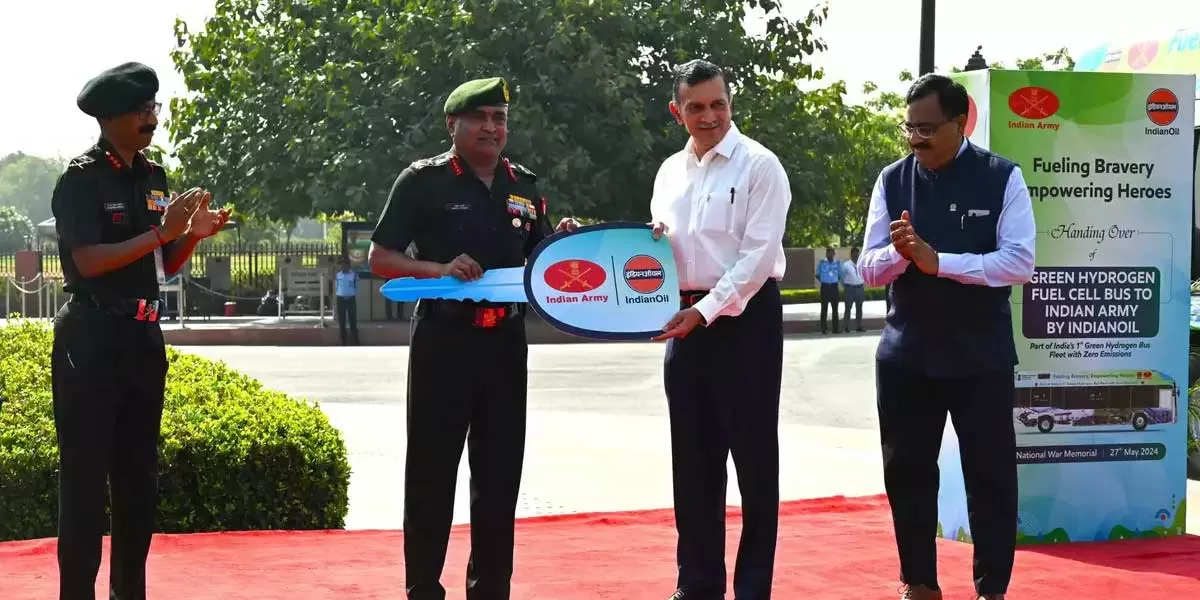
The Indian Army has partnered with the Indian Oil Corporation Limited (IOCL) to introduce green and sustainable transport solutions within the force. A Memorandum of Understanding (MoU) was formalised between the Army and IOCL, with Army Chief Gen Manoj Pande and Shrikant Madhav Vaidya, Indian Oil Chairman presiding over the signing ceremony.

As part of this collaboration, the Indian Army received a hydrogen fuel cell bus during an event held to mark the occasion. This collaboration signals the beginning of a mutually beneficial partnership focused on fostering innovation and promoting sustainable transport solutions for the future, as stated by the defence ministry.

Hydrogen fuel cell technology provides a clean and efficient alternative by converting hydrogen gas into electricity through an electrochemical process, producing only water vapour as a by-product, thereby ensuring zero emissions. The hydrogen fuel cell bus, boasting a seating capacity of 37 passengers, offers an impressive mileage of 250-300 km on a full 30 kg tank of hydrogen fuel.

Last year, on March 21, the Indian Army made history by becoming the first government entity to enter into an MoU with the National Thermal Power Corporation Renewable Energy Ltd for the installation of green hydrogen-based microgrid power plants along the northern borders. A pilot project is currently underway at Chushul, where a 200 Kilowatt green hydrogen-based microgrid will provide 24x7 clean electricity to troops stationed in challenging terrains and extreme weather conditions.

With a strong emphasis on innovation and environmental responsibility, the collaboration between the Indian Army and IOCL in introducing hydrogen fuel cell buses represents a significant leap towards cleaner and greener transport solutions, paving the way for a more sustainable future. (Source: ET Energy)

The Indian Army has partnered with the Indian Oil Corporation Limited (IOCL) to introduce green and sustainable transport solutions within the force. A Memorandum of Understanding (MoU) was formalised between the Army and IOCL, with Army Chief Gen Manoj Pande and Shrikant Madhav Vaidya, Indian Oil Chairman presiding over the signing ceremony. As part of this collaboration, the Indian Army received a hydrogen fuel cell bus during an event held to mark the occasion. This collaboration signals the beginning of a mutually beneficial partnership focused on fostering innovation and promoting sustainable transport solutions for the future, as stated by the defence ministry. Hydrogen fuel cell technology provides a clean and efficient alternative by converting hydrogen gas into electricity through an electrochemical process, producing only water vapour as a by-product, thereby ensuring zero emissions. The hydrogen fuel cell bus, boasting a seating capacity of 37 passengers, offers an impressive mileage of 250-300 km on a full 30 kg tank of hydrogen fuel. Last year, on March 21, the Indian Army made history by becoming the first government entity to enter into an MoU with the National Thermal Power Corporation Renewable Energy Ltd for the installation of green hydrogen-based microgrid power plants along the northern borders. A pilot project is currently underway at Chushul, where a 200 Kilowatt green hydrogen-based microgrid will provide 24x7 clean electricity to troops stationed in challenging terrains and extreme weather conditions. With a strong emphasis on innovation and environmental responsibility, the collaboration between the Indian Army and IOCL in introducing hydrogen fuel cell buses represents a significant leap towards cleaner and greener transport solutions, paving the way for a more sustainable future. (Source: ET Energy)

Next Story
Infrastructure Urban

Jyoti Structures FY26 profit rises 56.5%

Jyoti Structures (JSL) recently reported strong financial results for the quarter and year ended 31 March 2026, driven by disciplined execution, cost management and steady progress across its order book.For Q4 FY2025-26, total income rose 44.2 per cent to Rs 2.41 billion from Rs 1.67 billion in Q4 FY2024-25. EBITDA increased 58.6 per cent to Rs 237 million, while EBITDA margin improved by 89 basis points to 9.84 per cent. Profit before tax grew 53.3 per cent to Rs 188.5 million, and net profit rose 51.9 per cent to Rs 181.4 million.For FY2025-26, total income grew 53.1 per cent to Rs 7.72 bill..

Next Story
Infrastructure Energy

Cat BEPU to Power Doppstadt Separator at IFAT 2026

Caterpillar’s Cat Battery Electric Power Unit (BEPU) has been selected by Doppstadt to power its SWS 6 Spiral Shaft Separator, which will be showcased for the first time at IFAT 2026 in Munich, Germany, from 4–7 May.The compact plug-and-play BEPU is designed to replace a diesel engine within the same space, using the same mounting locations and relative machine position. It integrates the battery, motor, inverter, onboard charging, cooling and controls, enabling OEMs to electrify existing chassis platforms without extensive redesign.Caterpillar and Cat dealer Zeppelin Power Systems have be..

Next Story
Infrastructure Urban

VECV sales rise 6.9% in April 2026

VE Commercial Vehicles, a joint venture between Volvo Group and Eicher Motors, recorded sales of 7,318 units in April 2026, compared to 6,846 units in April 2025, registering 6.9 per cent growth. The total included 7,159 units under the Eicher brand and 159 units under the Volvo brand.Eicher branded trucks and buses reported sales of 7,159 units during the month, up 6.6 per cent from 6,717 units in April 2025. In the domestic commercial vehicle market, Eicher sales rose 8.6 per cent to 6,797 units from 6,257 units a year earlier.Exports declined 21.3 per cent, with VECV recording 362 units in ..

Advertisement

Subscribe to Our Newsletter

Get daily newsletters around different themes from Construction world.

STAY CONNECTED

Advertisement

Advertisement

Advertisement