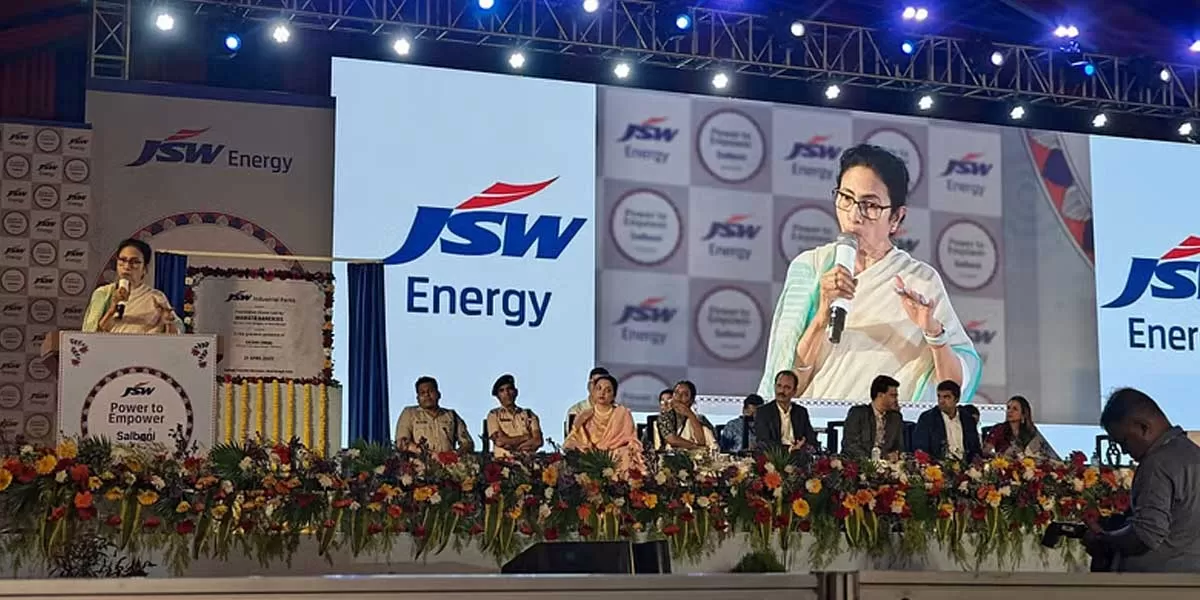
Mamata lays foundation for Rs 160 billion thermal plant in Salboni
POWER & RENEWABLE ENERGY

Mamata lays foundation for Rs 160 billion thermal plant in Salboni

West Bengal Chief Minister Mamata Banerjee on Monday laid the foundation stone for a Rs 160 billion ultra-supercritical thermal power plant at Salboni in Paschim Medinipur. Developed by JSW Energy, the 1,600 MW greenfield project marks a major addition to Bengal’s power capacity and industrial roadmap.

The project will include two 800 MW units, with the first expected to be operational in 42 months and the second in 48. Calling it a landmark initiative, Banerjee said the plant would serve 23 districts and generate 15,000 jobs.

“This is the first ultra-supercritical thermal project in Eastern India. It’s a big leap for Bengal,” Banerjee said, adding that the state’s power generation has jumped from 2,000 MW in 2011 to 10,000 MW, with plans to scale up to 18,000 MW.

Banerjee highlighted upcoming projects in Santaldih, Durgapur, and Sagardighi, and said Rs 480 billion will be invested to ramp up capacity. She noted that over Rs 760 billion has already been spent since 2011 to ensure an uninterrupted power supply across the state.

Consumer numbers have more than doubled—from 10.7 million in 2011 to 23 million now—signalling rising demand. To meet this, the state is also banking on the upcoming Deocha-Pachami coal mine, set to be the world’s second-largest.

JSW Group Chairman Sajjan Jindal described Salboni as a “dream project”, saying the plant would use cutting-edge, zero-pollution technology and support Bengal’s energy needs. He also announced a new 2,000-acre industrial park near the site and committed to setting up a skill training centre, a move welcomed by the CM.

Reiterating Bengal’s investor appeal, Banerjee said the new Synergy Committee has already cleared Rs 10 billion worth of proposals within 15 days. Of the Rs 4.4 trillion proposals received at the last business summit, projects worth Rs 10 billion are in progress, while Rs 13 trillion out of Rs 19 trillion proposed investments have been implemented.

She said 3.5 lakh km of electricity lines and 750 substations have been added, and six economic corridors are being developed. In Purulia’s Raghunathpur, Rs 720 billion worth of investment is underway, with five large companies setting up units.

Addressing critics, Banerjee said, “You can criticise me, but you can’t ignore what Bengal is achieving. We do things the right way.” She also called for unity and inclusiveness, saying India’s strength lies in its diversity.

Image source:www.deccanherald.com


West Bengal Chief Minister Mamata Banerjee on Monday laid the foundation stone for a Rs 160 billion ultra-supercritical thermal power plant at Salboni in Paschim Medinipur. Developed by JSW Energy, the 1,600 MW greenfield project marks a major addition to Bengal’s power capacity and industrial roadmap. The project will include two 800 MW units, with the first expected to be operational in 42 months and the second in 48. Calling it a landmark initiative, Banerjee said the plant would serve 23 districts and generate 15,000 jobs. “This is the first ultra-supercritical thermal project in Eastern India. It’s a big leap for Bengal,” Banerjee said, adding that the state’s power generation has jumped from 2,000 MW in 2011 to 10,000 MW, with plans to scale up to 18,000 MW. Banerjee highlighted upcoming projects in Santaldih, Durgapur, and Sagardighi, and said Rs 480 billion will be invested to ramp up capacity. She noted that over Rs 760 billion has already been spent since 2011 to ensure an uninterrupted power supply across the state. Consumer numbers have more than doubled—from 10.7 million in 2011 to 23 million now—signalling rising demand. To meet this, the state is also banking on the upcoming Deocha-Pachami coal mine, set to be the world’s second-largest. JSW Group Chairman Sajjan Jindal described Salboni as a “dream project”, saying the plant would use cutting-edge, zero-pollution technology and support Bengal’s energy needs. He also announced a new 2,000-acre industrial park near the site and committed to setting up a skill training centre, a move welcomed by the CM. Reiterating Bengal’s investor appeal, Banerjee said the new Synergy Committee has already cleared Rs 10 billion worth of proposals within 15 days. Of the Rs 4.4 trillion proposals received at the last business summit, projects worth Rs 10 billion are in progress, while Rs 13 trillion out of Rs 19 trillion proposed investments have been implemented. She said 3.5 lakh km of electricity lines and 750 substations have been added, and six economic corridors are being developed. In Purulia’s Raghunathpur, Rs 720 billion worth of investment is underway, with five large companies setting up units. Addressing critics, Banerjee said, “You can criticise me, but you can’t ignore what Bengal is achieving. We do things the right way.” She also called for unity and inclusiveness, saying India’s strength lies in its diversity.Image source:www.deccanherald.com

Related Stories

Gold Stories

Next Story
Infrastructure Urban

KONE Opens India's First Digital Experience Centre in Pune

KONE, a global elevator and escalator manufacturer, has inaugurated its first Digital Experience Centre (DEC) in India, located in Pune. The facility aims to showcase how artificial intelligence (AI), connectivity and data-driven technologies can enhance customer experiences and improve building operations.The centre was inaugurated by Jussi Herlin, Executive Vice Chair, KONE Corporation; Philippe Delorme, President and CEO, KONE; and Nandan Nilekani, Co-founder and Chairman of the Board, Infosys.Designed as an interactive customer environment, the facility demonstrates digital solutions cover..

Next Story
Infrastructure Urban

CII GreenCo Launches Circularity Guidelines for Indian Industry

The Confederation of Indian Industry (CII) GreenCo Council has launched the CII GreenCo Circularity Guidelines – Pilot Version at the 17th CII GreenCo Waste & Resource Management Summit 2026 in Chennai. The initiative aims to strengthen resource efficiency, waste reduction and circular economy practices across Indian manufacturing and process industries.The guidelines introduce a structured framework with circularity indices covering raw materials, consumables, packaging and other resource inputs. These indicators will help industries assess existing practices, identify opportunities to ..

Next Story
Infrastructure Energy

Global Electronics Association Launches IPC-1783-CO2E Standard

The Global Electronics Association has introduced IPC-1783-CO2E, a new international standard aimed at improving consistency, transparency and comparability in product carbon footprint reporting across the electronics manufacturing industry.The standard, titled International Standard for Data Collection and Reporting of CO2 Equivalent (CO2e) Emissions for the Electronics Manufacturing Supply Chain, provides industry-specific guidance for collecting, estimating and reporting carbon emissions data.With increasing regulatory requirements and customer expectations, electronics manufacturers face c..

Advertisement

Subscribe to Our Newsletter

Get daily newsletters around different themes from Construction world.

STAY CONNECTED

Advertisement

SPECIAL OFFER
QR Code