+
Mumbai Strengthens Grid With Kudus-Aarey HVDC Corridor
POWER & RENEWABLE ENERGY

Mumbai Strengthens Grid With Kudus-Aarey HVDC Corridor

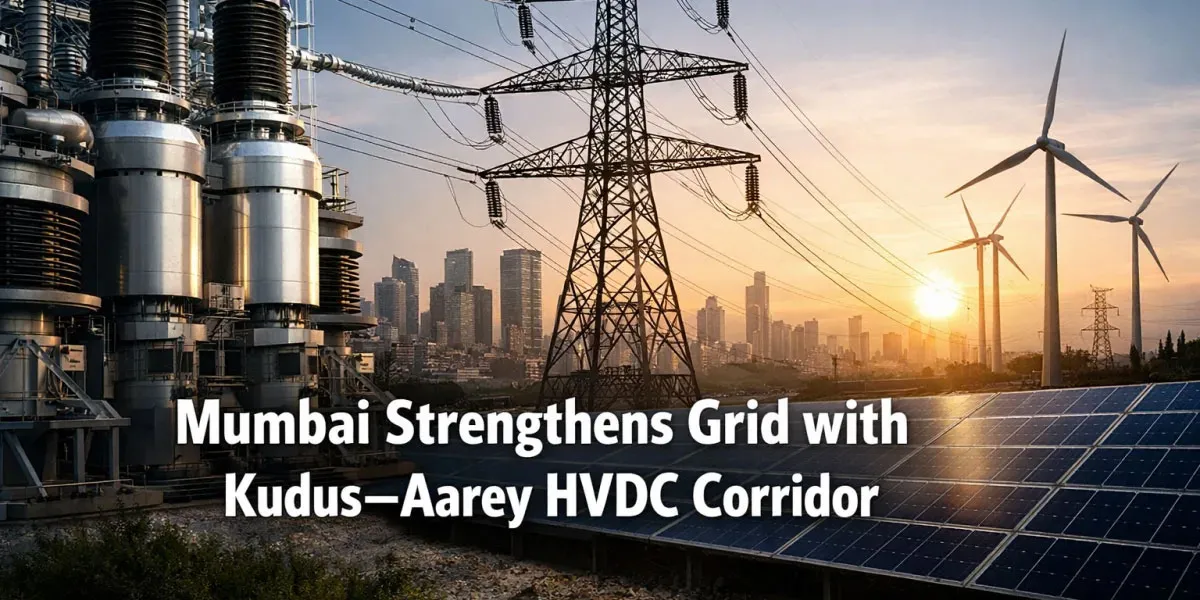
Mumbai will receive an additional 1,000 megawatts (MW) of renewable electricity following completion of the Kudus–Aarey High Voltage Direct Current (HVDC) transmission corridor, a major infrastructure project developed by Adani Energy Solutions Ltd (AESL). The corridor is intended to strengthen the city’s power supply and support its clean energy transition by enabling large imports of green power. The project will allow Mumbai to access renewable generation from power?rich states such as Gujarat and Rajasthan.

Built using 320 kV Voltage Source Converter (VSC) HVDC technology, the corridor spans approximately 80 kilometres and combines overhead transmission lines with extensive underground cabling through densely populated urban zones. The HVDC arrangement gives precise control of power flow and improved voltage stability, while reducing transmission losses compared with legacy alternating current links. These technical features are intended to improve grid reliability for a high?demand metropolitan network.

City officials report that electricity demand is projected to exceed 4,500 MW in the near term, driven by rapid urban growth, commercial expansion and increasing electric vehicle adoption. The Kudus–Aarey link is scheduled to become operational by March 2026 and is designed to help meet rising demand while reducing dependence on fossil fuel?based generation. Its commissioning follows the Kharghar–Vikhroli transmission line, which in 2023 added another 1,000 MW to Mumbai’s grid, creating a more resilient backbone for energy security.

The project was awarded to AESL under the Tariff?Based Competitive Bidding mechanism, with REC Power Development & Consultancy Ltd. serving as bid process coordinator. Industry specialists say the corridor will play a central role in integrating additional renewable energy into Mumbai’s supply mix and in supporting long?term sustainability targets. The installation is expected to contribute to improved reliability and to lower system losses as the city transitions towards cleaner sources.

Mumbai will receive an additional 1,000 megawatts (MW) of renewable electricity following completion of the Kudus–Aarey High Voltage Direct Current (HVDC) transmission corridor, a major infrastructure project developed by Adani Energy Solutions Ltd (AESL). The corridor is intended to strengthen the city’s power supply and support its clean energy transition by enabling large imports of green power. The project will allow Mumbai to access renewable generation from power?rich states such as Gujarat and Rajasthan. Built using 320 kV Voltage Source Converter (VSC) HVDC technology, the corridor spans approximately 80 kilometres and combines overhead transmission lines with extensive underground cabling through densely populated urban zones. The HVDC arrangement gives precise control of power flow and improved voltage stability, while reducing transmission losses compared with legacy alternating current links. These technical features are intended to improve grid reliability for a high?demand metropolitan network. City officials report that electricity demand is projected to exceed 4,500 MW in the near term, driven by rapid urban growth, commercial expansion and increasing electric vehicle adoption. The Kudus–Aarey link is scheduled to become operational by March 2026 and is designed to help meet rising demand while reducing dependence on fossil fuel?based generation. Its commissioning follows the Kharghar–Vikhroli transmission line, which in 2023 added another 1,000 MW to Mumbai’s grid, creating a more resilient backbone for energy security. The project was awarded to AESL under the Tariff?Based Competitive Bidding mechanism, with REC Power Development & Consultancy Ltd. serving as bid process coordinator. Industry specialists say the corridor will play a central role in integrating additional renewable energy into Mumbai’s supply mix and in supporting long?term sustainability targets. The installation is expected to contribute to improved reliability and to lower system losses as the city transitions towards cleaner sources.

Next Story
Infrastructure Energy

Jyoti Structures expands manufacturing capacity in Nashik

The announcement Jyoti Structures (JSL) reported steady operational performance in 2025, supported by stable project execution across its power transmission portfolio. The company commissioned galvanisation operations at its second Nashik manufacturing unit, adding 33,000 MT of annual capacity. This increased aggregate tower manufacturing capability at Nashik to approximately 69,000 MT per annum, aimed at improving fabrication accuracy, scheduling control and delivery predictability. JSL also expanded its workforce to over 750 employees, onboarding more than 70 engineers during the year. C..

Next Story
Infrastructure Energy

TSPL Mega Health Camp Reaches 338 Residents in Mansa

Talwandi Sabo Power (TSPL), Punjab’s largest and North India’s largest private thermal power plant, organised a Mega Health Camp at Village Raipur, Mansa, under its flagship healthcare initiative Project SEHAT. The camp benefitted 338 community members through free consultations and diagnostic services.A team comprising a General Physician, Gynaecologist, Dermatologist and Dentist provided medical advice and treatment. Beneficiaries received free diagnostic tests including BP, HB, blood sugar, malaria, dengue and blood group tests, along with free medicines.The camp was inaugurated by Vill..

Next Story
Infrastructure Transport

Mumbai Coastal Road Musical Path Plays Jai Ho

Mumbai inaugurated India’s first musical path on the Coastal Road that plays the song Jai Ho for motorists. The civic administration said the installation used Hungarian technology and that the intention was to implement the concept of Sangeet Marg in future projects. A senior official suggested implementing a pilot on the Samruddhi Expressway, which connects Mumbai and Nagpur. City officials described the inauguration as a symbolic demonstration of collaboration between municipal authorities and foreign partners. The inauguration was attended by the Consul General of Hungary Ferenc Jari, f..

Advertisement

Subscribe to Our Newsletter

Get daily newsletters around different themes from Construction world.

STAY CONNECTED

Advertisement

Advertisement

Advertisement

Open In App