Next-Gen Material Enables Efficient Energy Storage And Green Hydrogen
POWER & RENEWABLE ENERGY

Next-Gen Material Enables Efficient Energy Storage And Green Hydrogen

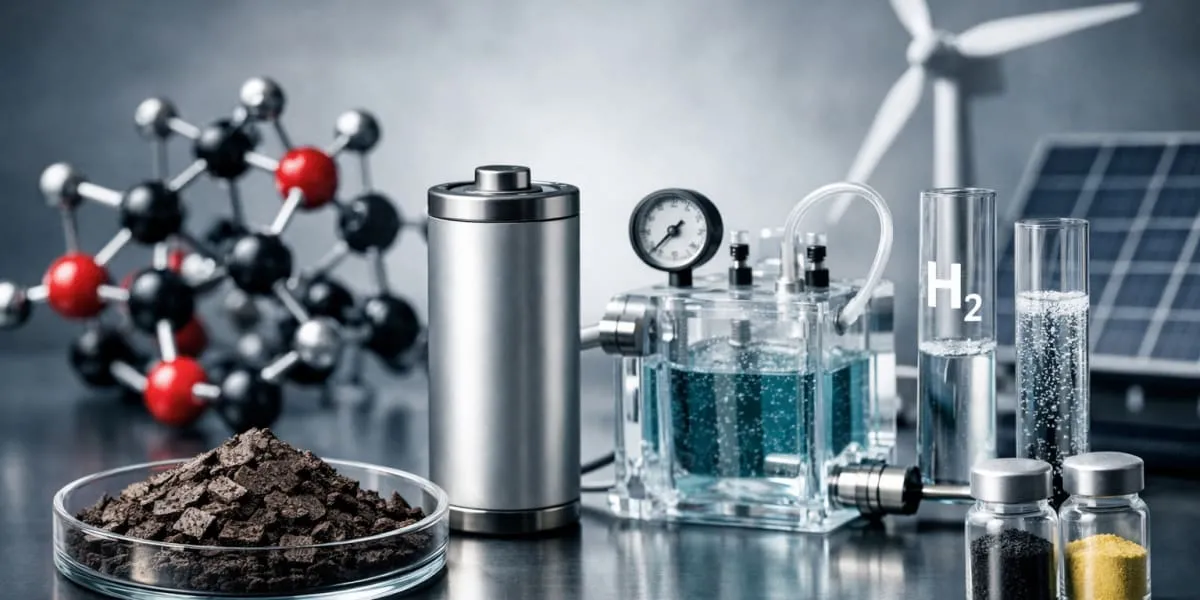
A team at the Centre for Nano and Soft Matter Sciences (CeNS) of the Department of Science and Technology (DST), with CHRIST (Deemed to be University), Bengaluru, has reported polymeric materials that could transform clean energy technologies. The study describes two coordination polymers, Zn(DAB) and Cd(DAB), formed from zinc or cadmium ions and 3,3'-diaminobenzidine that assemble into layered frameworks. The materials can be synthesised at room temperature in large quantities without complex equipment, which supports scale up.

The team tested the polymers for storing energy and producing hydrogen. In laboratory three electrode evaluations the materials showed high specific capacitances of 2091.4 F g-1 for Zn(DAB) and 1341.6 F g-1 for Cd(DAB). In asymmetric supercapacitor configurations Zn(DAB) reached 785.3 F g-1 while Cd(DAB) achieved 428.5 F g-1. The materials retained much of their capacity after 5000 continuous charge discharge cycles, indicating durability.

The polymers also acted as electrocatalysts for water splitting to generate hydrogen, requiring overpotentials of 263 mV for Zn(DAB) and 209 mV for Cd(DAB). These relatively low energy requirements make the materials competitive with leading catalysts and suggest potential to lower the cost of green hydrogen production. The combination of energy storage and hydrogen generation in a single material sets these coordination polymers apart from many single purpose alternatives.

The findings were published in ACS Omega and Catalysis Science and Technology and were authored by Samika Anand, Abhishek Kumar, Dr C. V. Yelamaggad and Dr Sunaja Devi K. R. The researchers noted that scalable synthesis combined with robust device level performance could bridge laboratory advances and practical deployment. Further work will need to demonstrate long term operation in integrated systems and to assess cost implications for commercial use.

A team at the Centre for Nano and Soft Matter Sciences (CeNS) of the Department of Science and Technology (DST), with CHRIST (Deemed to be University), Bengaluru, has reported polymeric materials that could transform clean energy technologies. The study describes two coordination polymers, Zn(DAB) and Cd(DAB), formed from zinc or cadmium ions and 3,3'-diaminobenzidine that assemble into layered frameworks. The materials can be synthesised at room temperature in large quantities without complex equipment, which supports scale up. The team tested the polymers for storing energy and producing hydrogen. In laboratory three electrode evaluations the materials showed high specific capacitances of 2091.4 F g-1 for Zn(DAB) and 1341.6 F g-1 for Cd(DAB). In asymmetric supercapacitor configurations Zn(DAB) reached 785.3 F g-1 while Cd(DAB) achieved 428.5 F g-1. The materials retained much of their capacity after 5000 continuous charge discharge cycles, indicating durability. The polymers also acted as electrocatalysts for water splitting to generate hydrogen, requiring overpotentials of 263 mV for Zn(DAB) and 209 mV for Cd(DAB). These relatively low energy requirements make the materials competitive with leading catalysts and suggest potential to lower the cost of green hydrogen production. The combination of energy storage and hydrogen generation in a single material sets these coordination polymers apart from many single purpose alternatives. The findings were published in ACS Omega and Catalysis Science and Technology and were authored by Samika Anand, Abhishek Kumar, Dr C. V. Yelamaggad and Dr Sunaja Devi K. R. The researchers noted that scalable synthesis combined with robust device level performance could bridge laboratory advances and practical deployment. Further work will need to demonstrate long term operation in integrated systems and to assess cost implications for commercial use.

Next Story
Real Estate

Vestian reports 36% drop in construction activity in Q1

Vestian reported a 36 per cent quarter-on-quarter decline in new office completions to 9.7 million sq ft in Q1 2026, marking the lowest level in the past four quarters amid the West Asia crisis.The slowdown was led by cities such as Bengaluru, Hyderabad and Mumbai, where developers adopted a cautious approach. Hyderabad saw the steepest drop, with completions falling 95 per cent to 0.3 million sq ft from 6.0 million sq ft in the previous quarter.Despite constrained supply, office absorption rose 20 per cent year-on-year to 21.53 million sq ft, driven by sustained demand from global capability ..

Next Story
Real Estate

fäm Properties reports 95% sales in Dubai 2026 supply

Data from DXBinteract shows that 41,015 of 43,217 units due this year have already been sold. Across the 2026–2029 pipeline, 71.45 per cent of 426,182 units have been committed, indicating sustained absorption levels.The analysis highlights strong demand across leading developers, with several reporting near or full sell-outs. Emaar and Meraas have sold over 99 per cent of their 2026 inventory, while Dubai Holding and Meydan projects are fully sold.Commenting on the trend, Firas Al Msaddi, CEO, fam Properties, said, “Dubai continues to demonstrate a level of forward demand that is structur..

Next Story
Equipment

EKKI Pumps launches Hori-Max sump pump range

EKKI Pumps has launched its Hori-Max range of horizontal multistage sump submersible pumps at Plumbex 2026 in Bengaluru.The new range, comprising Hori-Max S, Hori-Max SVR and Hori-Max M series, is designed for water transfer and boosting applications across residential, commercial, infrastructure and agricultural segments.The pumps feature a multistage horizontal design with high-efficiency components, including FG 250 cast iron diffusers and stainless steel impellers, enabling consistent pressure and improved hydraulic performance. A key capability is operation in shallow water conditions, wi..

Advertisement

Subscribe to Our Newsletter

Get daily newsletters around different themes from Construction world.

STAY CONNECTED

Advertisement

Advertisement

Advertisement