Power Ministry Extends Deadline For Draft NEP 2026 Feedback Till Mar 19
POWER & RENEWABLE ENERGY

Power Ministry Extends Deadline For Draft NEP 2026 Feedback Till Mar 19

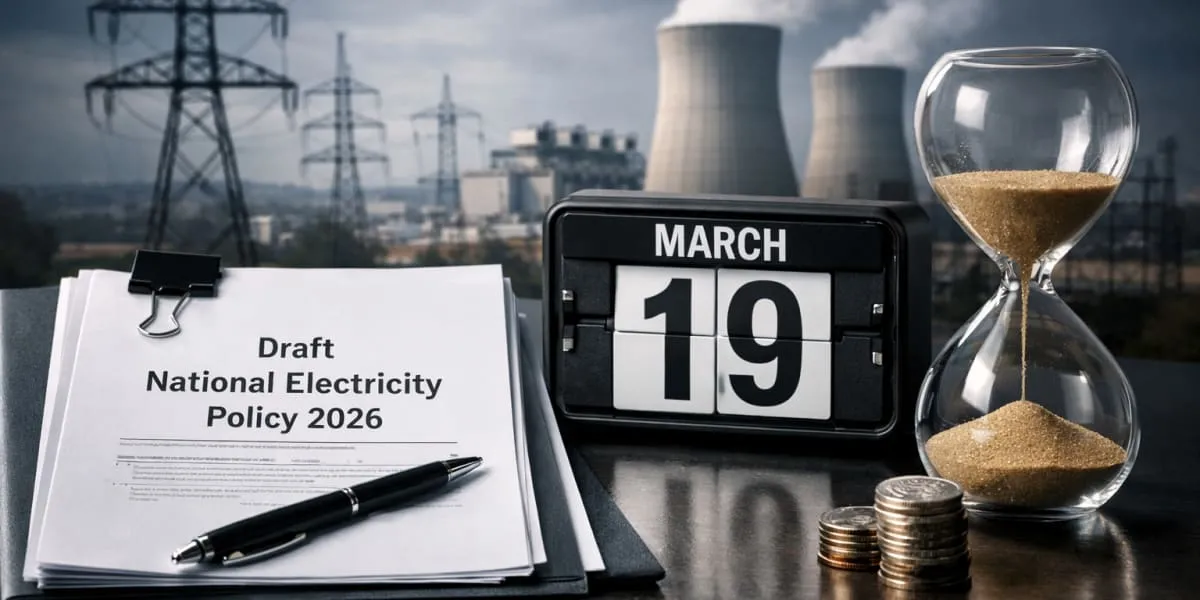
The Ministry of Power has extended the timeline for submissions on the Draft National Electricity Policy 2026 by one month, with the new deadline set at 19 March. The extension followed requests from several stakeholders for additional time to examine the provisions of the draft. The ministry issued a notification dated 25 February to communicate the revised schedule.

The draft policy aims to tackle persistent problems in the power sector, notably high losses and debt of distribution companies and tariffs that are not cost reflective, as well as significant cross-subsidisation. A non-cost-reflective tariff was described in the notification as a pricing structure in which the rate charged to a particular consumer category is below the utility's average cost of supplying electricity to that category. The policy document is intended to promote measures that reduce fiscal stress and improve financial sustainability.

The ministry's explanation of cross-subsidisation noted that certain consumer groups such as industrial, commercial and higher-income domestic users are charged tariffs above the cost of supply to offset lower tariffs offered to agricultural consumers and low-income households. The draft sets out measures to address these distortions while safeguarding vulnerable consumers through targeted interventions. Stakeholders were invited to submit comments and suggestions to inform the final policy.

The draft also seeks to foster competition, ensure grid resilience to integrate higher shares of variable renewable energy and provide consumer-centric services with demand-side interventions, according to the ministry. The reform push is being pursued despite several achievements since 2005, with the ministry highlighting that challenges persist in the distribution segment. Interested parties now have until 19 March to provide feedback to the ministry.

The Ministry of Power has extended the timeline for submissions on the Draft National Electricity Policy 2026 by one month, with the new deadline set at 19 March. The extension followed requests from several stakeholders for additional time to examine the provisions of the draft. The ministry issued a notification dated 25 February to communicate the revised schedule. The draft policy aims to tackle persistent problems in the power sector, notably high losses and debt of distribution companies and tariffs that are not cost reflective, as well as significant cross-subsidisation. A non-cost-reflective tariff was described in the notification as a pricing structure in which the rate charged to a particular consumer category is below the utility's average cost of supplying electricity to that category. The policy document is intended to promote measures that reduce fiscal stress and improve financial sustainability. The ministry's explanation of cross-subsidisation noted that certain consumer groups such as industrial, commercial and higher-income domestic users are charged tariffs above the cost of supply to offset lower tariffs offered to agricultural consumers and low-income households. The draft sets out measures to address these distortions while safeguarding vulnerable consumers through targeted interventions. Stakeholders were invited to submit comments and suggestions to inform the final policy. The draft also seeks to foster competition, ensure grid resilience to integrate higher shares of variable renewable energy and provide consumer-centric services with demand-side interventions, according to the ministry. The reform push is being pursued despite several achievements since 2005, with the ministry highlighting that challenges persist in the distribution segment. Interested parties now have until 19 March to provide feedback to the ministry.

Related Stories

Gold Stories

Next Story
Resources

Schindler named among Forbes’ World’s Best Employers 2026

Schindler has been named among Forbes’ World’s Best Employers 2026, a global ranking recognising companies for their workplace environments.Compiled by Forbes in partnership with Statista, the ranking is based on independent employee feedback, including whether employees would recommend their organisation to friends and family.The company said the recognition reflected its focus on creating a workplace where employees can develop their expertise and build careers. ..

Next Story
Infrastructure Urban

India needs an export-execution mindset: Vishesh Jain

Interview with Vishesh Jain, Founder & CEO, EximpleWhat gaps in India’s global trade ecosystem led you to build Eximple, and what problem did you see businesses struggling with most?Eximple came out of a problem that all three founders had seen from different choke points in the trade ecosystem. India has millions of MSMEs and manufacturers, and many of them can make products that are genuinely competitive on quality. Yet only a small fraction is able to build meaningful international businesses. In our experience, the gap is usually not manufacturing capability; it is the ability to exe..

Next Story
Building Material

Nuvoco reports 13.5% revenue growth in Q2 FY27

Nuvoco Vistas Corp. Ltd. reported consolidated revenue of Rs 27.9 billion for Q2 FY27, up 13.5% year on year. Cement sales volume rose 9% to 4.7 million tonnes (MMT), while EBITDA increased 11% to Rs 4.11 billion.The company said it began its cement operations in 2014 with a 2.3 MMT per annum (MMTPA) operation at Nimbol. It now aims to reach 35 MMTPA of cement capacity by FY28, nearly 15 times its initial capacity. Its portfolio spans cement, ready-mix concrete and modern building materials.On sustainability and cost efficiency, Nuvoco partnered with CleanMax for a 46.4 MW wind-solar hybrid re..

Advertisement

Subscribe to Our Newsletter

Get daily newsletters around different themes from Construction world.

STAY CONNECTED

Advertisement

SPECIAL OFFER
QR Code