Renewable Curtailment Reaches 23 GW Amid Coal Flexibility Limits
POWER & RENEWABLE ENERGY

Renewable Curtailment Reaches 23 GW Amid Coal Flexibility Limits

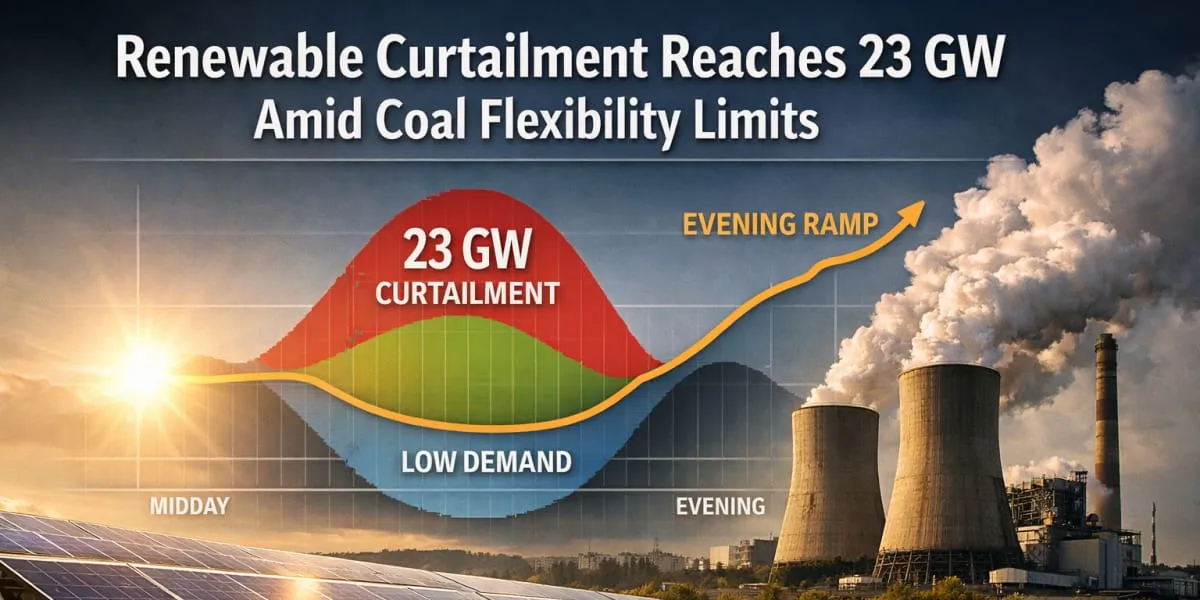
GRID-India told the Central Electricity Authority committee that rising renewable capacity is intensifying the duck curve, with surplus mid-day solar and an evening ramp of nearly 60 GW creating operational strain. Data show peak renewable curtailment of 23 GW between May and November, with significant events on 12 October and nine November. Intra-state thermal units unable to operate at 55 per cent technical minimum load were identified as a key constraint.

GRID-India warned of grid security risks after reporting that in May system frequency remained above the Indian Electricity Grid Code operating band for nearly 20 per cent of the time and that high frequency persisted for almost four hours during solar generation. The permissible band covers 49.900 Hz to 50.050 Hz and excursions beyond that range raise the risk of unstable conditions and equipment stress. Operators have used emergency down dispatch and thermal backing down but challenges persist during peak solar output.

The committee recorded that on 25 May 2025, despite backing down the national thermal fleet to approximately 58 per cent and curtailing nearly 10 GW of solar through TRAS emergency down dispatch, system frequency rose to 50.48 Hz. The data list curtailment above 16 GW on nine November, above 13 GW on 28 September and one June, above 11 GW on 31 May and 10 August, and a minimum of four point six GW on 29 July. Stakeholders are assessing operational and market measures to reduce avoidable curtailment.

As India pursues a target of 500 GW of non-fossil fuel capacity and 50 per cent non-fossil installed capacity by 2030, the CEA has proposed a phased roadmap to enable coal-fired plants to operate at 40 per cent minimum technical load by 2030. The plan includes two-shift thermal operations, battery energy storage systems and expansion of pumped storage projects. GRID-India told the committee that technical progress on 55 per cent Technical Minimum Load among inter-state stations is being limited by commercial and regulatory factors, and that structural reforms will be required alongside technical measures.

GRID-India told the Central Electricity Authority committee that rising renewable capacity is intensifying the duck curve, with surplus mid-day solar and an evening ramp of nearly 60 GW creating operational strain. Data show peak renewable curtailment of 23 GW between May and November, with significant events on 12 October and nine November. Intra-state thermal units unable to operate at 55 per cent technical minimum load were identified as a key constraint. GRID-India warned of grid security risks after reporting that in May system frequency remained above the Indian Electricity Grid Code operating band for nearly 20 per cent of the time and that high frequency persisted for almost four hours during solar generation. The permissible band covers 49.900 Hz to 50.050 Hz and excursions beyond that range raise the risk of unstable conditions and equipment stress. Operators have used emergency down dispatch and thermal backing down but challenges persist during peak solar output. The committee recorded that on 25 May 2025, despite backing down the national thermal fleet to approximately 58 per cent and curtailing nearly 10 GW of solar through TRAS emergency down dispatch, system frequency rose to 50.48 Hz. The data list curtailment above 16 GW on nine November, above 13 GW on 28 September and one June, above 11 GW on 31 May and 10 August, and a minimum of four point six GW on 29 July. Stakeholders are assessing operational and market measures to reduce avoidable curtailment. As India pursues a target of 500 GW of non-fossil fuel capacity and 50 per cent non-fossil installed capacity by 2030, the CEA has proposed a phased roadmap to enable coal-fired plants to operate at 40 per cent minimum technical load by 2030. The plan includes two-shift thermal operations, battery energy storage systems and expansion of pumped storage projects. GRID-India told the committee that technical progress on 55 per cent Technical Minimum Load among inter-state stations is being limited by commercial and regulatory factors, and that structural reforms will be required alongside technical measures.

Next Story
Infrastructure Urban

Lemon Tree Hotels Signs Resort In Lonavala Maharashtra

Lemon Tree Hotels Limited (LTHL) has signed a licence agreement for Lemon Tree Resort in Lonavala, Maharashtra, with the asset to be managed by Carnation Hotels Private Limited, a wholly owned subsidiary of LTHL. The resort will offer 50 well appointed rooms and will include a restaurant, banquet, meeting room, swimming pool, spa and fitness centre. The company described the addition as part of its strategy to expand branded resort offerings in key getaway destinations. Lonavala, located in the Sahyadri hills, is a popular leisure destination in western India known for scenic landscapes and a ..

Next Story
Infrastructure Urban

Kalai Chettinad Art And Architecture Festival At The Lotus Palace

The Lotus Palace Chettinad will host Kalai, the Chettinad Art and Architecture Festival, a four-day, three-night immersive celebration of the artistic legacy of Chettinad from three to six April 2026. The event has been organised by Apeejay Surrendra Park Hotels Limited (ASPHL) and will take place across restored heritage properties in Chettinad. It will be designed to offer guests a layered experience of place, structure and story that connects art, architecture and living traditions. The festival aims to present a confluence of global influences and local aesthetics. Kalai has been curated i..

Next Story
Infrastructure Energy

SJVN Reaches One bn Units At 1,000 MW Bikaner Solar Project

SJVN Limited (SJVN) has reached a milestone with its 1,000 megawatt (MW) Bikaner Solar Power Project by generating one bn units of electricity on 20 March 2026. The achievement underscores the company's role in supplying clean and sustainable energy to the national grid. The generation milestone was recorded within months of the project commencing operations and highlights rapid performance from the new facility. The Bikaner project, located in Bikaner district of Rajasthan, has been developed and implemented by SJVN Green Energy Limited (SGEL) under the Central Public Sector Undertaking Schem..

Advertisement

Subscribe to Our Newsletter

Get daily newsletters around different themes from Construction world.

STAY CONNECTED

Advertisement

Advertisement

Advertisement