Researchers Propose Smart Systems for Ghat Road Safety
POWER & RENEWABLE ENERGY

Researchers Propose Smart Systems for Ghat Road Safety

Researchers presented proposals on road construction, maintenance and traffic safety at the inaugural session of the 85th Indian Roads Congress in Hyderabad, including solar-powered accident alert systems for ghat roads and methods to reduce construction costs.

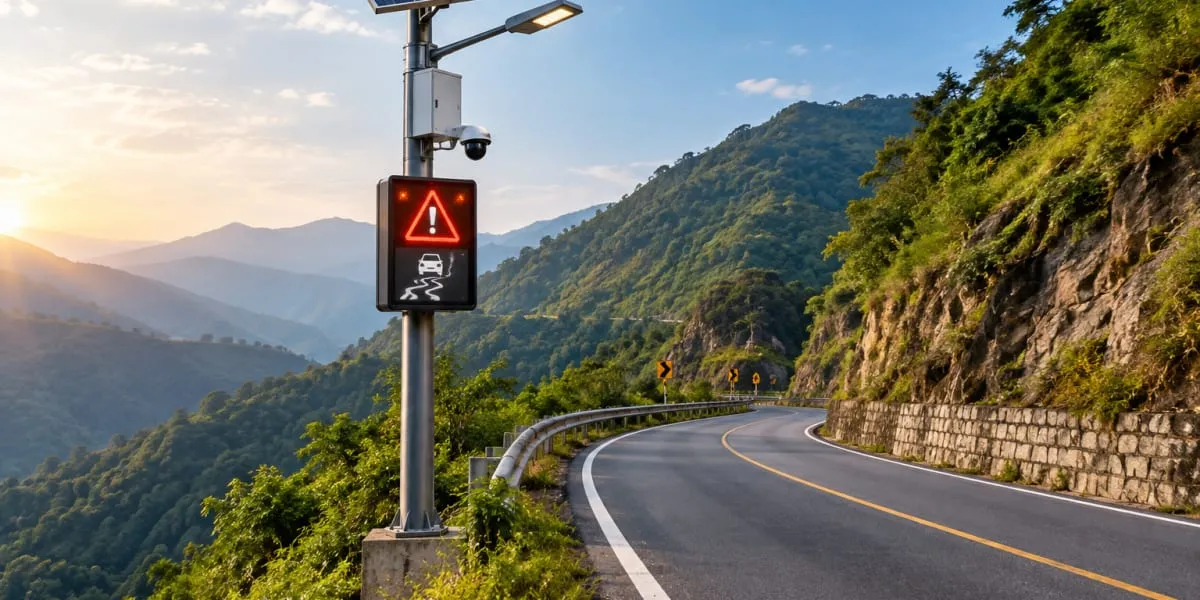
Sudarshan Sampatrao Bobade of Pimpri Chinchwad College of Engineering and Research, Pune, proposed installing smart poles at accident-prone locations along ghat roads. Powered by solar panels and wind turbines, the poles would use surveillance cameras and artificial intelligence-based detection technology to track vehicles travelling between designated points. If a vehicle failed to reach the next monitoring point within the expected time, the system would alert authorities to a possible accident and support rescue operations, including on stretches with poor mobile connectivity.

For urban traffic, Bobade proposed redesigning junctions with separate lanes for vehicles travelling straight and for heavy and light vehicles making U-turns. He also suggested multi-level bridges with separate decks for light vehicles, heavy vehicles and local traffic. Restricting the upper deck to light vehicles could reduce structural loads and construction costs by 35 to 45 per cent, although pilot studies would be needed to establish the proposals’ feasibility.

In another presentation, Suryakant Sahdev of IIT Ropar discussed Full Depth Reclamation (FDR), a road repair technique that reuses existing pavement material instead of replacing the entire road. The process involves breaking down the surface, stabilising the underlying material with cement or other additives, and compacting it as a base for a fresh asphalt or concrete layer.

The study drew on field trials at four locations in Himachal Pradesh’s Hamirpur and Bilaspur districts. Researchers examined four sources of reclaimed road material and tested cement dosages of 4 per cent, 4.5 per cent and 5 per cent by the dry weight of aggregate. The quality and performance of the material varied according to its source and composition, with particle-size distribution alone found insufficient to determine its suitability. Other sessions covered pavement design, recycled asphalt, bridge durability and road foundation compaction. The exhibition featured 401 stalls representing 104 Indian and international companies.

Researchers presented proposals on road construction, maintenance and traffic safety at the inaugural session of the 85th Indian Roads Congress in Hyderabad, including solar-powered accident alert systems for ghat roads and methods to reduce construction costs. Sudarshan Sampatrao Bobade of Pimpri Chinchwad College of Engineering and Research, Pune, proposed installing smart poles at accident-prone locations along ghat roads. Powered by solar panels and wind turbines, the poles would use surveillance cameras and artificial intelligence-based detection technology to track vehicles travelling between designated points. If a vehicle failed to reach the next monitoring point within the expected time, the system would alert authorities to a possible accident and support rescue operations, including on stretches with poor mobile connectivity. For urban traffic, Bobade proposed redesigning junctions with separate lanes for vehicles travelling straight and for heavy and light vehicles making U-turns. He also suggested multi-level bridges with separate decks for light vehicles, heavy vehicles and local traffic. Restricting the upper deck to light vehicles could reduce structural loads and construction costs by 35 to 45 per cent, although pilot studies would be needed to establish the proposals’ feasibility. In another presentation, Suryakant Sahdev of IIT Ropar discussed Full Depth Reclamation (FDR), a road repair technique that reuses existing pavement material instead of replacing the entire road. The process involves breaking down the surface, stabilising the underlying material with cement or other additives, and compacting it as a base for a fresh asphalt or concrete layer. The study drew on field trials at four locations in Himachal Pradesh’s Hamirpur and Bilaspur districts. Researchers examined four sources of reclaimed road material and tested cement dosages of 4 per cent, 4.5 per cent and 5 per cent by the dry weight of aggregate. The quality and performance of the material varied according to its source and composition, with particle-size distribution alone found insufficient to determine its suitability. Other sessions covered pavement design, recycled asphalt, bridge durability and road foundation compaction. The exhibition featured 401 stalls representing 104 Indian and international companies.

Related Stories

Gold Stories

Next Story
Infrastructure Urban

NDMC Approves Five Prakriti Cafés in Three Delhi Parks

The New Delhi Municipal Council (NDMC) approved the setting up of five Prakriti Cafés across three prominent parks in the capital during its council meeting on Tuesday. The locations include Lodhi Garden, Nehru Park and BRICS Garden on Shanti Path. Two cafés will be developed in Lodhi Garden, while two others will come up in Nehru Park. The remaining café is planned for BRICS Garden. The council granted in-principle approval to explore the project under the Build-Operate-Transfer (BOT) model. Under the proposed arrangement, the selected agency will develop the cafés at its own cost and man..

Next Story
Infrastructure Transport

Air India and Airbus to Build India's First Corporate SAF Programme

Air India and Airbus have partnered to develop a framework for India’s first voluntary corporate Sustainable Aviation Fuel (SAF) programme. The feasibility study will examine how businesses can reduce lifecycle emissions associated with air travel by voluntarily supporting the procurement and use of SAF. Jürgen Westermeier, President and Managing Director of Airbus India and South Asia, and P Balaji, Group Head of Governance, Risk and Compliance and Corporate Affairs at Air India, signed the Feasibility Study Agreement. The signing took place in the presence of Rammohan Naidu Kinjarapu, Min..

Next Story
Infrastructure Energy

Indian Companies to Buy US LPG from Four Firms in 2027

Indian state-run oil companies have awarded a joint tender to Saudi Aramco, Chevron, TotalEnergies Trading SA (Totsa) and Vitol for the import of about 2.75 mn t of US liquefied petroleum gas (LPG) in 2027. The contracts are intended to diversify supplies and reduce India’s reliance on the Middle East. Indian Oil, Bharat Petroleum and Hindustan Petroleum floated the tender in September. They sought four very large gas carrier (VLGC) cargoes each month on a delivered basis and one cargo each month on a free-on-board basis from the US. A VLGC typically carries about 46,000 t of LPG, which cons..

Advertisement

Subscribe to Our Newsletter

Get daily newsletters around different themes from Construction world.

STAY CONNECTED

Advertisement

SPECIAL OFFER
QR Code