Uniper, AM Green Seal Landmark Green Ammonia Deal
POWER & RENEWABLE ENERGY

Uniper, AM Green Seal Landmark Green Ammonia Deal

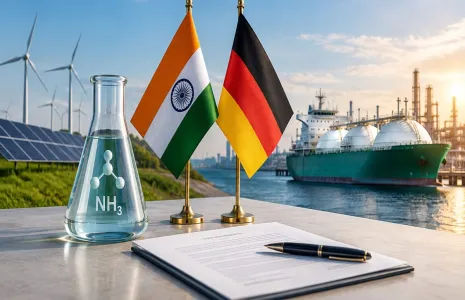
Uniper Global Commodities SE and AM Green Ammonia India Private Limited have signed a long-term, binding offtake agreement for renewable ammonia certified as a Renewable Fuel of Non-Biological Origin (RFNBO), marking the first such agreement for an Indian company.

The agreement was exchanged in Ahmedabad between Uniper chief executive Michael Lewis and AM Green founder and group chairman Anil Kumar Chalamalasetty, in the presence of Narendra Modi and German Chancellor Friedrich Merz.

Under the agreement, Uniper will offtake up to 500,000 tonnes of green ammonia per year from AM Green’s projects. The first shipments are expected as early as 2028 from AM Green’s 1 million tonnes per annum plant currently under construction in Kakinada, Andhra Pradesh. The deal is seen as a key milestone in India’s ambition to emerge as a major exporter of green hydrogen and green ammonia, aligned with the National Green Hydrogen Mission.

For Uniper, the agreement supports its strategy to build a diversified portfolio of renewable and low-carbon molecules for European customers. Renewable ammonia is expected to play a critical role in decarbonising sectors such as chemicals, fertilisers, refining and, over time, shipping, either as a feedstock or as a hydrogen carrier. Both companies said they will work closely with certification bodies to ensure traceability and robust compliance for European end-users.

Chalamalasetty said the partnership marks a milestone for India’s role in the global energy transition, noting that AM Green’s renewable ammonia has been designed to meet stringent European RFNBO standards through firm, dispatchable clean power solutions. Uniper’s Lewis said the agreement helps establish one of the first large-scale green supply corridors between India and Europe, offering competitive decarbonisation at scale.

Mahesh Kolli, co-founder of Greenko Group and AM Green, said the partnership demonstrates the ability to deliver low-carbon hydrogen and ammonia at the right price point for large-scale global adoption. John Roper, chief executive for the Middle East at Uniper Global Commodities, said the agreement shows how aligning supply, certification and demand-side incentives can deliver meaningful emissions reductions for European industry.

AM Green Ammonia is backed by AM Green along with Gentari, GIC and the Abu Dhabi Investment Authority. The company is developing a portfolio of green ammonia plants across Kakinada, Tuticorin and Kandla. The Kakinada project, which achieved final investment decision in 2024, is among a small number of large-scale RFNBO-compliant green ammonia facilities under construction globally. Once fully operational, it is expected to support more than 600 local jobs and avoid around 2 million tonnes of carbon dioxide emissions annually.

Uniper Global Commodities SE and AM Green Ammonia India Private Limited have signed a long-term, binding offtake agreement for renewable ammonia certified as a Renewable Fuel of Non-Biological Origin (RFNBO), marking the first such agreement for an Indian company. The agreement was exchanged in Ahmedabad between Uniper chief executive Michael Lewis and AM Green founder and group chairman Anil Kumar Chalamalasetty, in the presence of Narendra Modi and German Chancellor Friedrich Merz. Under the agreement, Uniper will offtake up to 500,000 tonnes of green ammonia per year from AM Green’s projects. The first shipments are expected as early as 2028 from AM Green’s 1 million tonnes per annum plant currently under construction in Kakinada, Andhra Pradesh. The deal is seen as a key milestone in India’s ambition to emerge as a major exporter of green hydrogen and green ammonia, aligned with the National Green Hydrogen Mission. For Uniper, the agreement supports its strategy to build a diversified portfolio of renewable and low-carbon molecules for European customers. Renewable ammonia is expected to play a critical role in decarbonising sectors such as chemicals, fertilisers, refining and, over time, shipping, either as a feedstock or as a hydrogen carrier. Both companies said they will work closely with certification bodies to ensure traceability and robust compliance for European end-users. Chalamalasetty said the partnership marks a milestone for India’s role in the global energy transition, noting that AM Green’s renewable ammonia has been designed to meet stringent European RFNBO standards through firm, dispatchable clean power solutions. Uniper’s Lewis said the agreement helps establish one of the first large-scale green supply corridors between India and Europe, offering competitive decarbonisation at scale. Mahesh Kolli, co-founder of Greenko Group and AM Green, said the partnership demonstrates the ability to deliver low-carbon hydrogen and ammonia at the right price point for large-scale global adoption. John Roper, chief executive for the Middle East at Uniper Global Commodities, said the agreement shows how aligning supply, certification and demand-side incentives can deliver meaningful emissions reductions for European industry. AM Green Ammonia is backed by AM Green along with Gentari, GIC and the Abu Dhabi Investment Authority. The company is developing a portfolio of green ammonia plants across Kakinada, Tuticorin and Kandla. The Kakinada project, which achieved final investment decision in 2024, is among a small number of large-scale RFNBO-compliant green ammonia facilities under construction globally. Once fully operational, it is expected to support more than 600 local jobs and avoid around 2 million tonnes of carbon dioxide emissions annually.

Next Story
Infrastructure Urban

Implementation Status of Jal Jeevan Mission

Since August 2019 the Government has implemented Jal Jeevan Mission to provide assured potable water through household tap connections in rural India. At the start of the mission only 32.3 million (mn) rural households, representing 16.7 per cent, were reported to have tap water connections. States and union territories have reported that 125.8 mn additional rural households have since been provided with tap connections. As a result, of about 193.6 mn rural households roughly 158.2 mn, or 81.71 per cent, are reported to have tap water supply at home.\n\nThe State, district and village level st..

Next Story
Infrastructure Urban

Jal Jeevan Mission Reaches Eighty One Per Cent Rural Coverage

The Government reported substantial progress under the Jal Jeevan Mission, launched in August 2019 to provide tap water to every rural household. At launch only 32.3 million (mn) rural households had tap connections and states and Union territories reported provision of 125.8 mn additional households by March 2026. Consequently, out of about 193.6 mn rural households around 158.2 mn, or 81.71 per cent, are reported to have tap water at home. The Finance Minister announced extension of the mission until 2028 in the 2025-26 budget speech. The Swachh Bharat Mission Grameen, launched in October 20..

Next Story
Infrastructure Urban

Empowering Local Governance for Sustainable Rural Water Supply

The Ministry of Jal Shakti has aligned the Jal Jeevan Mission (JJM) with the 73rd Amendment to strengthen village level planning and community ownership of water supply. Gram Panchayats, village water and sanitation committees and Pani Samitis are to plan, implement, manage and maintain piped water systems, with gram sabha processes formalising handover and oversight. Implementation support agencies including non government organisations, community based organisations and self help groups have been empanelled to train local committees and promote women participation. Under JJM, the department ..

Advertisement

Subscribe to Our Newsletter

Get daily newsletters around different themes from Construction world.

STAY CONNECTED

Advertisement

Advertisement

Advertisement