+
Uttar Pradesh Plans Rs. 385.2 bn Transmission Buildout for Renewable Power
POWER & RENEWABLE ENERGY

Uttar Pradesh Plans Rs. 385.2 bn Transmission Buildout for Renewable Power

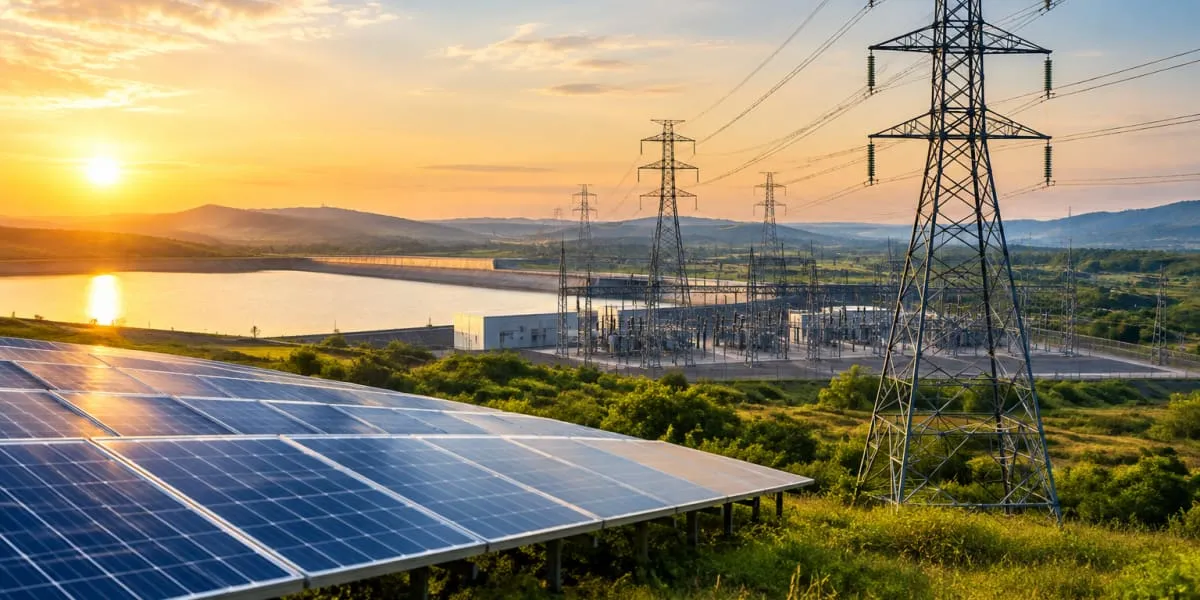
Uttar Pradesh is planning a major expansion of its transmission network to evacuate 8.25 GW of renewable power under the Green Energy Corridor programmes. The state’s revised five-year roadmap includes infrastructure for 4,600 MW of solar capacity and 3,650 MW of pumped-storage capacity. The revised Green Energy Corridor III (GEC-III) scheme, including a proposed 765 kV Mirzapur pooling station, has been approved by the Central Electricity Authority, according to a submission to the Uttar Pradesh Electricity Regulatory Commission.

The plan also identifies 4,000 MW of additional solar evacuation under Green Energy Corridor II (GEC-II). Uttar Pradesh Power Corporation (UPPCL) has proposed augmenting substations and transmission lines for this capacity, with the works estimated to cost Rs. 20.69 bn. Solar capacity in the state increased from 39.94 MW in FY2020-21 to 8,131.76 MW in FY2025-26, according to the regulatory order.

Bundelkhand is a key focus of the renewable-energy transmission programme. The plan includes 3,200 MW of renewable-energy-source bulk solar parks and 1,400 MW of distributed solar generation plants in the region. Transmission planning is also being undertaken to support the transfer of power from about 4,000 MW of renewable-energy projects being developed under the Green Energy Corridor framework.

The inclusion of pumped storage alongside solar reflects a broader effort to integrate variable generation with storage-backed electricity. The five-year plan also addresses rising demand, with peak power requirement projected to increase from 32,002 MW in FY2025-26 to 42,820 MW by FY2030-31. Including demand from the Integrated Manufacturing and Logistics Cluster, Awas Vikas and the Lucknow Development Authority, the projected requirement reaches 43,247 MW.

To support the expansion, the plan provides for 137 new substations with combined transformation capacity of 90,150 MVA and 13,649 circuit km of transmission lines through FY2030-31. The total network is expected to reach 850 substations, 294,150 MVA and 75,729 circuit km. Proposed transmission capital expenditure is Rs. 77.61 bn for FY2026-27, while total five-year investment is estimated at Rs. 385.2 bn. The regulator has instructed the transmission utility to monitor implementation closely after several earlier schemes were deferred or dropped.

Uttar Pradesh is planning a major expansion of its transmission network to evacuate 8.25 GW of renewable power under the Green Energy Corridor programmes. The state’s revised five-year roadmap includes infrastructure for 4,600 MW of solar capacity and 3,650 MW of pumped-storage capacity. The revised Green Energy Corridor III (GEC-III) scheme, including a proposed 765 kV Mirzapur pooling station, has been approved by the Central Electricity Authority, according to a submission to the Uttar Pradesh Electricity Regulatory Commission. The plan also identifies 4,000 MW of additional solar evacuation under Green Energy Corridor II (GEC-II). Uttar Pradesh Power Corporation (UPPCL) has proposed augmenting substations and transmission lines for this capacity, with the works estimated to cost Rs. 20.69 bn. Solar capacity in the state increased from 39.94 MW in FY2020-21 to 8,131.76 MW in FY2025-26, according to the regulatory order. Bundelkhand is a key focus of the renewable-energy transmission programme. The plan includes 3,200 MW of renewable-energy-source bulk solar parks and 1,400 MW of distributed solar generation plants in the region. Transmission planning is also being undertaken to support the transfer of power from about 4,000 MW of renewable-energy projects being developed under the Green Energy Corridor framework. The inclusion of pumped storage alongside solar reflects a broader effort to integrate variable generation with storage-backed electricity. The five-year plan also addresses rising demand, with peak power requirement projected to increase from 32,002 MW in FY2025-26 to 42,820 MW by FY2030-31. Including demand from the Integrated Manufacturing and Logistics Cluster, Awas Vikas and the Lucknow Development Authority, the projected requirement reaches 43,247 MW. To support the expansion, the plan provides for 137 new substations with combined transformation capacity of 90,150 MVA and 13,649 circuit km of transmission lines through FY2030-31. The total network is expected to reach 850 substations, 294,150 MVA and 75,729 circuit km. Proposed transmission capital expenditure is Rs. 77.61 bn for FY2026-27, while total five-year investment is estimated at Rs. 385.2 bn. The regulator has instructed the transmission utility to monitor implementation closely after several earlier schemes were deferred or dropped.

Related Stories

Gold Stories

Next Story
Infrastructure Transport

Kopri-Patni Creek Bridge to Improve Thane-Navi Mumbai Connectivity

Road connectivity between Thane and Navi Mumbai is set to receive a boost with the proposed six-lane Kopri-Patni Creek Bridge, which will provide a new route across Thane Creek. The project is intended to create a direct link between the two urban centres and add capacity to the region’s road network. The bridge will connect Kopri in Thane East with Patni in Navi Mumbai. It will begin at Mith Bandar Road in Kopri, about 750 metres from Thane railway station, cross Thane Creek and land near Airoli Knowledge City Road in Navi Mumbai. The project has advanced with Akshya Infra Projects emerging..

Next Story
Infrastructure Urban

Bengaluru Cuts Unaccounted-for Water to 26.5 Per Cent

The Bengaluru Water Supply and Sewerage Board (BWSSB) has reduced unaccounted-for water from nearly 51 per cent in 2013 to 26.5 per cent in 2025, improving efficiency across a metropolitan region of 14 mn people. The reduction has saved nearly 200 mn litres of water a day without requiring equivalent additional capacity. Bengaluru depends primarily on the Cauvery river system, with water transported over 100 km to the city. BWSSB operates six major treatment plants with combined installed capacity of 2,293 MLD and supplies nearly 150 litres per person per day. The Cauvery Water Supply Scheme S..

Next Story
Infrastructure Transport

J&K Government Approves Free Public Transport for Differently-Abled

The Jammu and Kashmir Government has sanctioned free travel for differently-abled persons on public transport, fulfilling a key Budget announcement made in March. The decision was announced on Wednesday and is intended to improve access to essential transport services across the Union Territory. The facility will cover services operated by the Jammu and Kashmir Road Transport Corporation (JKRTC). It will also apply to e-buses operated by Jammu Smart City and Srinagar Smart City, extending the concession across public transport networks in the Jammu and Srinagar areas. The Office of Chief Minis..

Advertisement

Subscribe to Our Newsletter

Get daily newsletters around different themes from Construction world.

STAY CONNECTED

Advertisement

SPECIAL OFFER
QR Code