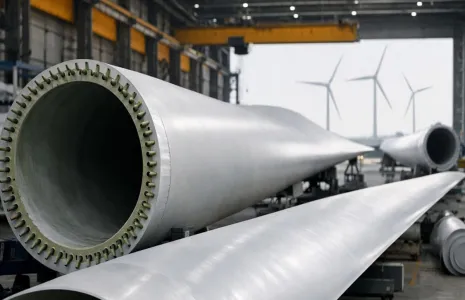
Vayona Energy Signs 702 MW Turbine Deal With Tata Power
POWER & RENEWABLE ENERGY

Vayona Energy Signs 702 MW Turbine Deal With Tata Power

Vayona Energy, a wind turbine original equipment manufacturer active across India and South Asia, has signed a 702 Megawatt (MW) supply agreement with Tata Power Renewable Energy Limited, a subsidiary of The Tata Power Company Limited. Under the agreement Vayona will supply 195 SG 3.6-145 wind turbines for multiple projects in Karnataka, Maharashtra and Tamil Nadu, which are expected to add 702 MW of new wind generation capacity and strengthen Tata Power Renewable Energy's wind portfolio, which now exceeds two Gigawatts (GW) across operational assets and projects under development.

Vayona reported that its three point six GW order book reflected growing market confidence in its three X turbine platform on account of technology reliability and performance under Indian operating conditions. Company executives indicated that production facilities were being ramped up to meet rising demand and to reinforce a commitment to Make in India, noting that more than two GW was installed as of December 2025. Executives added that the three X platform's performance had been validated across diverse wind regimes in India.

The firm said its portfolio exceeded 12 GW across operational and development assets and described the transaction as part of continued expansion in India’s wind sector. The announcement followed a 64.8 MW turbine supply and operation and maintenance contract with Oyster Renewable Energy for a project in Andhra Pradesh earlier in the month. The company framed the transaction as consistent with its strategy to consolidate a market position following the reorganisation of the former Siemens Gamesa onshore business.

The agreement is expected to broaden Tata Power Renewable Energy's project pipeline across the three states and support domestic manufacturing and supply chain development in the renewables sector. Market analysts commented that the deal could accelerate wind capacity additions and reinforce competition among turbine suppliers in the region. Analysts noted the order could prompt rivals to accelerate their own manufacturing plans and bids for projects in the region.

Vayona Energy, a wind turbine original equipment manufacturer active across India and South Asia, has signed a 702 Megawatt (MW) supply agreement with Tata Power Renewable Energy Limited, a subsidiary of The Tata Power Company Limited. Under the agreement Vayona will supply 195 SG 3.6-145 wind turbines for multiple projects in Karnataka, Maharashtra and Tamil Nadu, which are expected to add 702 MW of new wind generation capacity and strengthen Tata Power Renewable Energy's wind portfolio, which now exceeds two Gigawatts (GW) across operational assets and projects under development. Vayona reported that its three point six GW order book reflected growing market confidence in its three X turbine platform on account of technology reliability and performance under Indian operating conditions. Company executives indicated that production facilities were being ramped up to meet rising demand and to reinforce a commitment to Make in India, noting that more than two GW was installed as of December 2025. Executives added that the three X platform's performance had been validated across diverse wind regimes in India. The firm said its portfolio exceeded 12 GW across operational and development assets and described the transaction as part of continued expansion in India’s wind sector. The announcement followed a 64.8 MW turbine supply and operation and maintenance contract with Oyster Renewable Energy for a project in Andhra Pradesh earlier in the month. The company framed the transaction as consistent with its strategy to consolidate a market position following the reorganisation of the former Siemens Gamesa onshore business. The agreement is expected to broaden Tata Power Renewable Energy's project pipeline across the three states and support domestic manufacturing and supply chain development in the renewables sector. Market analysts commented that the deal could accelerate wind capacity additions and reinforce competition among turbine suppliers in the region. Analysts noted the order could prompt rivals to accelerate their own manufacturing plans and bids for projects in the region.

Next Story
Infrastructure Transport

Sector 51-52 Metro skywalk in Noida remains shut despite being ready for over a year

Thousands of commuters travelling between Delhi Metro Rail Corporation’s (DMRC) Sector 52 station and Noida Metro Rail Corporation’s (NMRC) Sector 51 station continue to face daily inconvenience as the 300-metre air-conditioned skywalk connecting the two stations remains closed, despite being completed over a year ago, according to a report.The Noida Metro Rail Corporation built the foot overbridge to enable a seamless interchange between the Delhi Metro and Noida Metro networks. However, pending finishing work and a structural obstruction have delayed its opening.Krishna Karunesh, Chief E..

Next Story
Infrastructure Transport

Maharashtra clears Metro Line 5A, expansion of Mumbai Metro Line 5

The Maharashtra government has approved the expansion of Mumbai Metro Line 5 along with a new integrated corridor, Metro Line 5A, forming a combined 34.2-km metro network across the Thane-Bhiwandi-Kalyan-Ulhasnagar belt. The integrated project has been cleared at an estimated cost of ₹18,130.55 crore, according to a government resolution (GR).Metro Line 5 was originally approved in October 2017 as a 24.9-km fully elevated corridor with 17 stations connecting Thane, Bhiwandi and Kalyan, with an initial project cost of ₹8,416.51 crore. The corridor is being developed in two phases.The first ..

Next Story
Infrastructure Transport

Bengaluru Metro expansion seen driving office demand

Bengaluru’s expanding metro network is expected to emerge as a major catalyst for real estate growth, with the Yellow and Pink Lines likely to boost both office demand and residential prices across key micro-markets, according to a report by Colliers India.The report estimates that over the next two years, Bengaluru could witness an additional 5–7 million sq ft of Grade A office space demand across the Central Business District (CBD), Secondary Business District (SBD) and Electronic City. Improved metro connectivity and reduced commute times are expected to drive higher occupier interest a..

Advertisement

Subscribe to Our Newsletter

Get daily newsletters around different themes from Construction world.

STAY CONNECTED

Advertisement

Advertisement

Advertisement