Our current order book is over Rs 3,000 crore
Formwork

Our current order book is over Rs 3,000 crore

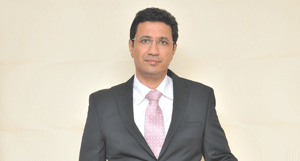
Rahul Katyal, Managing Director, Capacit´e Infraprojects
Located in Mumbai, Delhi and Bengaluru, Capacit´e Infraprojects is a new entrant in the industry.
However, it has a strong base owing to its close association with Pratibha Pipes and Structural Ltd. The company specialises in the construction of buildings of all varieties, from mass housing, residential villas and high-rise residential towers to composite steel structures, commercial complexes and hospitals. Within six months of its establishment in mid-2012, the company won contracts from various developers across the country. Rahul Katyal, Managing Director, Capacit´e Infraprojects, speaks to AHLAM RAIS about the key challenges of a building contractor and the various construction technologies in the market.

Which segment among high-rise buildings, ultra-modern townships, hotels, malls, stadiums and allied infrastructure is the maximum demand coming from?
We find the high-rise building segment active with multiple inquiries, unlike the other segments that are awaiting clearances and investor interest. We are geared up to substantially expand our order book in the current year in this segment even as we wait and watch happenings in the buildings sector.

What are the challenges you face as a building contractor? How do you plan on overcoming them?
Although we find numerous opportunities for urban infrastructure development in the country, there is a scarcity of EPC contracts, which deprives us of growth in this sector. We hope that the situation will improve post elections.

In building projects too, multi-stage clearances impede work progress significantly, consuming time and cost of resources deployed. A simpler regime and efficient administration of the same are the need of the hour for upcoming building projects, so that construction work is completed on time with minimum cost and investment. We strive to mitigate the consequences of work suspensions for regulatory approvals in the interest of all stakeholders.

What are the modern technologies adopted by the company?
We make honest representations on various construction technologies, including resource requirements, cost and time implications thereof, letting our customers choose the technology appropriate to the particular need. Depending on the cycle time requirement (three days per floor or seven to 10 days per floor or 12 to 14 days per floor), appropriate technology and formwork systems are selected.

For every project, we develop an animation model rendering the construction method, for better clarity and to avoid constructability-related difficulties during the execution stage. Detailed construction methods and a full-scale mock-up are insisted upon to ensure smooth construction on site. Also, for timely procurement of resources and seamless documentation and accounting, we have implemented Buildsmart, the leading ERP system for the construction industry world over.

Apart from this, we have utilised numerous technologies in our projects. For instance, in the Lodha Splendora project that comprises 13 buildings and has a set up of G+31 floors, we have made use of aluminium formwork technology sourced from Mivan. For another Hiranadani project of six towers, we have used formwork technology imported from RMD, UK.

The purpose of using these technologies is to avoid relying on manpower for producing quality construction. Our focus is to rely on systems and engineered formwork to ensure that quality is consistent.

Lodha´s Altamount Road project is another project we are associated with. This is one of the first residential projects in India that will possess a steel structure. On completion, the project will include 42 upper floors and have a huge crown at the top. Various technologies are being used for this project such as the hydraulic climb work form in the central core of the structure. The central core will be constructed in concrete and the peripheral will have a steel structure. The advantage of using this technology is to reduce on-site construction work. In this process, the structure´s steel units are manufactured in the plants, the labour requirement at the site reduces and one can cast floors in four days, which is the fastest possible. If this structure is constructed in a conventional format, it would take four to five years; however, with the help of this technology one can complete the structure in 20 months.

Additionally, in Lodha´s The Park project, the tallest twin towers in Mumbai, we have associated with Doka for formwork engineering. This project is using the best technologies from across the globe such as climb formwork systems, luffing cranes, high-speed lifts, placer booms and hydraulic screens.

Also, we are making use of tunnel form technology; this is the first time in India that a slum rehabilitation project will be constructed with the assistance of this technology. We have sourced this technology from Meru in Turkey. Its use results in 60 per cent saving in labour strength at site, reinforcement, etc, owing to its pre-engineered concept. As it is available in the form of a mesh, it eliminates cutting, bending and binding at site. One can obtain a time cycle of three days per floor, which is the quickest.

One technology cannot be used for all kinds of structures;
it depends on the design of the project. Nowadays, the latest technologies are being used as there is a working restriction, especially in South Mumbai. Owing to this, one has to adopt pre-engineered concepts to complete the project on time.

What are the measures taken on site to provide increased accuracy and minimise waste?
Construction waste can be present in various forms. It is not only waste being generated at site, but also because of non-planning of logistics, rectification of a particular job, not planning the equipment base properly, etc. One has to determine the exact need of equipment, formwork, manpower, method statement and study the project. We strive to avoid waste of time, resource and material in construction work by continually seeking to improve our work practice through the development of knowledge, skill and attitude of workforce.

We have deployed state-of-the-art equipment and formwork to ensure better accuracy and faster completion.

How do you fund your projects?
We undertake project-specific finance with the assistance of various financial institutions. Formwork and equipment are financed as equipment financing. We draw out a cash flow for the project; we also receive advances from the client. And we have a project-based funding department in the company. If you maintain the discipline of project-specific funds, the cash flow is established on day one and if there is a shortage, the company pumps in the additional amount.

What equipment and technologies do you invest in?
Our current equipment bank is over Rs 75 crore. We have invested heavily in tower cranes, concrete placer booms, etc, to meet the work requirements of over 25 ongoing projects. We have also invested in system formwork, aluminium formwork and automatic climbing systems besides conventional or cup lock systems to achieve the targeted time duration. We have developed a reliable subcontract base for excavation, piling, concrete production, etc, to minimise capital investment in these supporting activities and are in the process of procuring equipment and formwork in large measures during the current year for deployment in recently awarded projects.

Do you offer any training to your workforce to increase efficiency on site?
Our current equipment bank is over Rs 75 crore. We have roped in a reputed international consultant whose expatriate personnel are training our staff and workmen on increasing productivity, avoiding wastage and rework, improving quality, occupational health, safety, housekeeping and environment management practices besides extending the durability of equipment, formwork and other assets through better care and proper handling. We have enforced a zero-tolerance policy with respect to safety, ensuring 100-per cent personal protective equipment compliance at each and every project site.

What are your expectations from the new government in terms of building and infrastructure policies?
We look forward to a renewal of the investment cycle, leading to a larger takeoff of building projects, besides revival of EPC contracts in the urban infrastructure sector. We hope regulatory clearances will speed up, leading to faster completion of the projects in the years to come.

FACT SHEET
Year of establishment: 2012
No. of employees: 800
Ongoing projects: 25
Upcoming projects: 5
Order book: Rs 3,000 crore
Turnover in FY 2013-14:
Rs 273 crore
To share your views on this interview, write in at feedback@ASAPPmedia.com

"Join industry leaders at RAHSTA Expo, India's premier platform for roads, highways and traffic infrastructure. Register now to explore innovations, network with experts and shape the future of mobility."

Rahul Katyal, Managing Director, Capacit´e Infraprojects Located in Mumbai, Delhi and Bengaluru, Capacit´e Infraprojects is a new entrant in the industry. However, it has a strong base owing to its close association with Pratibha Pipes and Structural Ltd. The company specialises in the construction of buildings of all varieties, from mass housing, residential villas and high-rise residential towers to composite steel structures, commercial complexes and hospitals. Within six months of its establishment in mid-2012, the company won contracts from various developers across the country. Rahul Katyal, Managing Director, Capacit´e Infraprojects, speaks to AHLAM RAIS about the key challenges of a building contractor and the various construction technologies in the market. Which segment among high-rise buildings, ultra-modern townships, hotels, malls, stadiums and allied infrastructure is the maximum demand coming from? We find the high-rise building segment active with multiple inquiries, unlike the other segments that are awaiting clearances and investor interest. We are geared up to substantially expand our order book in the current year in this segment even as we wait and watch happenings in the buildings sector. What are the challenges you face as a building contractor? How do you plan on overcoming them? Although we find numerous opportunities for urban infrastructure development in the country, there is a scarcity of EPC contracts, which deprives us of growth in this sector. We hope that the situation will improve post elections. In building projects too, multi-stage clearances impede work progress significantly, consuming time and cost of resources deployed. A simpler regime and efficient administration of the same are the need of the hour for upcoming building projects, so that construction work is completed on time with minimum cost and investment. We strive to mitigate the consequences of work suspensions for regulatory approvals in the interest of all stakeholders. What are the modern technologies adopted by the company? We make honest representations on various construction technologies, including resource requirements, cost and time implications thereof, letting our customers choose the technology appropriate to the particular need. Depending on the cycle time requirement (three days per floor or seven to 10 days per floor or 12 to 14 days per floor), appropriate technology and formwork systems are selected. For every project, we develop an animation model rendering the construction method, for better clarity and to avoid constructability-related difficulties during the execution stage. Detailed construction methods and a full-scale mock-up are insisted upon to ensure smooth construction on site. Also, for timely procurement of resources and seamless documentation and accounting, we have implemented Buildsmart, the leading ERP system for the construction industry world over. Apart from this, we have utilised numerous technologies in our projects. For instance, in the Lodha Splendora project that comprises 13 buildings and has a set up of G+31 floors, we have made use of aluminium formwork technology sourced from Mivan. For another Hiranadani project of six towers, we have used formwork technology imported from RMD, UK. The purpose of using these technologies is to avoid relying on manpower for producing quality construction. Our focus is to rely on systems and engineered formwork to ensure that quality is consistent. Lodha´s Altamount Road project is another project we are associated with. This is one of the first residential projects in India that will possess a steel structure. On completion, the project will include 42 upper floors and have a huge crown at the top. Various technologies are being used for this project such as the hydraulic climb work form in the central core of the structure. The central core will be constructed in concrete and the peripheral will have a steel structure. The advantage of using this technology is to reduce on-site construction work. In this process, the structure´s steel units are manufactured in the plants, the labour requirement at the site reduces and one can cast floors in four days, which is the fastest possible. If this structure is constructed in a conventional format, it would take four to five years; however, with the help of this technology one can complete the structure in 20 months. Additionally, in Lodha´s The Park project, the tallest twin towers in Mumbai, we have associated with Doka for formwork engineering. This project is using the best technologies from across the globe such as climb formwork systems, luffing cranes, high-speed lifts, placer booms and hydraulic screens. Also, we are making use of tunnel form technology; this is the first time in India that a slum rehabilitation project will be constructed with the assistance of this technology. We have sourced this technology from Meru in Turkey. Its use results in 60 per cent saving in labour strength at site, reinforcement, etc, owing to its pre-engineered concept. As it is available in the form of a mesh, it eliminates cutting, bending and binding at site. One can obtain a time cycle of three days per floor, which is the quickest. One technology cannot be used for all kinds of structures; it depends on the design of the project. Nowadays, the latest technologies are being used as there is a working restriction, especially in South Mumbai. Owing to this, one has to adopt pre-engineered concepts to complete the project on time. What are the measures taken on site to provide increased accuracy and minimise waste? Construction waste can be present in various forms. It is not only waste being generated at site, but also because of non-planning of logistics, rectification of a particular job, not planning the equipment base properly, etc. One has to determine the exact need of equipment, formwork, manpower, method statement and study the project. We strive to avoid waste of time, resource and material in construction work by continually seeking to improve our work practice through the development of knowledge, skill and attitude of workforce. We have deployed state-of-the-art equipment and formwork to ensure better accuracy and faster completion. How do you fund your projects? We undertake project-specific finance with the assistance of various financial institutions. Formwork and equipment are financed as equipment financing. We draw out a cash flow for the project; we also receive advances from the client. And we have a project-based funding department in the company. If you maintain the discipline of project-specific funds, the cash flow is established on day one and if there is a shortage, the company pumps in the additional amount. What equipment and technologies do you invest in? Our current equipment bank is over Rs 75 crore. We have invested heavily in tower cranes, concrete placer booms, etc, to meet the work requirements of over 25 ongoing projects. We have also invested in system formwork, aluminium formwork and automatic climbing systems besides conventional or cup lock systems to achieve the targeted time duration. We have developed a reliable subcontract base for excavation, piling, concrete production, etc, to minimise capital investment in these supporting activities and are in the process of procuring equipment and formwork in large measures during the current year for deployment in recently awarded projects. Do you offer any training to your workforce to increase efficiency on site? Our current equipment bank is over Rs 75 crore. We have roped in a reputed international consultant whose expatriate personnel are training our staff and workmen on increasing productivity, avoiding wastage and rework, improving quality, occupational health, safety, housekeeping and environment management practices besides extending the durability of equipment, formwork and other assets through better care and proper handling. We have enforced a zero-tolerance policy with respect to safety, ensuring 100-per cent personal protective equipment compliance at each and every project site. What are your expectations from the new government in terms of building and infrastructure policies? We look forward to a renewal of the investment cycle, leading to a larger takeoff of building projects, besides revival of EPC contracts in the urban infrastructure sector. We hope regulatory clearances will speed up, leading to faster completion of the projects in the years to come. FACT SHEET Year of establishment: 2012 No. of employees: 800 Ongoing projects: 25 Upcoming projects: 5 Order book: Rs 3,000 crore Turnover in FY 2013-14: Rs 273 crore To share your views on this interview, write in at feedback@ASAPPmedia.com

Next Story
Infrastructure Transport

Noida Airport Fuels NCR Realty Growth

The start of commercial operations at Noida International Airport has recently emerged as a major trigger for real estate growth across Noida, Greater Noida and the Yamuna Expressway region. The airport is expected to improve regional connectivity and support the next phase of development in eastern NCR.The airport, inaugurated on 28 March, has begun passenger services, while cargo operations are also expected to strengthen its role as an economic and logistics hub. Its operationalisation is expected to reduce dependence on Delhi’s Indira Gandhi International Airport for residents and busine..

Next Story
Technology

thyssenkrupp and GlobalLogic Form AI Alliance

thyssenkrupp AG and GlobalLogic, a Hitachi Group company, have recently formed a strategic alliance to deploy autonomous robotics and Physical AI across heavy industry operations. The partnership aims to improve safety, reduce engineering bottlenecks and accelerate industrial transformation at scale.The alliance brings together thyssenkrupp’s industrial expertise with Hitachi’s innovation capabilities. It includes GlobalLogic, Method and Hitachi America R&D, creating a “Lab-to-Scale” pipeline that connects research, digital strategy, design and enterprise software engineering for i..

Next Story
Real Estate

Platinum Corp Launches Luxury Suites in Santacruz

Platinum Corp has recently launched Platinum Stellar: Bespoke Presidential Suites, a premium residential project in Santacruz West, Mumbai. The development is positioned as a boutique luxury offering for homebuyers seeking expansive layouts, privacy and personalised living experiences.Located on Main Avenue, the project has been designed as a low-density, high-end residential address with spacious homes starting from 2,500 sq ft and extending to full-floor residences. The project targets HNIs, business owners and legacy residents from the Bandra-Khar-Santacruz belt.Platinum Stellar has been de..

Advertisement

Subscribe to Our Newsletter

Get daily newsletters around different themes from Construction world.

STAY CONNECTED

Advertisement

Advertisement

Advertisement