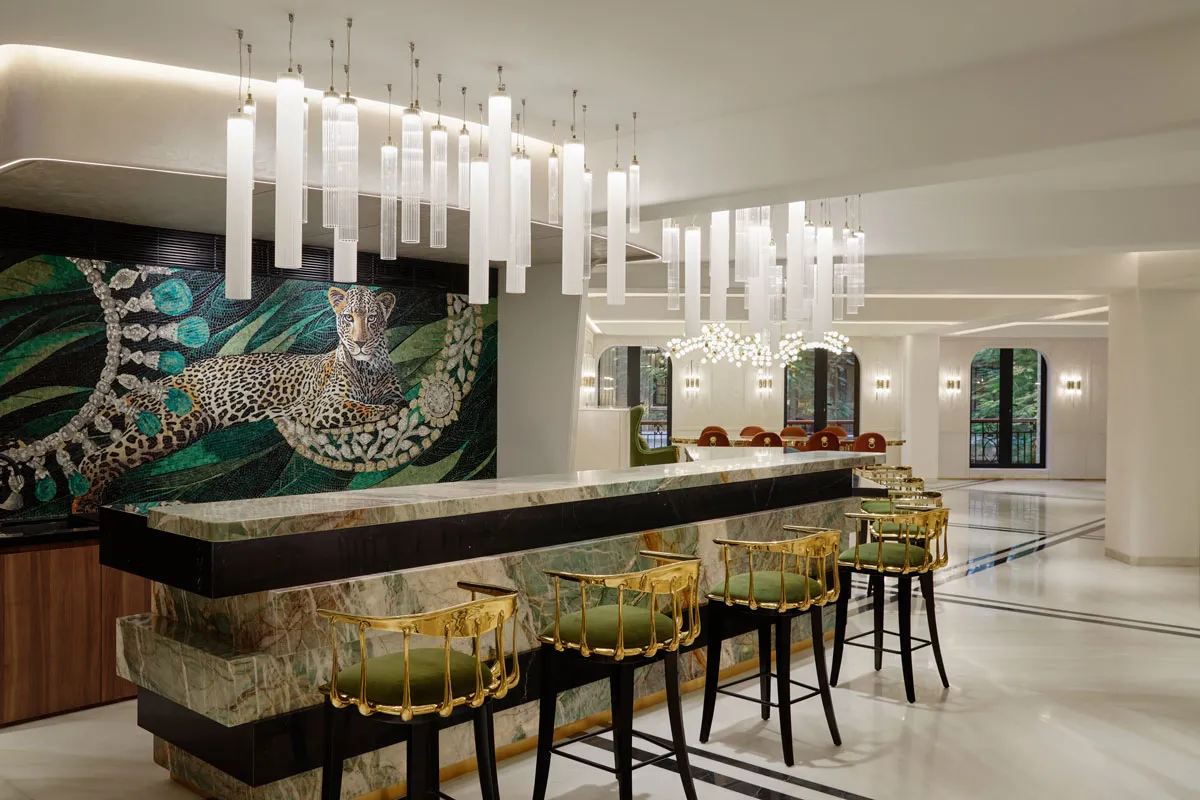
At Darabshaw House in Ballard Estate, The House of Rose represents more than a retail flagship. It is an architectural negotiation between legacy and contemporary restraint—where business ambition and spatial discipline converge.Framing the intent, Biren Vaidya, Managing Director, The Rose Group of Companies, says, “It has always been a dream, nurtured over the last forty-five years, to create a luxury brand of Indian origin with true international standing.” He adds, “With the current generation, luxury has become quieter, more personal, and deeply experiential.” That philosophical repositioning became the foundation for the architectural response led by Zaki Shaikh, Founder and Principal Architect, Parthenon Architects.Heritage as FrameworkShaikh explains, “The central architectural concept at Darabshaw House was to establish a quiet dialogue between the preserved heritage shell and a restrained contemporary insertion that embodies ‘silent luxury.’”Rather than dramatise contrast, he notes that “the design strategy was to treat the historic fabric as the primary narrative framework; retaining its arches, proportions, and structural rhythm while introducing contemporary elements that are deliberately minimal, precise, and materially refined.”Luxury, he clarifies, “is expressed not through ornament or spectacle, but through spatial clarity, craftsmanship, depth, and subtle detailing.”Vaidya echoes this sensitivity toward context: “Darabshaw House in Ballard Estate carries a rare, untouched beauty and a character that belongs to another time. Such a place does not ask to be changed; it asks to be understood.” Façade as Cultural InterfaceFor Shaikh, the façade was not a retail frontage but an architectural mediator. “The façade and Outdoor Museum were conceived as an extension of the building’s architecture rather than a superficial retail frontage.”He adds, “Instead of inserting conventional vitrines, the arches were activated as deep-set thresholds that create inhabitable niches, allowing shadow, depth, and proportion to become the primary design language.”By transforming each bay into “a curated architectural alcove rather than a product window,” the façade becomes a layered civic interface rather than a commercial display surface.Sequencing the experienceThe spatial choreography between Centre Stage and The Mezz defines the flagship’s experiential hierarchy.Vaidya states, “The spatial journey was therefore designed not as a path to purchase, but as a journey of emotional connection, where discovery, beauty, knowledge, and hospitality come together to create ownership in the heart of the patron.” Shaikh articulates how architecture translates that philosophy: “The spatial planning across Centre Stage and The Mezz was conceived as a continuous architectural narrative rather than a conventional retail layout.”He explains that sightlines are “deliberately layered, allowing long visual connections across the floor while subtly framing focal moments,” while the vertical transition to The Mezz “acts as a spatial filter, compressing scale, softening light, and introducing warmer materiality.”The result is what he describes as “a psychological gradient from public immersion to personalised engagement.”Material restraint, operational depth Material selection reinforces this calibrated expression.Shaikh notes, “Materials were chosen for their ability to age gracefully,” citing natural stone, brushed or patinated metals, and low-iron glass. “The idea was to let texture, proportion, and detailing communicate luxury rather than decorative excess.”Lighting was equally disciplined. “Instead of dramatic spotlighting, a layered and concealed lighting strategy was employed to create gradients of illumination, accentuating textures and edges while avoiding harsh contrasts.”For Vaidya, these technical layers align with a broader ethos: “Flexibility, longevity, and adaptability were therefore not treated as technical features alone, but as intrinsic qualities embedded into the very soul of the space.” Invisible infrastructureService integration was engineered to remain visually silent.Shaikh explains, “Technology should be felt, not seen.” Lighting fixtures were concealed within coves and recesses; HVAC was aligned with architectural grids or hidden within shadow gaps; acoustic moderation was embedded within layered materials rather than exposed panels.He summarises, “Together, these systems operate as an invisible infrastructure, precisely engineered yet discreetly concealed, ensuring that comfort, clarity, and sensory immersion are achieved without visually overpowering the architecture.”Vaidya reinforces the invisible-versus-visible duality: “What is visible on the outside is important, but what lies within the invisible systems, structure, and spirit that make everything function is far more vital.” Beyond TransactionUltimately, the project redefines performance metrics.“True luxury is not defined by revenue, transactions, or immediate business outcomes. It is defined by relationships, by trust, by aspiration, and by a sense of belonging that a patron feels toward the brand,” says Vaidya. At Darabshaw House, architecture becomes the medium through which that philosophy is spatialised—heritage retained, contemporary insertions restrained, systems concealed, and experience choreographed.The result is not a retail spectacle, but a calibrated architectural proposition—where silence, proportion and precision carry the weight of luxury.