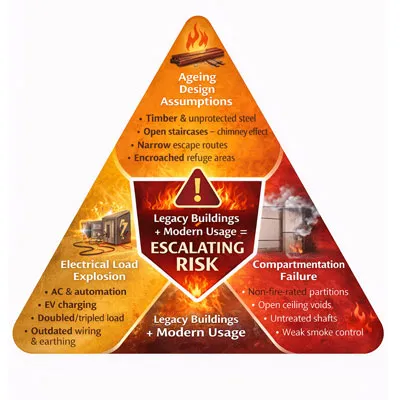
In 2023 alone, Mumbai recorded 4,721 fire calls. Over the past three years, the city has seen nearly 13,000 fire incidents. A significant majority of these cases have one recurring thread: electrical faults, overloaded systems, concealed fire spread and buildings that were simply not designed for the way they are used today.India’s biggest fire vulnerability is not in the buildings yet to be constructed. It lies in those already occupied –residential towers built 10-20 years ago, mixed-use properties with incremental modifications, and commercial assets that have undergone multiple retrofits without holistic upgrades.As we explore the issue, it becomes clear that the crisis is not rooted in a single point of failure but in the convergence of legacy design, electrical evolution and inadequate compartmentation under modern occupancy pressures.When design assumptions ageMany of the risks embedded in older buildings are architectural. Suraj Chaphekar, Assistant Vice President - Architecture, AVIGHNA, points out that fire risk in legacy structures is often “built-in” due to the standards of the era. Pointing to combustible structural elements, he says, “Many of Mumbai’s heritage or pre-RCC structures rely on timber framing, wooden flooring and unprotected steel. Unlike modern concrete, these materials act as fuel, accelerating the rate of structural collapse during a fire.” Further highlighting the vertical risk embedded in circulation design, he says, “In older ‘chawl’ systems or walk-ups, staircases are often open to the hallways. While this aids ventilation, it creates a ‘chimney effect’ during a fire, allowing smoke and heat to rise rapidly through the building's primary escape route.” Narrow circulation compounds this challenge. “The limited width of staircases in older high-density buildings is a significant hurdle,” notes Chaphekar. “These passages were not designed for modern occupancy loads, making simultaneous two-way movement – residents exiting while firefighters enter – nearly impossible.” Usage patterns, such as encroachment on common areas, amplify vulnerability. “In mixed-use buildings, commercial units often expand into fire passages or refuge areas for storage. This not only blocks egress but often introduces high-fire-load materials (like textile or paper stock) into the very paths meant to be ‘safe zones’.”The implication is clear: design decisions made decades ago are colliding with current density and occupancy realities.The electrical load realityIf design assumptions have aged, electrical assumptions have collapsed entirely. Shashi Amin, Director (Non-Board Member) and CEO - B2B Channel & Corporate Communication, Polycab India, observes: “India’s electrical landscape has transformed dramatically over the past decade and older buildings are feeling the strain. When most high-rise and mid-rise structures were designed 10-15 years ago, the electrical load assumptions were modest, focused on basic lighting and limited appliances. Today, the reality is very different. Air-conditioning, modular kitchens, home automation and now EV charging have pushed actual demand to nearly double or even triple those original estimates.” He adds, “Overloaded circuits and outdated wiring systems are among the leading causes of electrical faults and fire hazards in urban India.” Amit Mathur, President - Sales & Marketing, Finolex Cables, echoes the shift in usage patterns, “When many properties were designed 10-15 years ago, it was difficult to anticipate the scale of digital adoption we see today, from work-from-home setups and smart appliances to inverter systems, automation and EV readiness.” He references emerging data: “In Mumbai, news portals have reported that fire brigade records show around 70-80 per cent of fire incidents in residential buildings have links to electrical short circuits and overloaded systems. This is a clear signal that electrical demand growth must be matched by periodic risk assessment and system upgrades rather than assuming static design suffices.” This is not simply about product upgrade. It is about load review, insulation health, circuit protection and earthing integrity. As Amin emphasises, “The first non-negotiable step for any existing building is a comprehensive electrical audit focused on wiring integrity and load capacity.” Without this, even well-designed structures remain vulnerable.The invisible spread: Compartmentation failuresMany fires escalate not because systems fail, but because fire and smoke travel too freely. Sumit Bidani, CEO, Knauf India, notes, “In many existing buildings, it is not system failure that drives fire spread but poor compartmentation of spaces. Openable modular ceilings, non-fire-rated drywalls and untreated service shafts allow fire and smoke to move quickly across floors and escape routes. Once smoke starts travelling through these gaps, evacuation becomes difficult within seconds. Proper compartmentation slows this spread and buys critical time, which is often the difference between a manageable incident and a major emergency.” This shifts the conversation from active systems alone – alarms and sprinklers – to passive integrity: shafts, partitions, ceilings and fire stops. Retrofitting these systems is not merely aesthetic – it is structural logic reintroduced into occupied buildings.The retrofit barrier: DisruptionIf the solutions are clear, why are upgrades slow? Anshuman Magazine, Chairman & CEO - India, South-East Asia, Middle East & Africa, CBRE, provides a grounded explanation. “While capital expenditure is a significant factor, operational disruption remains the main barrier. In a high-occupancy Grade-A asset, the prospect of invasive works like drilling through floor slabs or disabling life-safety systems can be a dampener for owners wary of tenant displacement or business interruption.” He suggests a pragmatic pathway: “The upgrade is likely to become easier if owners start treating fire safety as a core component of the building's lifecycle. For instance, fire system modernisations may be aligned with planned ESG and energy efficiency upgrades.” In other words, fire safety must move from reaction to lifecycle planning.Designing the future differentlyRedevelopment presents an opportunity to avoid repeating past assumptions. Chaphekar argues that redevelopment must move beyond minimal compliance: “Redevelopment offers a clean slate to bake safety into the building’s DNA. Architects must move beyond mere code compliance toward performance-based design.” He further outlines the direction: “As glass and composite panels become the norm for Mumbai’s new skyline, the façade must be treated as a life-safety system, not just an aesthetic one.” And emphasises the evolution of stair cores: “The traditional staircase must evolve. We recommend the integration of fire towers – staircases that are separated from the main building by a ventilated lobby.” Combined with pressurisation and redundancy, these measures shift the building from compliant to resilient.The consensusAcross architects, electrical manufacturers, passive fire specialists and facility managers, some truths are evident: Electrical loads have doubled or tripled; compartmentation is inconsistent; circulation logic in older buildings is flawed; and retrofitting is delayed by disruption concerns.India does not lack codes. It lacks periodic reassessment of ageing buildings under new usage realities.The most urgent fire intervention required in India today is not at the drawing board. It is at the electrical panel, the ceiling void and the stairwell of buildings already occupied.Rebuilding Mumbai, safelyMumbai’s redevelopment wave is rapidly transforming its skyline. Yet across the city, thousands of ageing residential and mixed-use buildings remain occupied during transition phases – often for years – creating a parallel safety imperative. This presents a dual challenge: Legacy buildings awaiting redevelopment, many operating with outdated fire design assumptions and new towers that must not inherit the design blind spots of the past.The opportunity, however, is equally significant. As Suraj Chaphekar, Assistant Vice President - Architecture, AVIGHNA, notes, redevelopment offers a clean slate, allowing architects to integrate façade fire performance, compartmented service shafts and properly pressurised fire towers from inception.The real test for Mumbai’s next skyline is whether fire safety becomes a foundational design principle or, once again, a retrofit response after risk has already surfaced.Compliance Ends, Risk BeginsSrinivas Valluri, National President – FSAI, notes that the most serious fire safety gaps in operational buildings arise after occupancy, when compliance becomes complacency. Fire NOCs are treated as one-time approvals rather than ongoing responsibilities, leading to blocked exits, narrowed staircases, compromised compartmentation and poor smoke control. Detection and alarm systems are often left in fault mode or disconnected due to nuisance alerts, while integration with lifts and HVAC systems remains weak. Firefighting infrastructure, too, suffers from neglect — empty or diverted fire water tanks, untested pumps and closed sprinkler valves are not uncommon. High-risk zones such as basements and electrical rooms frequently lack adequate protection, compounded by overloaded circuits and insufficient protective devices. To address this, building owners and facility managers must prioritise restoring reliability to core systems: ensure pumps are operational, fire water is dedicated and available, hydrants and sprinklers are functional, and alarms are properly integrated with evacuation mechanisms. Equally critical are clear exits, functional emergency lighting, trained first responders, regular mock drills and periodic professional audits to maintain readiness without disrupting operations.