India has historically protected domestic industry
and, under the guise of safeguarding MSMEs, the
policy framework has often ended up shielding large
industrialists—many of whom struggle to compete in
a truly free market. As a result, tariffs have remained
high, frequently without any sunset clause. President
Donald Trump’s actions have forced the
Government’s hand in reducing tariffs, compelling it
to re-examine its foreign trade policy and accelerate
the stitching together of trade agreements. The
recent Free Trade Agreements with the UK, EFTA,
Oman, New Zealand, the UAE, the European Union
and, finally, the USA provide India with a strategic
advantage over several competing nations and
represent a real opportunity to produce for the
world. In the case of the USA, India enjoys a clear
advantage over China: while Chinese exports
face tariffs of 37 per cent, India’s tariff stands at
18 per cent. Reduced tariffs under the EU agreement
will improve access to advanced machinery for
India’s manufacturing sector, while electronics,
engineering, pharmaceuticals and chemicals are
poised to gain from deeper market access.
Auto components and passenger vehicle
manufacturers, however, will face pressure as
margins come under strain.
India must now evolve towards a strategy of
manufacture domestically, export for growth. This
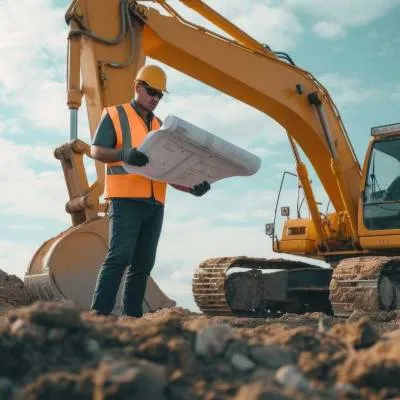
transition is already visible in the construction
equipment sector, where OEMs such as JCB, Schwing
Stetter and Volvo manufacture in India and export to
global markets. The Union Budget has provided a
token allocation of Rs.200 crore for an Infrastructure
Equipment scheme aimed at strengthening domestic
manufacturing of high-value, technologically
advanced advanced equipment. However, the scheme clubs
together elevators for multi-storey apartments and
firefighting equipment—neither of which requires
such support—with genuinely strategic machinery
such as tunnel-boring machines for metro networks
and road tunnels. The Finance Ministry needs to
recognise the distinct requirements and economic
impact of a $10-billion construction equipment
industry and revisit this approach. A dedicated PLI
scheme for construction equipment is clearly
warranted, particularly when the auto sector has
been allocated Rs.5,940 crore.
Road construction as of 31 December 2025 stands
at 4,938 km. While road awards have been
pathetically low, the Border Roads Organisation
(BRO) has provided a silver lining. Under its
perspective plan, 470 roads covering approximately 27,300 km are planned in border areas. In
parallel, the Ministry of Road Transport & Highways
has identified a PPP project pipeline of 13,400 km,
with an estimated cost of `8.3 trillion, to be
developed over the next three years. BOT projects
are making a cautious comeback, with tweaks
designed to test investor appetite.
In Budget FY 2026–27, border infrastructure has
received a capital outlay of Rs.7,394 crore, up from Rs.7,146.5 crore in the previous year. The allocation
for Road Transport and Highways has risen by a
modest 7.9 per cent over revised estimates to Rs.3.10 trillion, of which `1.87 trillion has been
infused into NHAI. Railways has received a
10.1 per cent increase, taking its allocation to Rs.2.81 trillion.
The Ministry of Housing and Urban Affairs has
seen a sharp 49.5 per cent increase over revised
estimates, with an allocation of Rs.85,522 crore.
The budget for the North-Eastern Region has been
raised by 22.1 per cent to Rs.1,08,335 crore.
Cement consumption to the extent of nearly
10 per cent is driven by PMAY. PMAY-Rural has
received a 69 per cent increase to Rs.54,917 crore,
while PMAY-Urban has seen a 179 per cent jump to Rs.22,025 crore. Although the Jal Jeevan Mission
underspent last year’s provision by Rs.50,000 crore,
the Jal Shakti Ministry has been allocated an
additional Rs.53,371 crore over revised estimates,
taking the total provision to Rs.94,808 crore.
With over Rs.1 trillion locked up in disputes, NHAI
has now effectively excluded arbitration as a
dispute-resolution mechanism for claims exceeding Rs.10 crore. The new circular recommends
conciliation followed by civil court adjudication for
disputes above this threshold. Justice delayed is
justice denied. Whatever the mechanism, justice
must be delivered swiftly.
The Economic Survey indicates that the economy
has the potential to achieve 7.2 per cent growth in
FY2027. With multiple FTAs now sealed, India
appears well-positioned to surpass its targeted
growth figures.
Mumbai has been given the green light to grow
vertically, and the Rs.1.5 trillion real estate market
has been steadily inching upward—both in terms of
projects and prices. But what about its
infrastructure? Can the city cope?
Chief Minister Devendra Fadnavis and his able officers have engineered a plan to build
infrastructure beneath the city. A network of 50 km is
already underway, with another 70 km planned to
create additional capacity for urban transportation.
Last month, the Tunnelling Association of India (TAI)
honoured Dr Sanjay Mukherjee, IAS, Metropolitan
Commissioner, MMRDA with the award for
Outstanding Contributions to National Infrastructure
and Tunnelling Excellence.
Speaking about Davos, Dr Mukherjee highlighted
Maharashtra’s haul of 19 MoUs with a total
investment commitment of Rs.14.5 trillion. MMRDA
alone signed MoUs worth approximately Rs.11 trillion
with global firms, including Brookfield and
Sumitomo. In addition, agreements were signed with
leading global institutions such as the University of
California, Berkeley; MIT; Munich; and several
others to enable cooperation in knowledge sharing,
technology adoption, and process implementation.
While Dr Mukherjee shared insights into his
project management approach, the editorial team of
Construction World was offered a rare glimpse
nearly 30 metres below ground—inside a tunnel
boring machine inching its way from Orange Gate
to connect with the Coastal Road at Marine Drive.
Follow me on Linkedin twitter @PratapPadode