Delhi Metro set to launch driverless train services in another corridor
RAILWAYS & METRO RAIL

Delhi Metro set to launch driverless train services in another corridor

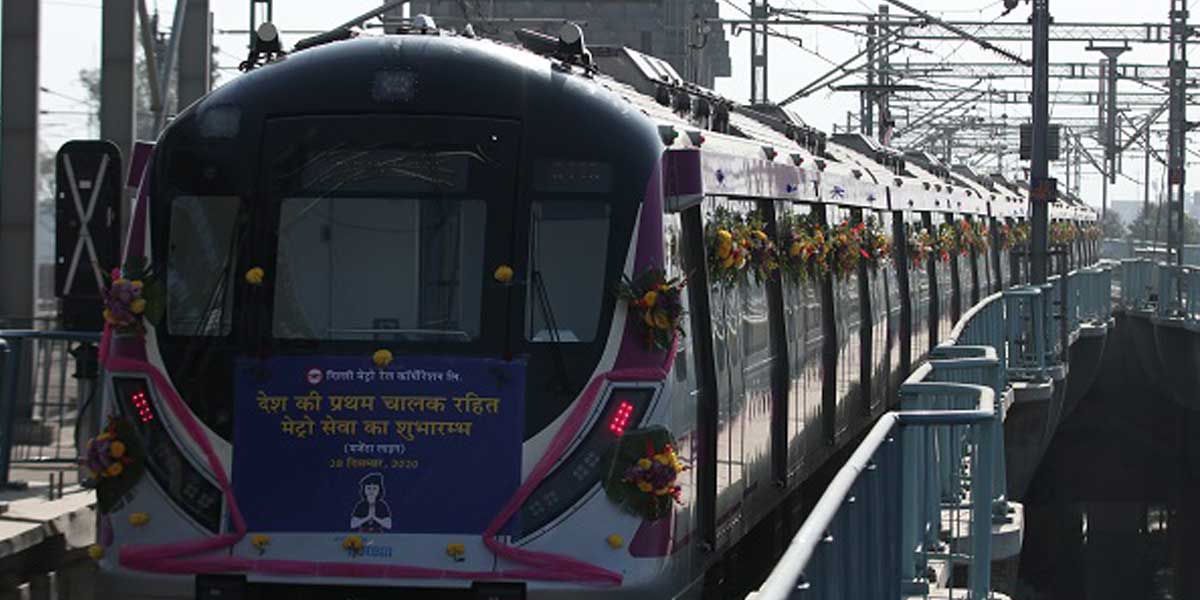
Following the successful launch of India’s first-ever fully automated driverless train service on one of its 11 corridors a few days earlier, the Delhi Metro Rail Corp. (DMRC) is now gearing up to launch...

Following the successful launch of India’s first-ever fully automated driverless train service on one of its 11 corridors a few days earlier, the Delhi Metro Rail Corp. (DMRC) is now gearing up to launch it in another by the second half of this year. “After starting driverless services on the 37 km long Magenta Line (Janakpuri West-Botanical Garden), another major corridor of the Delhi Metro, the 59 km long Pink Line (Majlis Park-Shiv Vihar) will also have driverless operations by the mid of 2021. #MetroRevolution,” DMRC informed through its official Twitter handle. Pink Line services of the country’s largest metro network operate in a circle around the busy Inner Ring Road of the national capital. The first driverless train service was inaugurated by Prime Minister Narendra Modi on DMRC’s Magenta Line via video conferencing in the presence of Housing and Urban Affairs & Civil Aviation, Hardeep Singh Puri and Delhi Chief Minister, Arvind Kejriwal on December 28. The online ceremony was also attended by senior representatives of the central and state governments, the Ambassador of Japan to India, Satoshi Suzuki and officials from Japan International Cooperation Agency (JICA). “In a momentous day for the Metro operations in the country, we took a massive leap towards futuristic technology when PM Sh @narendramodi Ji inaugurated unmanned operation between Janakpuri West to Botanical Garden on Delhi Metro’s Magenta Line,” Puri later wrote on his official Twitter handle. With the launch of the fully automated driverless train operations (DTO), the country has joined the league of 16 countries currently offering this facility in their metro systems. “The fully automated trains will reduce human intervention in operations and offer more reliability and safety for the commuters. This system also brings more flexibility to trains in operation. As a result, the number of trains in service can be regulated based on demand dynamically without any dependence on the availability of crew,” a DMRC spokesperson told INFRASTRUCTURE TODAY. Since these trains operate on communication-based train control or signalling system, they can be run with a headway 90-second headway to provide more carrying capacity.   In the initial months, the train operator will be present on the train to reassure passengers. The advanced level of diagnostic features in the DTO will help DMRC to move from conventional time-based maintenance to condition-based maintenance. This will effectively help reduce maintenance downtime of trains.  In the last couple of years, DMRC had been conducting DTO trials during non-revenue hours. Meanwhile, other metro systems in the country are also looking at rolling out the technology on their networks. The Bengaluru Metro Rail Corporation Ltd (BMRCL) or Namma Metro is already working with Siemens in this regard for the second phase of its expansion. The prime minister also unveiled the National Common Mobility Card (NCMC) on the 23 km long Airport Express Line (New Delhi to Dwarka Sector 21) at the launch of the driverless train on the Magenta Line. The service enables passengers from any part of the country travelling on DMRC’s Airport Express Line to use their NCMC compliant RuPay debit card for seamless travel. DMRC’s system will be able to accept transactions from 23 banks through the debit card issued by them. DMRC is a joint venture between the Central Government and Delhi State Government. Commencing operations in 2002, DMRC today operates a 390 km long network with 285 stations. - MANISH PANT

Next Story
Infrastructure Transport

Kavach 4.0 Commissioned on Delhi–Mumbai and Delhi–Howrah

"Kavach version four has been commissioned on 1,452 route km, covering the high density Delhi–Mumbai and Delhi–Howrah corridors. The rollout included laying 8,570 km of optical fibre, installation of 1,100 telecom towers, deployment of trackside equipment over 6,776 RKm and establishment of 767 station data centres. Trackside implementation has been taken up on 24,427 RKm covering Golden Quadrilateral, Golden Diagonal and High Density Network sections. The programme aims to strengthen signalling and train protection on key routes.Kavach is an indigenously developed automatic train protecti..

Next Story
Infrastructure Transport

Railways Advance Kalyan–Murbad Line And Mumbai Capacity Expansion

"Indian Railways is advancing multiple rail infrastructure projects in Maharashtra, including the sanctioned Kalyan–Murbad new line and sizable investments under the Mumbai Urban Transport Project and the Mumbai–Ahmedabad High Speed Rail project. The Kalyan–Murbad 28 km new line has been sanctioned at Rs 8.36 billion (bn) on a 50:50 cost-sharing basis with the Government of Maharashtra and has been declared a Special Railway Project for land acquisition; proposals covering 214 hectares are at various stages of acquisition. Budgetary outlay for projects falling fully or partly in Maharash..

Next Story
Infrastructure Urban

Parliamentary Panel Flags Funding Gaps in Heavy Industries

"The Department-Related Parliamentary Standing Committee on Industry (Rajya Sabha) presented its 332nd report on the Demands for Grants 2026-27 of the Ministry of Heavy Industries (MHI). Figures converted from crore and lakh are expressed in million (mn). The Budget Estimates 2026-27 for the Ministry stand at Rs 79,399 mn against a projected requirement of Rs 94,843.2 mn, a shortfall of about 16 per cent, with revenue at Rs 79,370.8 mn and capital compressed to Rs 28.2 mn from Rs 5,020 mn.The committee flagged recurring BE-to-RE compression and declining revised estimate utilisation, and calle..

Advertisement

Subscribe to Our Newsletter

Get daily newsletters around different themes from Construction world.

STAY CONNECTED

Advertisement

Advertisement

Advertisement