The long term outlook is excellent for the crusher market: V Senthilkumar
What is the demand trend of aggregates for construction in India?
The aggregates industry in India is one of the biggest in the world because there is huge investment happening here. India is one the largest global consumers of aggregates and is touted as the epicentre of the world construction industry market. The COVID-19 pandemic has applied brakes but the aggregate sector is already showing signs of a strong recovery and the demand is steadily increasing.
What is the current scenario of aggregate and M-sand production?
There is a brilliant demand and supply circle here. The plant owners are producing good quality manufactured sand (M-sand) which is leading to higher demand and so happens the optimisation of plants in the aggregates business. The restrictions imposed on natural river sand are also making customers shift focus to M-sand. More than 50 per cent of the demand comes from the road construction sector, followed by core construction and real estate sectors. As the emphasis on creating sustainable projects rise, the demand for quality M-sand meeting specific requirements is also set to rise. M-sand is produced with the desired particle shape, gradation and silt content with the absence of deleterious materials, by crushing and washing. The most important point to note here is that the usage of cement in projects will be reduced by at least 5-6 per cent. Producers are promising consistent supply of M-sand to job sites as per the specifications and plant manufacturers are bringing in advancements into their sand producing equipment and promoting the same.
What is the market size of crushers and screens in India? What is the current market scenario?
The market size of crushers and screens is estimated to be approximately Rs 30 billion per year comprising both organised and unorganised sectors. This is for aggregates which is 100 tph and above. Out of this figure, track-mounted plant is estimated at Rs 6 billion, tyre-mounted plant at Rs 10 billion and Rs 14 billion for skid-mounted and unit equipment.
Which segments drive the demand for crushers and screens?
The demand for crushers and screens are rising consistently due to the construction and infrastructure development projects such as roads, dams, and railways which are lined up. The retail market for construction also plays a vital part. The ban on usage of river sand is also promoting the demand. Rapid urbanisation due to increase in population and better living standards is expected to propel the demand further.
How do you compare the demand trends of various crusher types?
It is very important that the product should meet all the requirements of the customer. The advantages and disadvantages of each type should be analysed thoroughly before selecting a product. The aggregate market demand is increasing and Cone and VSI crusher range is indigenously manufactured with the help of technological advancements. Customers have a wide range of crusher types to choose from. The capacity of demand, technology used in the crusher, financial back-up of the customer, relevant government policies and quality of the finished product are the factors that decide the selection.
Cone crusher is more sought after because of its capital expenditure, owning and operating cost and quality of the product.
What are the new technology trends in crushers and screens?
The incorporation of technology in the features of crushing and screening plants and its increased usage are fuelling the market growth in this sector. Automation in the mining and construction industry is also a key factor in propelling the industry growth. Track plants operated with electric power rather than by hydraulic means is the latest trend.
What are the latest products and solutions from Propel?
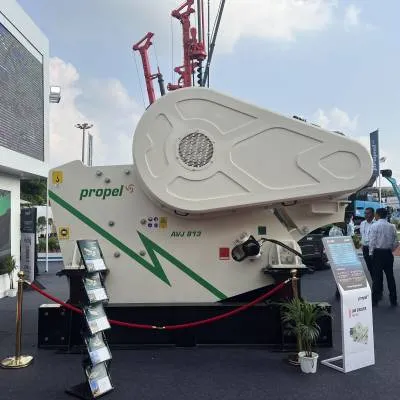
We are proud to share that Propel Industries has designed and developed a Gyratory cone crusher which can deliver more than 600 tonne per hour. We are the pioneers in this attempt, in the Indian crushing industry. The AVGC 600 model offers higher reduction ratio and higher input material size ranging from 340 mm to 450 mm. Customers can benefit from optimal crushing by utilising its large and stable feed opening, steep cavity and wider range of effective strokes, along with automated setting change. The product has a reliable hydraulic power pack and IP55 electrical panel box, which can control and monitor equipment performance using PLC solutions.
Propel’s horizontal impact crusher (HSI) is the new version of the ‘hammering rock’ configuration. The material feed is crushed at a very high intensive impact produced by the rotations of the rotor and blow bar, attached to the rotor. The material hitting the impactor arm gets crushed further. Hydraulics-assisted impactor arm and grinding path adjustment reduces the time on setting the gap. Sideliners are made of HARDOX400 Mn steel and this provides the required wear life. It is provided with a jib crane for easy replacement of wear parts like the blow bar. Propel’s HSI is suitable in processing soft and medium hard materials with its high reduction ratios. It has been designed to handle oversized rocks for higher capacity crushing, equipped with large feed opening and with heavy duty apron.
We have recently launched a higher capacity washing system called Prowash 250, along with a dewatering screen DW 300. The equipment is unique, easy to manufacture and assemble, modular in construction, robust, silent, and ergonomically designed for better servicing. The washing system takes less sand to fill up the truck as it avoids packing. It is suitable for areas with limited water resources.
How do you look at the long term market opportunities for crushers and screens?
It is interesting to note the final report on the National Infrastructure Pipeline projects with investments worth Rs 111 trillion between 2020-25, using both government and private funding. Projects worth Rs 44 trillion are already under implementation while projects worth Rs 33 trillion are at the conceptual stage and projects worth Rs 22 trillion are still under development, according to an official statement. Priority sectors include energy (24 per cent), roads (18 per cent), urban infrastructure (17 per cent) and railways (12 per cent). So, the long term outlook for the crusher market is excellent.

Propel Industries has pioneered over the years in developing some of the break-through solutions in the crusher market. V Senthilkumar, Managing Director, Propel Industries, shares more on the company’s solutions for the aggregate segment and the overall market scenario.What is the demand trend of aggregates for construction in India?The aggregates industry in India is one of the biggest in the world because there is huge investment happening here. India is one the largest global consumers of aggregates and is touted as the epicentre of the world construction industry market. The COVID-19 pandemic has applied brakes but the aggregate sector is already showing signs of a strong recovery and the demand is steadily increasing.What is the current scenario of aggregate and M-sand production?There is a brilliant demand and supply circle here. The plant owners are producing good quality manufactured sand (M-sand) which is leading to higher demand and so happens the optimisation of plants in the aggregates business. The restrictions imposed on natural river sand are also making customers shift focus to M-sand. More than 50 per cent of the demand comes from the road construction sector, followed by core construction and real estate sectors. As the emphasis on creating sustainable projects rise, the demand for quality M-sand meeting specific requirements is also set to rise. M-sand is produced with the desired particle shape, gradation and silt content with the absence of deleterious materials, by crushing and washing. The most important point to note here is that the usage of cement in projects will be reduced by at least 5-6 per cent. Producers are promising consistent supply of M-sand to job sites as per the specifications and plant manufacturers are bringing in advancements into their sand producing equipment and promoting the same.What is the market size of crushers and screens in India? What is the current market scenario? The market size of crushers and screens is estimated to be approximately Rs 30 billion per year comprising both organised and unorganised sectors. This is for aggregates which is 100 tph and above. Out of this figure, track-mounted plant is estimated at Rs 6 billion, tyre-mounted plant at Rs 10 billion and Rs 14 billion for skid-mounted and unit equipment.Which segments drive the demand for crushers and screens?The demand for crushers and screens are rising consistently due to the construction and infrastructure development projects such as roads, dams, and railways which are lined up. The retail market for construction also plays a vital part. The ban on usage of river sand is also promoting the demand. Rapid urbanisation due to increase in population and better living standards is expected to propel the demand further.How do you compare the demand trends of various crusher types? It is very important that the product should meet all the requirements of the customer. The advantages and disadvantages of each type should be analysed thoroughly before selecting a product. The aggregate market demand is increasing and Cone and VSI crusher range is indigenously manufactured with the help of technological advancements. Customers have a wide range of crusher types to choose from. The capacity of demand, technology used in the crusher, financial back-up of the customer, relevant government policies and quality of the finished product are the factors that decide the selection.Cone crusher is more sought after because of its capital expenditure, owning and operating cost and quality of the product.What are the new technology trends in crushers and screens?The incorporation of technology in the features of crushing and screening plants and its increased usage are fuelling the market growth in this sector. Automation in the mining and construction industry is also a key factor in propelling the industry growth. Track plants operated with electric power rather than by hydraulic means is the latest trend.What are the latest products and solutions from Propel?We are proud to share that Propel Industries has designed and developed a Gyratory cone crusher which can deliver more than 600 tonne per hour. We are the pioneers in this attempt, in the Indian crushing industry. The AVGC 600 model offers higher reduction ratio and higher input material size ranging from 340 mm to 450 mm. Customers can benefit from optimal crushing by utilising its large and stable feed opening, steep cavity and wider range of effective strokes, along with automated setting change. The product has a reliable hydraulic power pack and IP55 electrical panel box, which can control and monitor equipment performance using PLC solutions.Propel’s horizontal impact crusher (HSI) is the new version of the ‘hammering rock’ configuration. The material feed is crushed at a very high intensive impact produced by the rotations of the rotor and blow bar, attached to the rotor. The material hitting the impactor arm gets crushed further. Hydraulics-assisted impactor arm and grinding path adjustment reduces the time on setting the gap. Sideliners are made of HARDOX400 Mn steel and this provides the required wear life. It is provided with a jib crane for easy replacement of wear parts like the blow bar. Propel’s HSI is suitable in processing soft and medium hard materials with its high reduction ratios. It has been designed to handle oversized rocks for higher capacity crushing, equipped with large feed opening and with heavy duty apron.We have recently launched a higher capacity washing system called Prowash 250, along with a dewatering screen DW 300. The equipment is unique, easy to manufacture and assemble, modular in construction, robust, silent, and ergonomically designed for better servicing. The washing system takes less sand to fill up the truck as it avoids packing. It is suitable for areas with limited water resources.How do you look at the long term market opportunities for crushers and screens?It is interesting to note the final report on the National Infrastructure Pipeline projects with investments worth Rs 111 trillion between 2020-25, using both government and private funding. Projects worth Rs 44 trillion are already under implementation while projects worth Rs 33 trillion are at the conceptual stage and projects worth Rs 22 trillion are still under development, according to an official statement. Priority sectors include energy (24 per cent), roads (18 per cent), urban infrastructure (17 per cent) and railways (12 per cent). So, the long term outlook for the crusher market is excellent.

Related Stories
Gold Stories
Kamdhenu Realities acquires 4-acre Navi Mumbai land parcel
Kamdhenu Realities has acquired a 4-acre land parcel from RPG Life Sciences on Thane-Belapur Road for approximately Rs 1.5 billion, expanding its commercial real estate portfolio in Navi Mumbai.The parcel has a total developable potential of 1.8 million sq ft, on which Kamdhenu plans to develop a destination-scale commercial and lifestyle ecosystem. The proposed development will combine corporate office suites with high-street retail, F&B outlets, double-height lobbies, business infrastructure and lifestyle amenities.Located close to IKEA and opposite the upcoming Pawane Railway Station, t..
97 Per Cent Of Rongjeng-Mangsang-Adokgre Road Nears Completion
Deputy Chief Minister in-charge of public works Prestone Tynsong said in Shillong on 26 August that 97 per cent physical progress had been achieved on the ongoing Rongjeng-Mangsang-Adokgre road being constructed under the Non-Lapsable Central Pool of Resources (NLCPR). He noted the project was sanctioned in 2017 and that the stipulated time for completion had been 24 months from issue of the final work order. The deputy chief minister informed the assembly that the government had decided to include the remaining work under a World Bank project. In reply to a query from Rongjeng MLA Jim M Sangm..
First TBM Starts Digging Five Point Three Kilometre Tunnel Under SGNP
The Goregaon-Mulund Link Road (GMLR) Phase three (B) project has reached a key milestone as the first tunnel boring machine (TBM) began excavation of the first of two tunnels beneath the Sanjay Gandhi National Park (SGNP). The machine, named Tulsi, started cutting a five point three kilometre bore that will link Dadasaheb Phalke Chitranagari in Goregaon East with Amar Nagar in Mulund West. Officials issued a statement noting the commencement of tunnelling work under the protected green belt. The twin tunnels are being constructed using mechanised tunnelling methods that aim to limit surface di..
Related Articles
Latest Updates
Recommended for you
Advertisement
Subscribe to Our Newsletter
Get daily newsletters around different themes from Construction world.
subscribe to the newsletter
Don't miss out on valuable insights and opportunities
to connect with like minded professionals