MMRDA Installs 56-Metre Steel Span on Mumbai Metro Line 4
RAILWAYS & METRO RAIL

MMRDA Installs 56-Metre Steel Span on Mumbai Metro Line 4

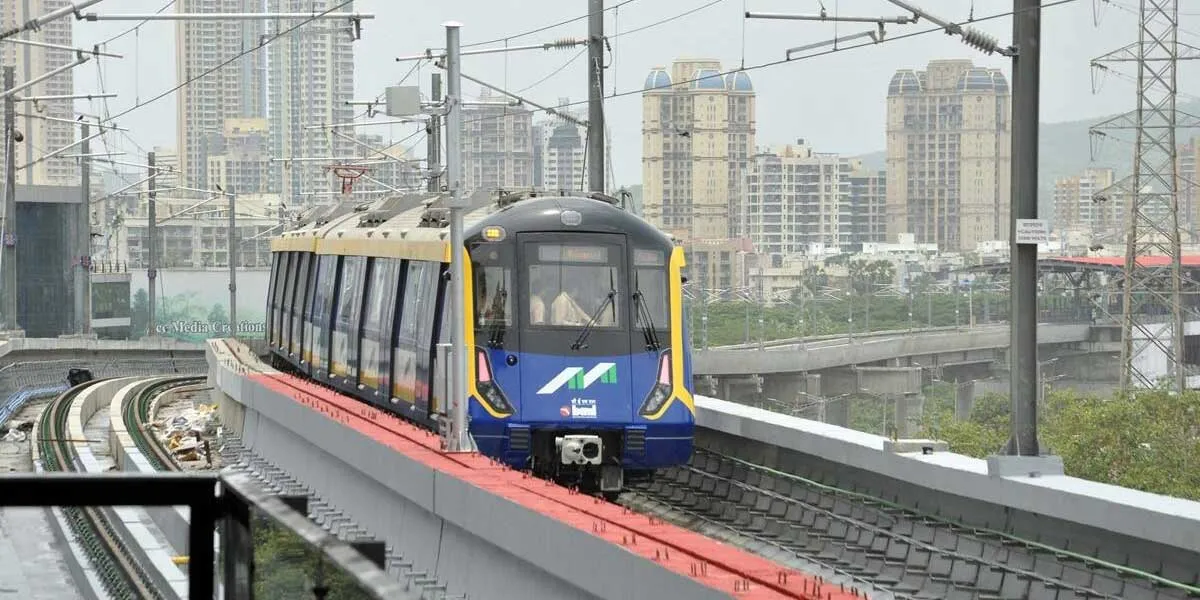
The Mumbai Metropolitan Region Development Authority (MMRDA) has achieved a major milestone in the Mumbai Metro Line 4 project with the successful overnight installation of a 56-metre-long, 450-ton steel span over the busy GMLR (Bhandup–Sonapur) Junction. With this feat, more than 84.5 per cent of the project’s construction has been completed.

The operation involved over 100 skilled workers and utilised nine high-capacity cranes and two multi-axle pullers to lift and position the two-girder steel span. Despite unseasonal rains and challenging site conditions, the installation was executed seamlessly without disrupting vehicular traffic.

The fully elevated Green Line extends 32.32 kilometres, connecting Wadala in the south to Kasarvadavali in the north, and features 30 stations that link Mumbai’s eastern and western suburbs. An additional 2.668-kilometre extension, Line 4A, will further connect Kasarvadavali to Gaimukh with two extra stations.

The Metro Line 4 project is being developed in three phases: Phase 1 (Gaimukh to Cadbury Junction) is expected to be completed by April 2026, with four stations ready by December 2025; Phase 2 (Cadbury to Gandhi Nagar) is slated for October 2026; and Phase 3 (Gandhi Nagar to Wadala) by October 2027.

The achievement reinforces MMRDA’s commitment to delivering high-quality infrastructure that enhances connectivity and reduces traffic congestion across Mumbai’s metropolitan region.

The Mumbai Metropolitan Region Development Authority (MMRDA) has achieved a major milestone in the Mumbai Metro Line 4 project with the successful overnight installation of a 56-metre-long, 450-ton steel span over the busy GMLR (Bhandup–Sonapur) Junction. With this feat, more than 84.5 per cent of the project’s construction has been completed. The operation involved over 100 skilled workers and utilised nine high-capacity cranes and two multi-axle pullers to lift and position the two-girder steel span. Despite unseasonal rains and challenging site conditions, the installation was executed seamlessly without disrupting vehicular traffic. The fully elevated Green Line extends 32.32 kilometres, connecting Wadala in the south to Kasarvadavali in the north, and features 30 stations that link Mumbai’s eastern and western suburbs. An additional 2.668-kilometre extension, Line 4A, will further connect Kasarvadavali to Gaimukh with two extra stations. The Metro Line 4 project is being developed in three phases: Phase 1 (Gaimukh to Cadbury Junction) is expected to be completed by April 2026, with four stations ready by December 2025; Phase 2 (Cadbury to Gandhi Nagar) is slated for October 2026; and Phase 3 (Gandhi Nagar to Wadala) by October 2027. The achievement reinforces MMRDA’s commitment to delivering high-quality infrastructure that enhances connectivity and reduces traffic congestion across Mumbai’s metropolitan region.

Related Stories

Gold Stories
Next Story
Infrastructure Urban

KONE Opens India's First Digital Experience Centre in Pune

KONE, a global elevator and escalator manufacturer, has inaugurated its first Digital Experience Centre (DEC) in India, located in Pune. The facility aims to showcase how artificial intelligence (AI), connectivity and data-driven technologies can enhance customer experiences and improve building operations.The centre was inaugurated by Jussi Herlin, Executive Vice Chair, KONE Corporation; Philippe Delorme, President and CEO, KONE; and Nandan Nilekani, Co-founder and Chairman of the Board, Infosys.Designed as an interactive customer environment, the facility demonstrates digital solutions cover..

Next Story
Infrastructure Urban

CII GreenCo Launches Circularity Guidelines for Indian Industry

The Confederation of Indian Industry (CII) GreenCo Council has launched the CII GreenCo Circularity Guidelines – Pilot Version at the 17th CII GreenCo Waste & Resource Management Summit 2026 in Chennai. The initiative aims to strengthen resource efficiency, waste reduction and circular economy practices across Indian manufacturing and process industries.The guidelines introduce a structured framework with circularity indices covering raw materials, consumables, packaging and other resource inputs. These indicators will help industries assess existing practices, identify opportunities to ..

Next Story
Infrastructure Energy

Global Electronics Association Launches IPC-1783-CO2E Standard

The Global Electronics Association has introduced IPC-1783-CO2E, a new international standard aimed at improving consistency, transparency and comparability in product carbon footprint reporting across the electronics manufacturing industry.The standard, titled International Standard for Data Collection and Reporting of CO2 Equivalent (CO2e) Emissions for the Electronics Manufacturing Supply Chain, provides industry-specific guidance for collecting, estimating and reporting carbon emissions data.With increasing regulatory requirements and customer expectations, electronics manufacturers face c..

Advertisement

Subscribe to Our Newsletter

Get daily newsletters around different themes from Construction world.

STAY CONNECTED

Advertisement

SPECIAL OFFER
QR Code