


High-Rises Reshape Visakhapatnam Housing Market
Real Estate

High-Rises Reshape Visakhapatnam Housing Market

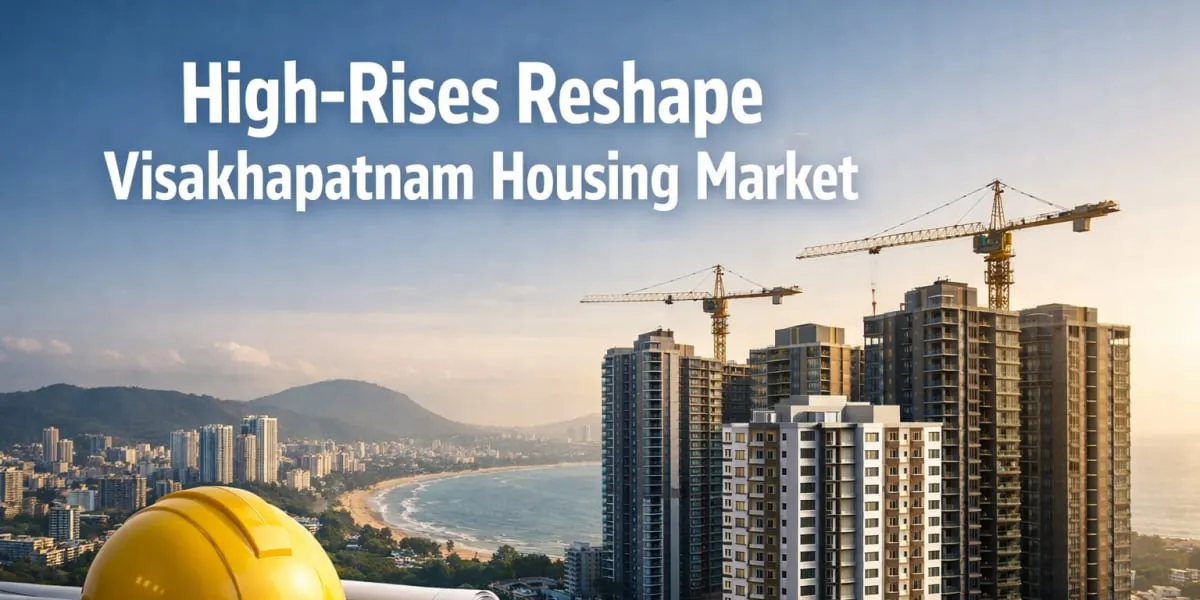
Rising land prices and the limited availability of large well?located plots are reshaping the residential landscape of Visakhapatnam as developers increasingly opt for high?rise housing projects. Industry representatives say that land values in prime areas have climbed to levels where low?rise developments are difficult to sustain, prompting a shift to vertical construction as a practical way to optimise land use and maintain project viability.

Developers report that high?rise projects allow the distribution of land cost across a greater number of housing units, helping to manage rising expenses and preserve price balance in a competitive market. Buyer preferences have also evolved, with purchasers placing emphasis on security, dedicated parking and shared amenities rather than horizontal layouts alone. Demand for housing remains steady, supported by employment growth in the information technology sector and allied industries.

Several micro?markets are witnessing increased activity in vertical residential launches, particularly in the Madhurawada?Kapuluppada corridor, the Anandapuram?Kommadi area, the Bhogapuram?Bheemili stretch and the Yendada?Rushikonda coastal belt. Developers attribute the uptake to road expansions, infrastructure upgrades and improved connectivity which make higher density projects more feasible. Land?use efficiency is said to improve where vertical expansion is supported by adequate civic services and planned urban growth.

Industry leaders underline the need for clear regulations and faster approvals by authorities to ensure projects are completed on schedule and that costs are kept under control. They argue that timely permissions and coordinated civic investment can reduce construction delays and financial strain, thereby sustaining investor confidence and protecting buyers. Urban planners caution that vertical growth must be accompanied by investment in transport, water and sanitation to avoid pressure on existing systems and to secure long?term liveability.

Rising land prices and the limited availability of large well?located plots are reshaping the residential landscape of Visakhapatnam as developers increasingly opt for high?rise housing projects. Industry representatives say that land values in prime areas have climbed to levels where low?rise developments are difficult to sustain, prompting a shift to vertical construction as a practical way to optimise land use and maintain project viability. Developers report that high?rise projects allow the distribution of land cost across a greater number of housing units, helping to manage rising expenses and preserve price balance in a competitive market. Buyer preferences have also evolved, with purchasers placing emphasis on security, dedicated parking and shared amenities rather than horizontal layouts alone. Demand for housing remains steady, supported by employment growth in the information technology sector and allied industries. Several micro?markets are witnessing increased activity in vertical residential launches, particularly in the Madhurawada?Kapuluppada corridor, the Anandapuram?Kommadi area, the Bhogapuram?Bheemili stretch and the Yendada?Rushikonda coastal belt. Developers attribute the uptake to road expansions, infrastructure upgrades and improved connectivity which make higher density projects more feasible. Land?use efficiency is said to improve where vertical expansion is supported by adequate civic services and planned urban growth. Industry leaders underline the need for clear regulations and faster approvals by authorities to ensure projects are completed on schedule and that costs are kept under control. They argue that timely permissions and coordinated civic investment can reduce construction delays and financial strain, thereby sustaining investor confidence and protecting buyers. Urban planners caution that vertical growth must be accompanied by investment in transport, water and sanitation to avoid pressure on existing systems and to secure long?term liveability.

Next Story
Infrastructure Urban

MIDC and Ramky Unit Sign Concession for Life Sciences Park

Maharashtra Industrial Development Corporation has signed a concession agreement with Maha Integrated Life Sciences City Limited (MILeS City), a wholly owned subsidiary of Ramky Infrastructure Limited (RIL), to develop a high-tech pharmaceutical park at Dighi Port Industrial Area in Raigad. The project will follow a public-private partnership under a DBFOT model and has an estimated cost of Rs 30 billion (Rs 30 bn). The concession will run for 95 years, including a five-year construction phase, with MILeS City responsible for development and management. The development will occupy approximatel..

Next Story
Real Estate

BuzzWorks Leases Hyderabad Office to MyComplianceOffice

Brigade Group’s managed workspace provider BuzzWorks has leased 550 seats at Mindspace Business Park in Hyderabad to Dublin based MyComplianceOffice, in what is the company’s largest office in India. With this signing, BuzzWorks' total leased office space in Hyderabad stands at zero point one one million (mn) square feet. The new premises will house core functions including product engineering, product management, customer success and global operations. Artificial intelligence enabled compliance technology initiatives will also be part of the local delivery model. BuzzWorks will provide wo..

Next Story
Infrastructure Transport

Jindal Stainless Flags Operational Strain From Middle East Crisis

Jindal Stainless warned that the Middle East war crisis has affected its operations because of dependence on industrial gases such as propane and LPG and on natural gas. The scrap-based production route used by the stainless steel maker does not generate blast furnace or coke oven gases internally, unlike the conventional steel industry. Several plant processes have been adversely impacted and production is being run at rationalised capacity. Disruptions in global shipping routes have resulted in vessel diversions, longer transit times and cargo delays, adding pressure to supply chains and to ..

Advertisement

Subscribe to Our Newsletter

Get daily newsletters around different themes from Construction world.

STAY CONNECTED

Advertisement

Advertisement

Advertisement