

India's Real Estate Investment Shifts to Income Growth: JLL
Real Estate

India's Real Estate Investment Shifts to Income Growth: JLL

India's commercial real estate market is entering a new phase of value creation, with investor returns increasingly driven by rental income growth, operational efficiency and strategic asset selection rather than capitalisation rate compression, according to JLL's report, A Decade of Change: The Institutionalization of Commercial Real Estate in India.

The report indicates that high-quality office assets can continue to deliver double-digit unlevered internal rates of return (IRR) over a typical five-year investment period, supported by resilient net operating income (NOI) growth and sustained occupier demand.

India has attracted approximately $78 billion in institutional real estate investment since 2014, with office properties accounting for 46% of total capital deployment. Between 2016 and the third quarter of 2026, capitalisation rates declined by 270 basis points for offices, 320 basis points for retail and 250 basis points for warehousing.

Lata Pillai, Senior Managing Director and Head of Capital Markets, India, JLL, said the market was shifting from broad-based asset revaluation towards long-term value creation through income growth and operational excellence.

The office sector offers approximately 500 million sq ft of institutional-grade stock, alongside 200 million sq ft of non-premium assets suitable for repositioning. An additional 241 million sq ft of office space is in the development pipeline, including 160 million sq ft of premium inventory.

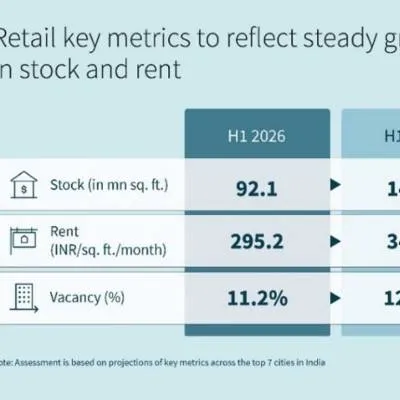
In retail, nearly 60% of the existing 50 million sq ft of premium stock remains under non-institutional ownership, creating acquisition opportunities. A further 40 million sq ft is expected by 2030, with premium developments accounting for 70% of the pipeline.

Warehousing is also witnessing substantial expansion, with 324 million sq ft of upcoming supply, of which 77% is Grade A. This is expected to increase the Grade A share of total warehousing stock from 57% to 65% by 2030.

India's Grade A office inventory has more than doubled from 439 million sq ft in 2014 to 952 million sq ft in Q3 2026. Global Capability Centres have accounted for over 40% of office leasing during the past decade, supporting occupancy and rental stability.

JLL expects capitalisation rates for core warehousing and premium retail assets to approach 7%, while premium office assets remain below 8%. The expanding REIT and InvIT ecosystem is expected to improve investment liquidity and exit opportunities, reinforcing India's attractiveness to long-term institutional investors.

India's commercial real estate market is entering a new phase of value creation, with investor returns increasingly driven by rental income growth, operational efficiency and strategic asset selection rather than capitalisation rate compression, according to JLL's report, A Decade of Change: The Institutionalization of Commercial Real Estate in India.The report indicates that high-quality office assets can continue to deliver double-digit unlevered internal rates of return (IRR) over a typical five-year investment period, supported by resilient net operating income (NOI) growth and sustained occupier demand.India has attracted approximately $78 billion in institutional real estate investment since 2014, with office properties accounting for 46% of total capital deployment. Between 2016 and the third quarter of 2026, capitalisation rates declined by 270 basis points for offices, 320 basis points for retail and 250 basis points for warehousing.Lata Pillai, Senior Managing Director and Head of Capital Markets, India, JLL, said the market was shifting from broad-based asset revaluation towards long-term value creation through income growth and operational excellence.The office sector offers approximately 500 million sq ft of institutional-grade stock, alongside 200 million sq ft of non-premium assets suitable for repositioning. An additional 241 million sq ft of office space is in the development pipeline, including 160 million sq ft of premium inventory.In retail, nearly 60% of the existing 50 million sq ft of premium stock remains under non-institutional ownership, creating acquisition opportunities. A further 40 million sq ft is expected by 2030, with premium developments accounting for 70% of the pipeline.Warehousing is also witnessing substantial expansion, with 324 million sq ft of upcoming supply, of which 77% is Grade A. This is expected to increase the Grade A share of total warehousing stock from 57% to 65% by 2030.India's Grade A office inventory has more than doubled from 439 million sq ft in 2014 to 952 million sq ft in Q3 2026. Global Capability Centres have accounted for over 40% of office leasing during the past decade, supporting occupancy and rental stability.JLL expects capitalisation rates for core warehousing and premium retail assets to approach 7%, while premium office assets remain below 8%. The expanding REIT and InvIT ecosystem is expected to improve investment liquidity and exit opportunities, reinforcing India's attractiveness to long-term institutional investors.

Related Stories

Gold Stories

Next Story
Infrastructure Urban

Copeland Expands Scroll Compressor Manufacturing in India

Copeland has expanded its manufacturing capabilities in Atit, Maharashtra, becoming the first company to manufacture scroll compressors in India. Production began in December 2025, marking a significant milestone in strengthening domestic manufacturing capabilities for heating, ventilation, air conditioning and refrigeration (HVACR) applications.The expansion forms part of Copeland's Rs 5 billion investment initiative announced in 2024, which also includes strengthening its engineering and innovation capabilities in Pune. The investment aims to support India's growing HVACR market while enhanc..

Next Story
Infrastructure Energy

RAYZON Solar to Commission 5.1 GW TOPCon Cell Plant in December

RAYZON Solar Limited is set to commence operations at its 5.1 GW TOPCon solar cell manufacturing facility in December 2026, with initial deliveries expected in the first quarter of 2027. The expansion marks a significant step towards strengthening backward integration and reducing India's dependence on imported solar components.Founded in 2017 by Chirag Nakrani and Hardik Kothiya, the company currently operates an installed solar module manufacturing capacity of 11.3 GW. The upcoming facility will expand its presence beyond module manufacturing into solar cell production, supporting India's do..

Next Story
Infrastructure Urban

Privi Q2 FY27 PAT Rises 24.61% to Rs 1.17 Billion

Privi Speciality Chemicals reported total income of Rs 7.73 billion for the quarter ended 30 September 2026, up 13.90% year-on-year. EBITDA rose 16.66% to Rs 2.12 billion, while profit after tax attributable to the company increased 24.61% to Rs 1.17 billion. EBITDA margin improved by 65 basis points to 27.48%.For the first half of FY27, total income grew 16.7% to Rs 14.54 billion. EBITDA increased 17.6% to Rs 3.79 billion and profit after tax rose 29.1% to Rs 2.01 billion. Net cash from operating activities stood at Rs 3.6 billion. Net debt-to-EBITDA improved 32.1% year-on-year to 1.07x.Privi..

Advertisement

Subscribe to Our Newsletter

Get daily newsletters around different themes from Construction world.

STAY CONNECTED

Advertisement

SPECIAL OFFER
QR Code