+
Mumbai collectors hold joint meet with real estate bodies
Real Estate

Mumbai collectors hold joint meet with real estate bodies

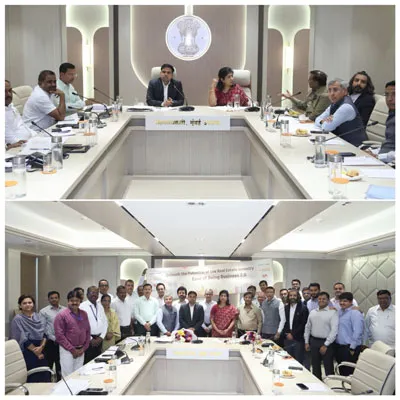
The District Collectors of Mumbai City and Mumbai Suburban have held a joint meeting with leading real estate bodies to address long-pending issues related to land administration and revenue processes, as per news reports.
The meeting brought together Aanchal Goyal, District Collector, Mumbai City, and Saurabh Katiyar, District Collector, Mumbai Suburban, with a Joint Task Force comprising representatives of CREDAI-MCHI, NAREDCO, Builders' Association of India (BDA), and PEATA, along with senior officials from both Collectorates.
Setting the tone, Goyal said issues flagged by the industry—particularly royalty applicability, procedural timelines and duplication of surveys—require systemic correction. She said both Collectorates are aligned on introducing clear, SOP-driven mechanisms to simplify processes, reduce ambiguity and ensure uniformity while maintaining statutory compliance.
Katiyar said a joint forum enables coordinated governance and consistent decision-making across City and Suburban jurisdictions. He added that proposals such as unified physical surveys, streamlined amalgamation and subdivision procedures, and enhanced transparency in land records would be examined through a structured institutional mechanism for time-bound implementation.
Industry representatives raised concerns around royalty on excavated soil—especially cases where material is not transported off-site—short validity periods, discrepancies in excavation quantity calculations, and approval delays. The Collectors assured that simplified and time-bound SOPs for royalty permissions would be introduced. Delays in amalgamation and subdivision proposals were also discussed, with assurances of dedicated SOPs to significantly reduce timelines.
Another key reform discussed was the introduction of a single, unified physical survey usable across multiple processes, including non-agricultural permissions, demarcation, amalgamation/subdivision and amenities handover, to avoid duplication and repeated site visits.
Sukhraj Nahar, President, CREDAI-MCHI, said the joint commitment to SOP-driven processes and unified surveys signals practical, time-bound reforms to improve ease of doing business while strengthening governance. Kamlesh Thakur said SOP-led clarity would enhance predictability across the sector. Representatives from BDA and PEATA said streamlined approvals would reduce procedural redundancies.
The Joint Task Force said a steering committee would be formed with officials from the Collectorates and ancillary departments to convert deliberations into on-ground reforms and recommend policy changes where required.

The District Collectors of Mumbai City and Mumbai Suburban have held a joint meeting with leading real estate bodies to address long-pending issues related to land administration and revenue processes, as per news reports.The meeting brought together Aanchal Goyal, District Collector, Mumbai City, and Saurabh Katiyar, District Collector, Mumbai Suburban, with a Joint Task Force comprising representatives of CREDAI-MCHI, NAREDCO, Builders' Association of India (BDA), and PEATA, along with senior officials from both Collectorates.Setting the tone, Goyal said issues flagged by the industry—particularly royalty applicability, procedural timelines and duplication of surveys—require systemic correction. She said both Collectorates are aligned on introducing clear, SOP-driven mechanisms to simplify processes, reduce ambiguity and ensure uniformity while maintaining statutory compliance.Katiyar said a joint forum enables coordinated governance and consistent decision-making across City and Suburban jurisdictions. He added that proposals such as unified physical surveys, streamlined amalgamation and subdivision procedures, and enhanced transparency in land records would be examined through a structured institutional mechanism for time-bound implementation.Industry representatives raised concerns around royalty on excavated soil—especially cases where material is not transported off-site—short validity periods, discrepancies in excavation quantity calculations, and approval delays. The Collectors assured that simplified and time-bound SOPs for royalty permissions would be introduced. Delays in amalgamation and subdivision proposals were also discussed, with assurances of dedicated SOPs to significantly reduce timelines.Another key reform discussed was the introduction of a single, unified physical survey usable across multiple processes, including non-agricultural permissions, demarcation, amalgamation/subdivision and amenities handover, to avoid duplication and repeated site visits.Sukhraj Nahar, President, CREDAI-MCHI, said the joint commitment to SOP-driven processes and unified surveys signals practical, time-bound reforms to improve ease of doing business while strengthening governance. Kamlesh Thakur said SOP-led clarity would enhance predictability across the sector. Representatives from BDA and PEATA said streamlined approvals would reduce procedural redundancies.The Joint Task Force said a steering committee would be formed with officials from the Collectorates and ancillary departments to convert deliberations into on-ground reforms and recommend policy changes where required.

Next Story
Equipment

Kabelschlepp India Installs Robotic VMC in Bengaluru

Kabelschlepp India, part of the Tsubaki Group, has installed a state-of-the-art Vertical Machining Center (VMC) integrated with robotic automation at its Bengaluru facility. The inauguration was held in the presence of Henning Preis, President & CEO, Kabelschlepp Group, Jörg Schulz, Vice President – Production, and Srinivas P. Kamisetty, Managing Director, Kabelschlepp India.The high-precision CNC VMC is designed for advanced milling, drilling, tapping and multi-axis machining. Equipped with a vertical spindle orientation, automatic tool changer and intelligent CNC control system, it en..

Next Story
Infrastructure Transport

Highway Delivery Reset!

Project delays and inefficiencies continue to bedevil the progress of India’s National Highways network. A multi-pronged reform agenda is needed to inject greater transparency and accountability at every stage – from planning and procurement to execution, maintenance and oversight. This article offers key recommendations and reform strategies that government stakeholders – from the Ministry of Road Transport & Highways (MoRTH) and the National Highways Authority of India (NHAI) to state agencies and oversight bodies – should pursue to put highway development on a better track.Decen..

Next Story
Infrastructure Transport

MSIDC Executes ₹37,000 Crore Road Programme

With Rs 37,000 crore worth of road projects under execution across Maharashtra, Maharashtra State Infrastructure Development Corporation (MSIDC) is driving one of the state’s largest infrastructure programmes. Dr Brijesh Dixit, Managing Director, discusses the institutional reforms, execution frameworks, financing strategies and technology adoption enabling timely, high-quality delivery, in conversation with PRATAP PADODE, Editor-in-Chief, CW.With over Rs 37,000 crore worth of road projects underway across districts – many under tight timelines – what institutional and executio..

Advertisement

Subscribe to Our Newsletter

Get daily newsletters around different themes from Construction world.

STAY CONNECTED

Advertisement

Advertisement

Advertisement

Open In App