Russia Offers Oil Diversion To India Amid Hormuz Crisis
ECONOMY & POLICY

Russia Offers Oil Diversion To India Amid Hormuz Crisis

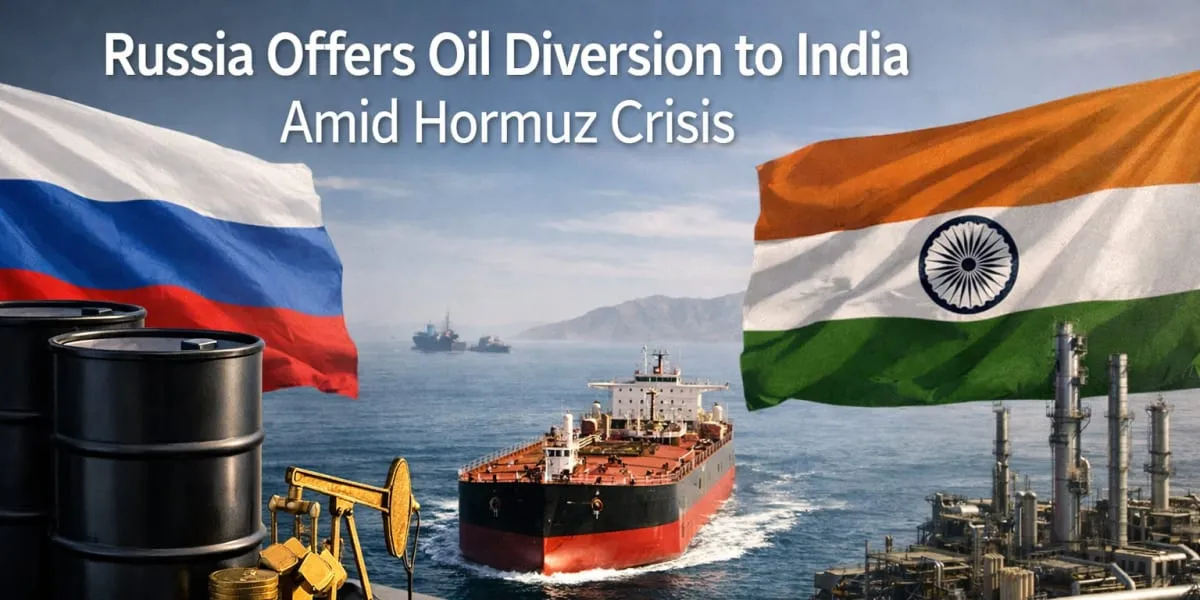
Russia has offered to divert shipments of crude oil to India to offset supply disruptions linked to the Strait of Hormuz crisis, with nine point five million (mn) barrels of Russian crude reported in vessels near Indian waters and able to arrive within weeks. An industry source said cargoes on non-Russian ships could be redirected to give refiners rapid relief without disclosing original destinations.

India is exposed to supply shocks because crude stocks cover about 25 days of demand, with refiners holding similarly limited inventories of gasoil, petrol and liquefied petroleum gas. Around 40 per cent of India’s crude imports transit the Strait of Hormuz, and near closure of the route has compelled the country to seek alternative supplies. Indian refiners process about five point six mn barrels per day, limiting the time available to reroute feedstocks.

The industry source said Russia was prepared to meet up to 40 per cent of India’s crude needs if required, while Indian purchases of Russian crude fell to about one point one mn barrels per day in January before rising back to roughly 30 per cent of imports in February. Any material increase in shipments from Moscow was indicated to depend on government guidance as trade talks with the United States continue and as India seeks to balance geopolitical pressures. New Delhi has reiterated that its strategy is to diversify supplies in line with market conditions and evolving international dynamics.

Russia was also reported to be ready to sell liquefied natural gas after a major supplier curtailed output, and Indian companies have reduced gas supplies to some industrial customers to manage shortfalls. Both China and India obtain about half of their crude from the Middle East, but India has less storage and is therefore more exposed to regional disruption. The situation has prompted authorities and firms to explore a range of logistics and procurement options to maintain refinery runs and fuel supplies.

"Join industry leaders at RAHSTA Expo, India's premier platform for roads, highways and traffic infrastructure. Register now to explore innovations, network with experts and shape the future of mobility."

Russia has offered to divert shipments of crude oil to India to offset supply disruptions linked to the Strait of Hormuz crisis, with nine point five million (mn) barrels of Russian crude reported in vessels near Indian waters and able to arrive within weeks. An industry source said cargoes on non-Russian ships could be redirected to give refiners rapid relief without disclosing original destinations. India is exposed to supply shocks because crude stocks cover about 25 days of demand, with refiners holding similarly limited inventories of gasoil, petrol and liquefied petroleum gas. Around 40 per cent of India’s crude imports transit the Strait of Hormuz, and near closure of the route has compelled the country to seek alternative supplies. Indian refiners process about five point six mn barrels per day, limiting the time available to reroute feedstocks. The industry source said Russia was prepared to meet up to 40 per cent of India’s crude needs if required, while Indian purchases of Russian crude fell to about one point one mn barrels per day in January before rising back to roughly 30 per cent of imports in February. Any material increase in shipments from Moscow was indicated to depend on government guidance as trade talks with the United States continue and as India seeks to balance geopolitical pressures. New Delhi has reiterated that its strategy is to diversify supplies in line with market conditions and evolving international dynamics. Russia was also reported to be ready to sell liquefied natural gas after a major supplier curtailed output, and Indian companies have reduced gas supplies to some industrial customers to manage shortfalls. Both China and India obtain about half of their crude from the Middle East, but India has less storage and is therefore more exposed to regional disruption. The situation has prompted authorities and firms to explore a range of logistics and procurement options to maintain refinery runs and fuel supplies.

Next Story
Real Estate

Pecan Realty Completes Rs 1.5 Billion Transactions

Pecan Realty has recently completed four institutional transactions worth over Rs 1.5 billion over the past two years, strengthening its position as an execution-led real estate platform. The deals include resolution-led acquisitions, structured finance transactions and capital partnerships across its development portfolio.The transactions covered acquisitions through the National Company Law Tribunal process and helped provide repayment or exits to both private and public sector lenders. The company said the deals demonstrate its ability to resolve complex project situations, work with instit..

Next Story
Real Estate

SNN Estates Expands North Bengaluru Housing Project

SNN Estates has announced an expansion of its SNN Estates Felicity residential project in North Bengaluru following strong buyer demand, with 75 per cent of the first-phase inventory sold within three days of launch.The developer will add 76 apartments in the new phase, taking the project's estimated revenue potential to around Rs 1,000 crore upon completion of Phase 2.Spread across 6.5 acres in Rachenahalli, near Manyata Tech Park, the project comprises 604 apartments in 1.5, 2, 2.5, 3 and 4 BHK configurations. The development includes a 50,000-sq-ft clubhouse with amenities such as sports co..

Next Story
Infrastructure Urban

SCG Drives ASEAN Industrial Transformation Strategy

SCG is strengthening its focus on ASEAN as a key growth region by advancing industrial transformation, enhancing competitiveness and building resilient regional value chains. Thammasak Sethaudom, President and Chief Executive Officer, SCG, highlighted the need for industries to continuously develop capabilities, strengthen resilience and deepen regional cooperation to achieve sustainable long-term growth.SCG views ASEAN as an important growth engine alongside China, supported by favourable demographics, trade connectivity and investment flows. With ASEAN’s GDP projected to grow by around 4.7..

Advertisement

Subscribe to Our Newsletter

Get daily newsletters around different themes from Construction world.

STAY CONNECTED

Advertisement

Advertisement

Advertisement