Apraava Energy Commences Rajasthan Transmission Line
POWER & RENEWABLE ENERGY

Apraava Energy Commences Rajasthan Transmission Line

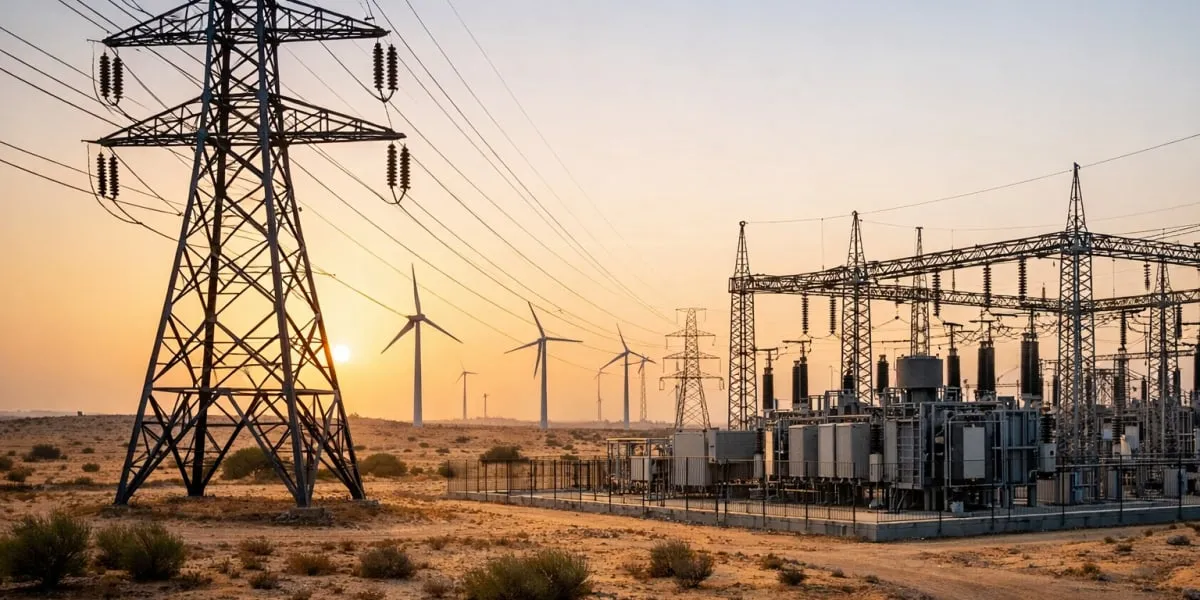
Apraava Energy has begun operations of a 400-kV electricity transmission line and a pooling substation in Rajasthan. The 22 km Fatehgarh IV transmission line in Barmer is a key component of the transmission scheme designed to evacuate renewable energy from the renewable energy zones in Rajasthan under Phase-III Part A1. A pooling substation brings together multiple renewable units and connects them to a central point to streamline evacuation. The Jaisalmer-Barmer region hosts substantial renewable resources and requires strengthened evacuation corridors to move generation to demand centres.

The new link has a transmission capacity of two point five gigawatt (GW) of renewable power delivered through five 500 MVA transformers and connects to Apraava Energy's Fatehgarh-III substation. This integration significantly enhances the capability to evacuate generation from the Jaisalmer-Barmer region and supports the reliable flow of power to downstream networks. The arrangement of five 500 MVA transformers is intended to provide operational redundancy and high throughput for sustained dispatch.

Apraava Energy said its managing director, Rajiv Ranjan Mishra, described the project as an enabler to strengthen the transmission infrastructure of Rajasthan and to ensure reliable dispatch of renewable energy to remote regions of the country. The company currently operates three power transmission assets spanning 516 km across Rajasthan, Madhya Pradesh, Assam, Nagaland, and Manipur, with a substation capacity of three point five GW. The addition complements the existing network by improving redundancy and operational flexibility across the company's transmission portfolio.

The commissioning of the Fatehgarh IV line forms part of broader efforts to bolster transmission capacity and facilitate the integration of renewable generation into the grid. Enhanced evacuation capability is expected to support the energy transition by reducing curtailment and enabling generation to reach demand centres more effectively. Operators anticipate improved grid stability and scheduling of intermittent generation as evacuation constraints are eased.

Apraava Energy has begun operations of a 400-kV electricity transmission line and a pooling substation in Rajasthan. The 22 km Fatehgarh IV transmission line in Barmer is a key component of the transmission scheme designed to evacuate renewable energy from the renewable energy zones in Rajasthan under Phase-III Part A1. A pooling substation brings together multiple renewable units and connects them to a central point to streamline evacuation. The Jaisalmer-Barmer region hosts substantial renewable resources and requires strengthened evacuation corridors to move generation to demand centres. The new link has a transmission capacity of two point five gigawatt (GW) of renewable power delivered through five 500 MVA transformers and connects to Apraava Energy's Fatehgarh-III substation. This integration significantly enhances the capability to evacuate generation from the Jaisalmer-Barmer region and supports the reliable flow of power to downstream networks. The arrangement of five 500 MVA transformers is intended to provide operational redundancy and high throughput for sustained dispatch. Apraava Energy said its managing director, Rajiv Ranjan Mishra, described the project as an enabler to strengthen the transmission infrastructure of Rajasthan and to ensure reliable dispatch of renewable energy to remote regions of the country. The company currently operates three power transmission assets spanning 516 km across Rajasthan, Madhya Pradesh, Assam, Nagaland, and Manipur, with a substation capacity of three point five GW. The addition complements the existing network by improving redundancy and operational flexibility across the company's transmission portfolio. The commissioning of the Fatehgarh IV line forms part of broader efforts to bolster transmission capacity and facilitate the integration of renewable generation into the grid. Enhanced evacuation capability is expected to support the energy transition by reducing curtailment and enabling generation to reach demand centres more effectively. Operators anticipate improved grid stability and scheduling of intermittent generation as evacuation constraints are eased.

Next Story
Infrastructure Urban

Leaders Question FIR Against Anil Agarwal

Several industry and public figures have questioned the FIR filed against Anil Agarwal following the boiler accident in Chhattisgarh, while also expressing condolences over the loss of lives and calling for a thorough investigation.Naveen Jindal said the tragedy was deeply painful and stressed that compensation, livelihood support for affected families and a fair probe were essential. He also questioned naming Agarwal in the FIR before completion of the investigation.Kiran Bedi urged restraint, saying investigations should focus on learning lessons and strengthening systems rather than prematu..

Next Story
Infrastructure Urban

Tier 2, 3 Cities Drive 66% of New D2C Orders

Tier 2 and Tier 3 cities accounted for 66 per cent of new direct-to-consumer (D2C) orders in FY 2026, according to a new analysis by Unicommerce.The report said buyers from smaller cities also contributed 60 per cent of incremental gross merchandise value (GMV) in FY 2026 compared with FY 2025, highlighting rising demand beyond metro markets.Overall, India’s D2C segment recorded strong growth, with order volumes rising 33 per cent and GMV increasing 32 per cent year-on-year. The findings are based on more than 400 million order items processed through brand websites on Unicommerce’s Uniwar..

Next Story
Infrastructure Urban

Chola Securities Gives Buy Call on Aadhar Housing

Chola Securities has initiated a buy call on Aadhar Housing Finance, projecting an upside potential of 24.8 per cent over a 15–18 month period.The brokerage cited the company’s steady business growth, with assets under management (AUM) rising at about 20 per cent CAGR between FY22 and FY25, while maintaining a similar year-on-year growth rate in 9MFY26. AUM increased from Rs 13,327 crore in FY21 to Rs 25,531 crore in FY25, and further to Rs 28,790 crore in 9MFY26.Chola Securities also highlighted the company’s asset quality, with gross NPAs at 1.40 per cent and net NPAs at 1.0 per cent, ..

Advertisement

Subscribe to Our Newsletter

Get daily newsletters around different themes from Construction world.

STAY CONNECTED

Advertisement

Advertisement

Advertisement