Raimondi T147 Flat-top Crane Drives Milan's Latest Restoration Project
Real Estate

Raimondi T147 Flat-top Crane Drives Milan's Latest Restoration Project

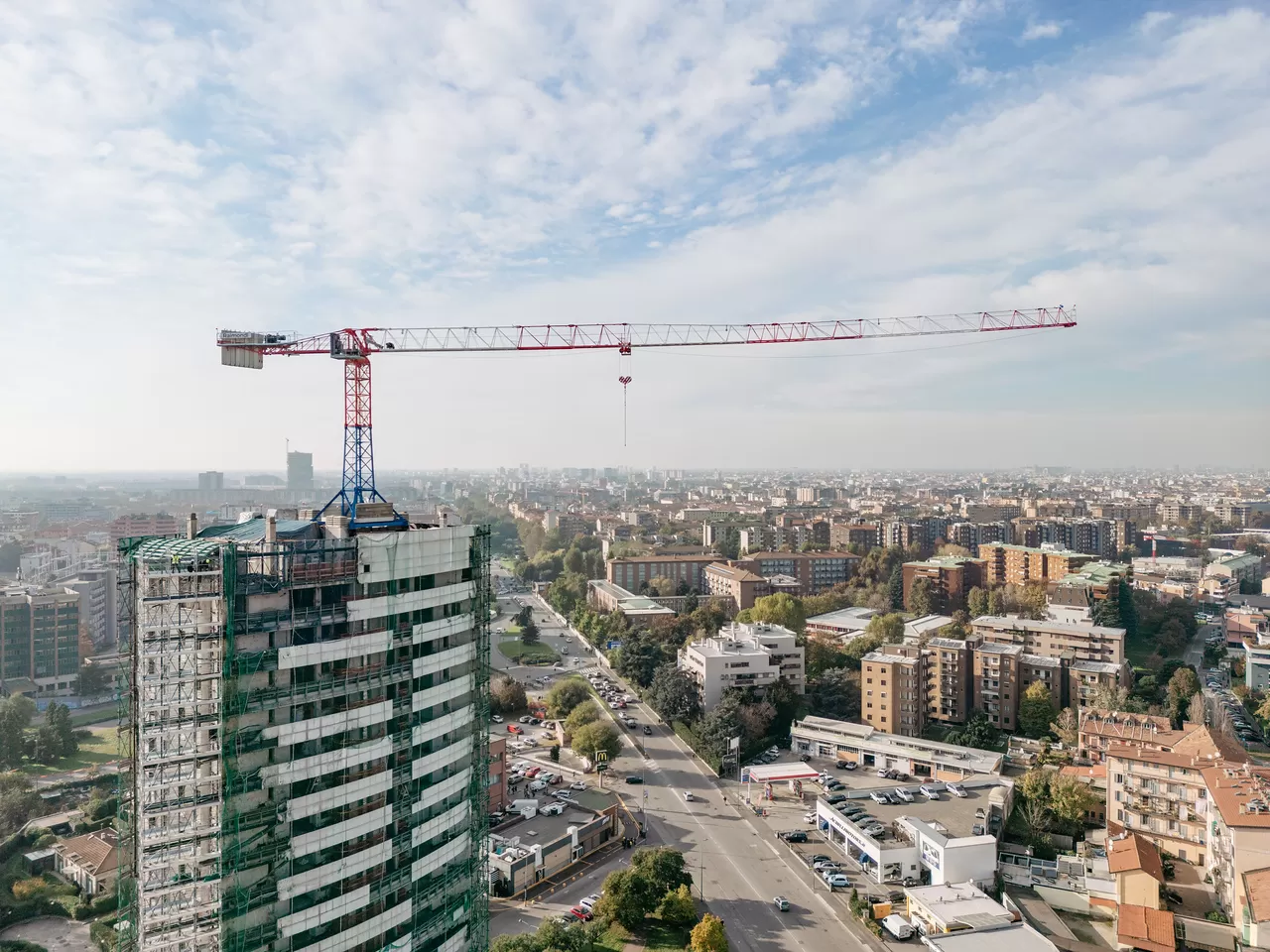
Official agent of Milan, Monza, and Brianza, Assistedile Srl has deployed a Raimondi T147 tower crane for the reconstruction of Torre dei Moro. 

The 20-story residential building, severely damaged by a fire in 2021, is now undergoing a major rebuild to restore its place in Milan’s skyline. 

“We are proud to support the redevelopment of one of the city’s prominent urban skyscrapers by renting a Raimondi T147 to IMPRECOM Srl, contractor of the project,” stated Luciano Friso, Director General, Assistedile. 

Due to the site’s unique nature and the necessity to preserve unaffected building elements, Assistedile’s operations team carefully evaluated the positioning and installation of the machine. 

The T147 was chosen to meet the complex jobsite’s requirements. Additional objectives, alongside preservation, including optimizing site safety, maximizing crane productivity, and reducing contractor costs.

“After extensive analysis and technical considerations, we opted for installing the flat-top directly atop the building with the support of a 350t mobile crane,” explained Alessandro Morosi, Technical Manager and Partner, Assistedile.

“This operation was made possible due to some of the T147’s key characteristics; weight-optimised carpentry elements and ease of jib assembly,” Morosi said. “The crane’s versatility, coupled with the great lifting performances fully met our client’s needs.”  

Positioned at a height of 67m on the rooftop of the structure, the Raimondi T147 is configured with a 18m mast and a maximum jib length of 62.5m. 

Standing at a final height of 85m, the 8t-heavy lifter presents a tip load of 1.45t and a hoisting gear of 37kW, allowing it to lift at a maximum speed of 105m/min and have a drum capacity of 620m. 

As part of Class 110, the flat-top is equipped with the ConCore control system, proving end-users with several technical and operational improvements, including advanced error diagnostics, faster commissioning, and enhanced safety features.  

The Raimondi T147 will remain onsite for approximately two years, supporting the revitalization of Torre dei Moro and helping to restore the residential tower to its former prominence in Milan’s cityscape. 

As a core part of Raimondi’s legacy, the involvement in this project reaffirms the company’s commitment to support the redevelopment of Italy’s key architectural infrastructure. 

Since focusing on the manufacturing of tower cranes for the country’s reconstruction after the World War II, in 1947, Raimondi machines have been instrumental in the renovation of several historic and primarily sites including the recovery of San Paolo Apostolo church and convent in Florence, the rebuild of numerous residential units in the city of L’Aquila, severely affected by an earthquake, and also the construction of some of Italy’s major healthcare infrastructure. 

“Building on our values and mission, we are honoured to contribute to projects of this nature, as they underscore our enduring dedication to Italy’s growth and development,” commented Luigi Maggioni, Group CEO, Raimondi Cranes. 

Official agent of Milan, Monza, and Brianza, Assistedile Srl has deployed a Raimondi T147 tower crane for the reconstruction of Torre dei Moro. The 20-story residential building, severely damaged by a fire in 2021, is now undergoing a major rebuild to restore its place in Milan’s skyline. “We are proud to support the redevelopment of one of the city’s prominent urban skyscrapers by renting a Raimondi T147 to IMPRECOM Srl, contractor of the project,” stated Luciano Friso, Director General, Assistedile. Due to the site’s unique nature and the necessity to preserve unaffected building elements, Assistedile’s operations team carefully evaluated the positioning and installation of the machine. The T147 was chosen to meet the complex jobsite’s requirements. Additional objectives, alongside preservation, including optimizing site safety, maximizing crane productivity, and reducing contractor costs.“After extensive analysis and technical considerations, we opted for installing the flat-top directly atop the building with the support of a 350t mobile crane,” explained Alessandro Morosi, Technical Manager and Partner, Assistedile.“This operation was made possible due to some of the T147’s key characteristics; weight-optimised carpentry elements and ease of jib assembly,” Morosi said. “The crane’s versatility, coupled with the great lifting performances fully met our client’s needs.”  Positioned at a height of 67m on the rooftop of the structure, the Raimondi T147 is configured with a 18m mast and a maximum jib length of 62.5m. Standing at a final height of 85m, the 8t-heavy lifter presents a tip load of 1.45t and a hoisting gear of 37kW, allowing it to lift at a maximum speed of 105m/min and have a drum capacity of 620m. As part of Class 110, the flat-top is equipped with the ConCore control system, proving end-users with several technical and operational improvements, including advanced error diagnostics, faster commissioning, and enhanced safety features.  The Raimondi T147 will remain onsite for approximately two years, supporting the revitalization of Torre dei Moro and helping to restore the residential tower to its former prominence in Milan’s cityscape. As a core part of Raimondi’s legacy, the involvement in this project reaffirms the company’s commitment to support the redevelopment of Italy’s key architectural infrastructure. Since focusing on the manufacturing of tower cranes for the country’s reconstruction after the World War II, in 1947, Raimondi machines have been instrumental in the renovation of several historic and primarily sites including the recovery of San Paolo Apostolo church and convent in Florence, the rebuild of numerous residential units in the city of L’Aquila, severely affected by an earthquake, and also the construction of some of Italy’s major healthcare infrastructure. “Building on our values and mission, we are honoured to contribute to projects of this nature, as they underscore our enduring dedication to Italy’s growth and development,” commented Luigi Maggioni, Group CEO, Raimondi Cranes. 

Next Story
Infrastructure Energy

Karnataka Clears Goa–Tamnar Line Despite Forest Impact

Karnataka has expedited approval for the contentious Goa–Tamnar power transmission project, clearing it only months after softening its stance and requesting a revised proposal from the implementing agency. The decision comes despite the project’s significant ecological risks to Mollem National Park, Bhagwan Mahavir Sanctuary and nearby villages, where large-scale forest diversion and fragmentation threaten sensitive Western Ghats ecosystems. The Karnataka Forest Department has now approved the updated proposal. The state government had earlier paused the project, linking the delay to Goa..

Next Story
Infrastructure Energy

Tata Power Commissions Koteshwar–Rishikesh Line

Tata Power has announced the commissioning of the 400 kV Koteshwar–Rishikesh transmission line, a major upgrade that strengthens North India’s grid by enabling the evacuation of 1,000 MW of clean hydropower. The line will transfer renewable energy from the Tehri–Koteshwar generation complex in Uttarakhand to multiple northern states and Union Territories, according to the company. The new infrastructure will supply clean energy not only to Uttarakhand but also to Haryana, Punjab, Uttar Pradesh, Jammu & Kashmir, Himachal Pradesh, Chandigarh, Rajasthan and Delhi. This is expected to signi..

Next Story
Infrastructure Transport

Telangana Outlines Major Rural Roads Push Under Vision 2047

The Telangana government has unveiled an ambitious rural mobility blueprint under its Telangana Rising 2047 vision, proposing two major road networks — the 770-kilometre Praja Valayam rural ring road and the 1,150-kilometre Telangana Maniharam corridor. Both corridors form part of a radio-centric grid designed to strengthen connectivity between rural communities, production centres, markets, and urban and semi-urban regions. Developed under the RARE (Rural Agriculture Region Economy) model, the blueprint envisions a comprehensive mobility ecosystem featuring a Regional Rapid Transit System,..

Advertisement

Subscribe to Our Newsletter

Get daily newsletters around different themes from Construction world.

STAY CONNECTED

Advertisement

Advertisement

Advertisement

Advertisement

Open In App