
+
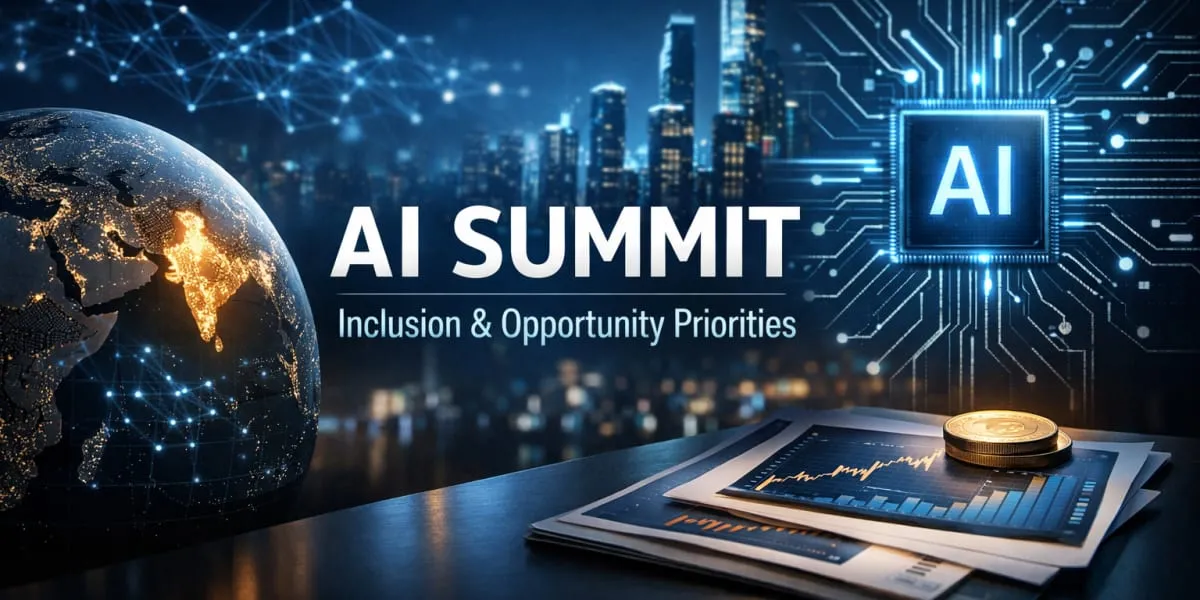
AI Summit Sets Inclusion And Opportunity As Priorities
Technology

AI Summit Sets Inclusion And Opportunity As Priorities

Three keynote addresses at the summit brought together leaders from fintech, research and global technology to outline how artificial intelligence (AI) is moving beyond experimentation into real-world transformation across finance, enterprise and human capability. The speeches positioned India as a hub for the next phase of AI development and highlighted the need to link technical sophistication with social benefits. Speakers emphasised inclusion, opportunity and the expansion of human potential as critical measures of progress.

Vijay Shekhar Sharma of Paytm presented the emergence of an AI India movement and framed the moment as a source of national pride while noting a shift from novelty to impact. He said artificial intelligence is increasingly applied in business, finance, agriculture and industry to solve real-world problems at scale. In financial services he outlined the potential for AI driven insights to deepen credit access and extend meaningful inclusion to the last mile, describing the development as a path to abundance rather than job loss.

Ananya Birla of Birla AI Labs outlined a dual mandate combining applied solutions for industry with foundational research that probes whether AI understands the structure of the world beyond pattern recognition. She urged industry to examine the effect of AI on human cognition and agency while embedding models across operations to unlock productivity gains. Birla highlighted microfinance as a space where AI can be most consequential for people, suggesting that careful deployment could expand financial access for underserved communities.

Takahito Tokita, President and CEO of Fujitsu, framed AI within a societal mission focused on sustainability and building trust through innovation, stressing a human-centric approach. He argued that AI must augment creativity, critical thinking and complex judgment rather than replace human autonomy. Together the speakers reinforced a shared theme that the next phase of AI will be judged by its ability to expand opportunity, deepen inclusion and strengthen human potential, positioning India and global industry leaders at the forefront of an AI driven future.

Three keynote addresses at the summit brought together leaders from fintech, research and global technology to outline how artificial intelligence (AI) is moving beyond experimentation into real-world transformation across finance, enterprise and human capability. The speeches positioned India as a hub for the next phase of AI development and highlighted the need to link technical sophistication with social benefits. Speakers emphasised inclusion, opportunity and the expansion of human potential as critical measures of progress. Vijay Shekhar Sharma of Paytm presented the emergence of an AI India movement and framed the moment as a source of national pride while noting a shift from novelty to impact. He said artificial intelligence is increasingly applied in business, finance, agriculture and industry to solve real-world problems at scale. In financial services he outlined the potential for AI driven insights to deepen credit access and extend meaningful inclusion to the last mile, describing the development as a path to abundance rather than job loss. Ananya Birla of Birla AI Labs outlined a dual mandate combining applied solutions for industry with foundational research that probes whether AI understands the structure of the world beyond pattern recognition. She urged industry to examine the effect of AI on human cognition and agency while embedding models across operations to unlock productivity gains. Birla highlighted microfinance as a space where AI can be most consequential for people, suggesting that careful deployment could expand financial access for underserved communities. Takahito Tokita, President and CEO of Fujitsu, framed AI within a societal mission focused on sustainability and building trust through innovation, stressing a human-centric approach. He argued that AI must augment creativity, critical thinking and complex judgment rather than replace human autonomy. Together the speakers reinforced a shared theme that the next phase of AI will be judged by its ability to expand opportunity, deepen inclusion and strengthen human potential, positioning India and global industry leaders at the forefront of an AI driven future.

Next Story
Equipment

Kabelschlepp India Installs Robotic VMC in Bengaluru

Kabelschlepp India, part of the Tsubaki Group, has installed a state-of-the-art Vertical Machining Center (VMC) integrated with robotic automation at its Bengaluru facility. The inauguration was held in the presence of Henning Preis, President & CEO, Kabelschlepp Group, Jörg Schulz, Vice President – Production, and Srinivas P. Kamisetty, Managing Director, Kabelschlepp India.The high-precision CNC VMC is designed for advanced milling, drilling, tapping and multi-axis machining. Equipped with a vertical spindle orientation, automatic tool changer and intelligent CNC control system, it en..

Next Story
Infrastructure Transport

Highway Delivery Reset!

Project delays and inefficiencies continue to bedevil the progress of India’s National Highways network. A multi-pronged reform agenda is needed to inject greater transparency and accountability at every stage – from planning and procurement to execution, maintenance and oversight. This article offers key recommendations and reform strategies that government stakeholders – from the Ministry of Road Transport & Highways (MoRTH) and the National Highways Authority of India (NHAI) to state agencies and oversight bodies – should pursue to put highway development on a better track.Decen..

Next Story
Infrastructure Transport

MSIDC Executes ₹37,000 Crore Road Programme

With Rs 37,000 crore worth of road projects under execution across Maharashtra, Maharashtra State Infrastructure Development Corporation (MSIDC) is driving one of the state’s largest infrastructure programmes. Dr Brijesh Dixit, Managing Director, discusses the institutional reforms, execution frameworks, financing strategies and technology adoption enabling timely, high-quality delivery, in conversation with PRATAP PADODE, Editor-in-Chief, CW.With over Rs 37,000 crore worth of road projects underway across districts – many under tight timelines – what institutional and executio..

Advertisement

Subscribe to Our Newsletter

Get daily newsletters around different themes from Construction world.

STAY CONNECTED

Advertisement

Advertisement

Advertisement

Open In App