India Launches Pilot to Test Toyota Mirai Hydrogen Car
Technology

India Launches Pilot to Test Toyota Mirai Hydrogen Car

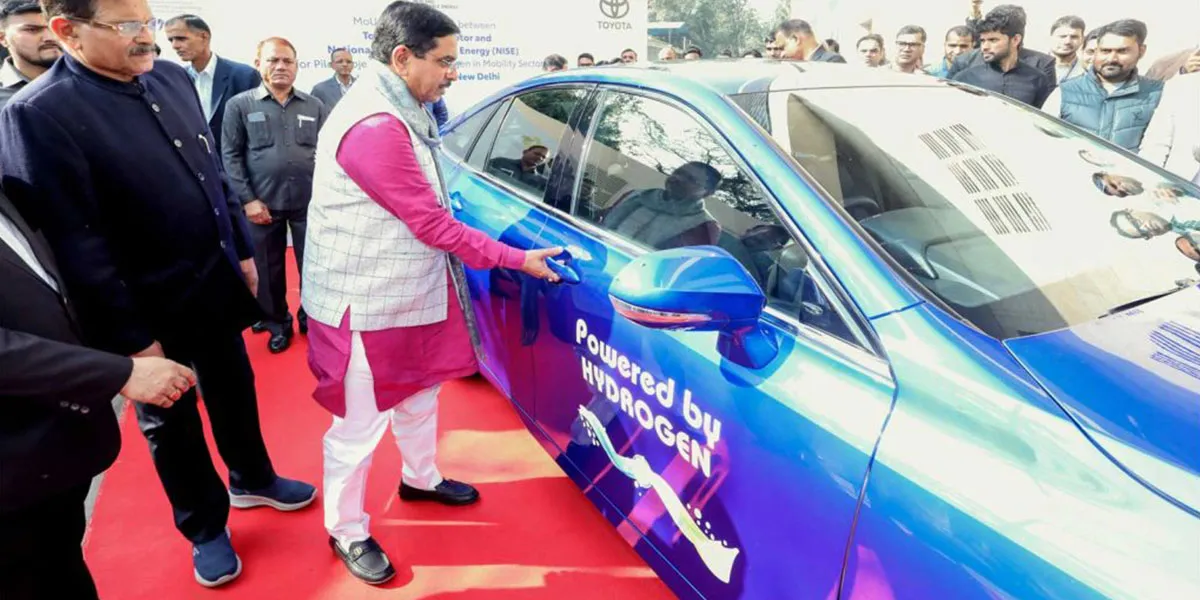
India has taken another step towards advancing green hydrogen-based mobility with the launch of a pilot project to test Toyota’s Mirai fuel cell electric vehicle under real-world Indian conditions. The initiative was launched on Thursday by Union Minister for New and Renewable Energy Pralhad Joshi, who described it as a key milestone in promoting clean transport solutions.

As part of the project, Toyota Kirloskar Motor has handed over the Mirai to the National Institute of Solar Energy, which will conduct two years of field trials. During this period, the institute will evaluate the vehicle’s performance across diverse Indian terrains, climatic conditions and traffic environments. The results are expected to inform future policy decisions, industry deployment and the scaling up of hydrogen-based mobility.

Joshi said green hydrogen is emerging as a critical pillar of global clean energy systems and will play a central role in India’s long-term energy transition. He added that the induction of the Mirai reflects growing collaboration between the government, research institutions and industry to advance fuel cell technologies, noting that hydrogen vehicles produce zero tailpipe emissions, releasing only water vapour.

Minister of State for New and Renewable Energy Shripad Yesso Naik said the pilot marks India’s shift from policy formulation to on-ground experimentation under the National Green Hydrogen Mission. He added that technology trials such as this would support efforts to commercialise hydrogen transport solutions and improve urban air quality.

Toyota Kirloskar Motor said the initiative reinforces its commitment to India’s hydrogen mission and its broader goal of achieving net-zero emissions. Senior officials from the Ministry of New and Renewable Energy and the National Institute of Solar Energy were present at the launch event.

Following the inauguration, Joshi drove the Mirai to Parliament, describing the green-certified complex as an apt venue to demonstrate emerging clean mobility technologies.

The Toyota Mirai is a second-generation hydrogen fuel cell vehicle that generates electricity onboard through a chemical reaction between hydrogen and oxygen, emitting only water vapour. The model has an estimated driving range of around 650 kilometres and can be refuelled in less than five minutes.

India has taken another step towards advancing green hydrogen-based mobility with the launch of a pilot project to test Toyota’s Mirai fuel cell electric vehicle under real-world Indian conditions. The initiative was launched on Thursday by Union Minister for New and Renewable Energy Pralhad Joshi, who described it as a key milestone in promoting clean transport solutions. As part of the project, Toyota Kirloskar Motor has handed over the Mirai to the National Institute of Solar Energy, which will conduct two years of field trials. During this period, the institute will evaluate the vehicle’s performance across diverse Indian terrains, climatic conditions and traffic environments. The results are expected to inform future policy decisions, industry deployment and the scaling up of hydrogen-based mobility. Joshi said green hydrogen is emerging as a critical pillar of global clean energy systems and will play a central role in India’s long-term energy transition. He added that the induction of the Mirai reflects growing collaboration between the government, research institutions and industry to advance fuel cell technologies, noting that hydrogen vehicles produce zero tailpipe emissions, releasing only water vapour. Minister of State for New and Renewable Energy Shripad Yesso Naik said the pilot marks India’s shift from policy formulation to on-ground experimentation under the National Green Hydrogen Mission. He added that technology trials such as this would support efforts to commercialise hydrogen transport solutions and improve urban air quality. Toyota Kirloskar Motor said the initiative reinforces its commitment to India’s hydrogen mission and its broader goal of achieving net-zero emissions. Senior officials from the Ministry of New and Renewable Energy and the National Institute of Solar Energy were present at the launch event. Following the inauguration, Joshi drove the Mirai to Parliament, describing the green-certified complex as an apt venue to demonstrate emerging clean mobility technologies. The Toyota Mirai is a second-generation hydrogen fuel cell vehicle that generates electricity onboard through a chemical reaction between hydrogen and oxygen, emitting only water vapour. The model has an estimated driving range of around 650 kilometres and can be refuelled in less than five minutes.

Next Story
Infrastructure Transport

CMRL to Open 15.8 km Chennai Metro Phase II in February

Chennai Metro Rail (CMRL) has revised its rollout strategy for Phase II of the Chennai Metro, deciding to commission the entire 15.8-km stretch between Poonamallee Bypass and Vadapalani directly in February. The move marks a shift from the earlier plan of launching services on a shorter section first and extending them in stages.Initially, CMRL had proposed to start operations on the Poonamallee Bypass–Porur Junction stretch by the end of January, with services extended to Vadapalani in February. However, officials said the revised approach would allow commuters to benefit from better connec..

Next Story
Infrastructure Transport

Power Mech Emerges L1 for Mumbai Monorail O&M Contract

Power Mech Projects has emerged as the lowest bidder (L1) for the operations and maintenance (O&M) contract of the Mumbai Monorail project, officials said. The contract was floated by the Mumbai Metropolitan Region Development Authority (MMRDA) with a tenure of 1,825 days, or five years.MMRDA had invited bids for the O&M work of the Mumbai Monorail corridor from Sant Gadge Maharaj Chowk to Chembur. Technical bids were opened on November 12, 2025, with four firms submitting bids for the contract. Following the technical evaluation conducted on January 1, 2026, two bidders were disqualif..

Next Story
Infrastructure Transport

E to E Transportation Clarifies SECR Contract Value at Rs 270.35 Mn

NSE Emerge-listed E to E Transportation Infrastructure has issued a clarification on the value of a railway signalling and telecommunication contract awarded by the South East Central Railway (SECR), Raipur Division, after identifying a typographical error in its earlier regulatory disclosure.In a filing dated January 4, 2026, the company said the correct value of the Letter of Acceptance (LoA) is Rs 270.34 million, and not Rs 2.73 billion as previously stated in an announcement uploaded on the NSE Emerge portal earlier the same day. The company noted that the incorrect figure was the result o..

Advertisement

Subscribe to Our Newsletter

Get daily newsletters around different themes from Construction world.

STAY CONNECTED

Advertisement

Advertisement

Advertisement

Advertisement

Open In App