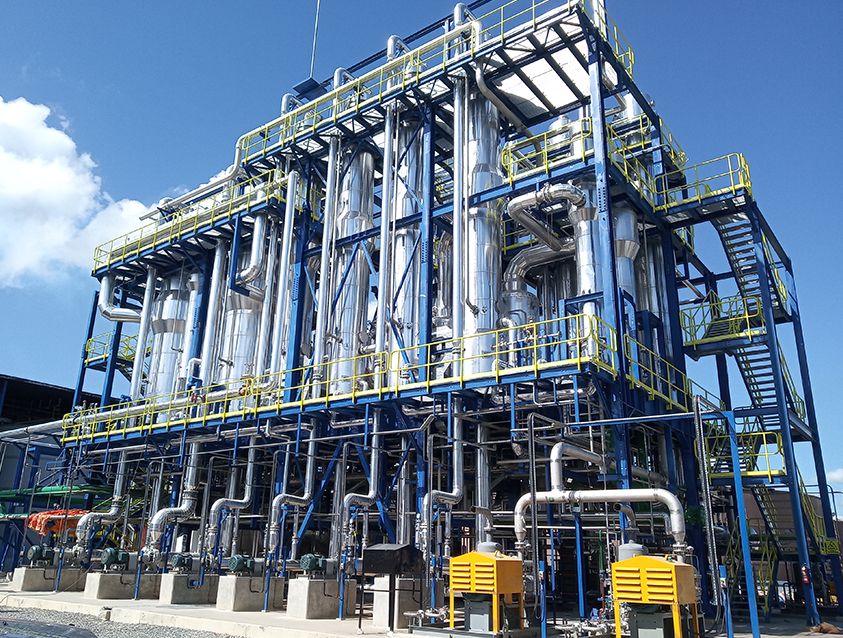
Praj Industries develops eco-friendly bio-bitumen
Technology

Praj Industries develops eco-friendly bio-bitumen

Pune-based biotechnology company Praj Industries has announced the production of a bio-bitumen based on lignin.

The company claimed that its bio-bitumen samples processed from purified lignin, as a part of its flagship CHAPLIN programme, has received a nod from the Netherlands-based Circular Biobased Delta (CBBD), one of Europe’s premier consortia in promoting bio-economy.

Under its flagship programme CHAPLIN, Praj aims to develop and commercialise bio-bitumen as a binder for use in asphalt to improve the green approach in road construction while reducing carbon dioxide intensity.

Lignin is one of the co-products resulting from the second generation ethanol plants, paper making, and also from compressed biogas plants.

A black viscous mixture of hydrocarbons, bitumen is produced by fractionation of crude oil and has a wide range of applications in road construction and roofing as a binder.

Praj has developed an advanced process to convert crude lignin into bio-bitumen, which can replace this fossil-based bitumen and offer eco-friendly green bitumen. The binding and viscoelastic property of bio-bitumen makes it useful for applications in asphalt.

Praj had provided bio-bitumen samples processed from wheat straw and rice and as feedstock in its 2G biorefinery demo plant in India to CBBD for testing and evaluation. After research, CBBD approved the bio-bitumen sample for scale-up in asphalt on a Dutch test strip on the road.

Praj is a biotechnology company driven by innovation and integration. Over the past four decades, Praj has focused on the environment, energy, and agri process industry, with over 750 customer references spanning 75 countries across five continents. BioMobility and Bio-Prism are the mainstays of Praj’s contribution to the global bio-economy.

Image Source


Also read: Stone mastic asphalt for heavy-traffic highways

Also read: Tripura gets first non-recyclable plastic waste road

Pune-based biotechnology company Praj Industries has announced the production of a bio-bitumen based on lignin. The company claimed that its bio-bitumen samples processed from purified lignin, as a part of its flagship CHAPLIN programme, has received a nod from the Netherlands-based Circular Biobased Delta (CBBD), one of Europe’s premier consortia in promoting bio-economy. Under its flagship programme CHAPLIN, Praj aims to develop and commercialise bio-bitumen as a binder for use in asphalt to improve the green approach in road construction while reducing carbon dioxide intensity. Lignin is one of the co-products resulting from the second generation ethanol plants, paper making, and also from compressed biogas plants. A black viscous mixture of hydrocarbons, bitumen is produced by fractionation of crude oil and has a wide range of applications in road construction and roofing as a binder. Praj has developed an advanced process to convert crude lignin into bio-bitumen, which can replace this fossil-based bitumen and offer eco-friendly green bitumen. The binding and viscoelastic property of bio-bitumen makes it useful for applications in asphalt. Praj had provided bio-bitumen samples processed from wheat straw and rice and as feedstock in its 2G biorefinery demo plant in India to CBBD for testing and evaluation. After research, CBBD approved the bio-bitumen sample for scale-up in asphalt on a Dutch test strip on the road. Praj is a biotechnology company driven by innovation and integration. Over the past four decades, Praj has focused on the environment, energy, and agri process industry, with over 750 customer references spanning 75 countries across five continents. BioMobility and Bio-Prism are the mainstays of Praj’s contribution to the global bio-economy. Image Source Also read: Stone mastic asphalt for heavy-traffic highways Also read: Tripura gets first non-recyclable plastic waste road

Next Story
Real Estate

AI: The New Recruit

From getting ideas to evaluating designs, presenting concepts to clients and tracking projects, artificial intelligence (AI) is helping architects work better and faster.“AI allows architects to spend more time doing what only they can do: think critically, synthesise complexity and design with intent,” says Dikshu C Kukreja, Managing Principal, CP Kukreja Architects. “Every minute reclaimed from repetitive processes can be invested in creativity, contextual understanding, interdisciplinary collaboration and innovation – the qualities that define meaningful architecture.”To read the ..

Next Story
Real Estate

Redevelopment 2.0

In 2017, Mumbai identified 160,000 ageing buildings due for structural audit. Close to half of these were in the Western Suburbs. Redeveloping the oldest and structurally weakest of these would help unlock new housing, much needed given the city’s growing population density and constant developed area of 437.7 sq km. At 30,600 people per sq km in 2024, Mumbai’s density was almost thrice that of Gurugram, and 60 per cent higher than Bengaluru’s.Essentially, Mumbai’s realty market has demand. It has capital. It has realty development potential.Fast forward to 2026. Mumbai has 1,094 regis..

Next Story
Technology

Cost intelligence will become a strategic contributor to project success

As India's construction industry accelerates its digital transformation, integrated platforms, AI and connected data are becoming essential to improving cost certainty, project efficiency and sustainability. Ravi Kumar, Sales Director – India, RIB Software India, shares how digital workflows are reshaping project planning, commercial management and decision-making across the construction value chain.India's construction sector is embracing digital technologies at an unprecedented pace. From your perspective, what are the biggest shifts driving this transformation and how is RIB Software enab..

Advertisement

Subscribe to Our Newsletter

Get daily newsletters around different themes from Construction world.

STAY CONNECTED

Advertisement

Advertisement

Advertisement