+
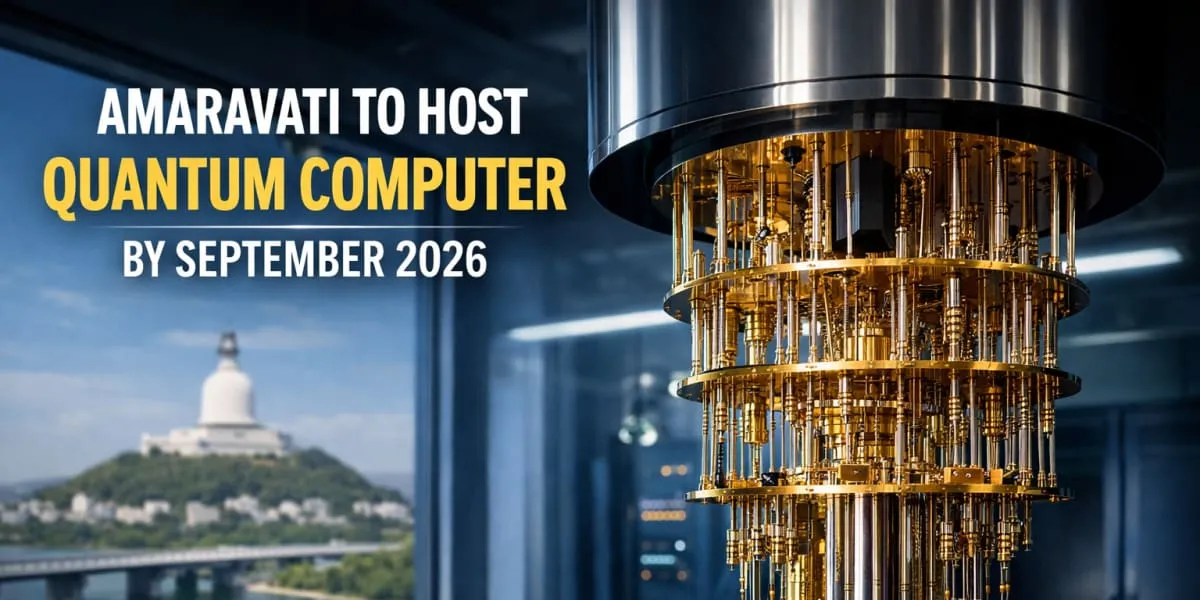
Amaravati To Host IBM Quantum Computer By September 2026
ECONOMY & POLICY

Amaravati To Host IBM Quantum Computer By September 2026

International Business Machines (IBM) chairman and chief executive officer Arvind Krishna has confirmed that Amaravati will host one of the first two IBM quantum computers to be established in India, with commissioning targeted by September 2026. The announcement was made at an event in the United States and was reflected in an official press release that described the timing and location of the deployment. The decision represents a notable achievement for Andhra Pradesh as it seeks to expand its technology infrastructure.

Krishna indicated that quantum computers are likely two to three years away from delivering substantial commercial advantages across sectors such as pharmaceuticals, materials science, financial services, logistics, cybersecurity and artificial intelligence (AI). The press release presented this as part of a broader industry expectation about when quantum hardware and software developments will begin to generate measurable returns for enterprises and researchers. Officials linked the timeline to advances in hardware scale and algorithm design.

The project forms part of Quantum Valley, Amaravati, which the state is promoting as a national centre for quantum innovation. The initiative is intended to unite government, industry, academia and startups to develop capabilities in quantum computing, quantum communication, quantum sensing and workforce training. Planners expect the cluster to foster collaboration between research institutions and commercial partners and to attract investment into supporting infrastructure.

With an IBM quantum system scheduled to be operational in Amaravati, the greenfield city is positioning itself at the forefront of India's next technological frontier and intends to provide researchers, startups and enterprises with access to cutting edge quantum infrastructure. The deployment is presented as a strategic step towards building a domestic ecosystem that can support advanced research and commercial applications ahead of the anticipated broader adoption of quantum technologies.

International Business Machines (IBM) chairman and chief executive officer Arvind Krishna has confirmed that Amaravati will host one of the first two IBM quantum computers to be established in India, with commissioning targeted by September 2026. The announcement was made at an event in the United States and was reflected in an official press release that described the timing and location of the deployment. The decision represents a notable achievement for Andhra Pradesh as it seeks to expand its technology infrastructure. Krishna indicated that quantum computers are likely two to three years away from delivering substantial commercial advantages across sectors such as pharmaceuticals, materials science, financial services, logistics, cybersecurity and artificial intelligence (AI). The press release presented this as part of a broader industry expectation about when quantum hardware and software developments will begin to generate measurable returns for enterprises and researchers. Officials linked the timeline to advances in hardware scale and algorithm design. The project forms part of Quantum Valley, Amaravati, which the state is promoting as a national centre for quantum innovation. The initiative is intended to unite government, industry, academia and startups to develop capabilities in quantum computing, quantum communication, quantum sensing and workforce training. Planners expect the cluster to foster collaboration between research institutions and commercial partners and to attract investment into supporting infrastructure. With an IBM quantum system scheduled to be operational in Amaravati, the greenfield city is positioning itself at the forefront of India's next technological frontier and intends to provide researchers, startups and enterprises with access to cutting edge quantum infrastructure. The deployment is presented as a strategic step towards building a domestic ecosystem that can support advanced research and commercial applications ahead of the anticipated broader adoption of quantum technologies.

Related Stories

Gold Stories

Next Story
Infrastructure Transport

MMRDA Targets Completion of Projects by December 2028

The Mumbai Metropolitan Region Development Authority (MMRDA) is targeting the completion of all its ongoing infrastructure projects by December 2028, a year ahead of its December 2029 deadline, Metropolitan Commissioner Dr Sanjay Mukherjee has said.Speaking at the sixth edition of the Real Estate & Infrastructure Investors' Summit (REIIS) 2026 in Mumbai, Mukherjee said the authority was developing an integrated network of roads, tunnels, sea links and Metro corridors under its broader vision of “Mumbai in 59 Minutes”.The objective is to improve east-west and north-south connectivity an..

Next Story
Building Material

High-Performance Façades Gain Ground in Indian Buildings

High-performance façades are gaining greater importance in Indian architecture as developers and architects increasingly focus on energy efficiency, thermal comfort and building performance, according to Shankar Fenestrations & Glasses.The company said modern façade systems are increasingly being considered as part of a building's overall performance strategy rather than being used primarily as aesthetic elements.High-performance glass, curtain wall systems and structural glazing can contribute to thermal regulation, solar control, daylight management and indoor comfort. Their growing ad..

Next Story
Technology

SPML Infra's 104.4 kWh BESS Battery Pack Clears Global Tests

SPML Infra has announced that its proprietary 104.4 kWh Battery Energy Storage System (BESS) battery pack has completed key international safety, performance and transportation testing and certification requirements, marking a step towards its commercial deployment.Developed under the company's own intellectual property, the battery pack has completed requirements under UL9540A, IEC 62619, IEC 63056, IEC 60730, IEC 61000-6-2, IEC 61000-6-4 and UN38.3 standards.The testing covers areas including thermal runaway safety, battery performance, system functional safety, electromagnetic compatibility..

Advertisement

Subscribe to Our Newsletter

Get daily newsletters around different themes from Construction world.

STAY CONNECTED

Advertisement

SPECIAL OFFER
QR Code