





Amit Shah Lays Foundation of NFSU, CFSL in Raipur
ECONOMY & POLICY

Amit Shah Lays Foundation of NFSU, CFSL in Raipur

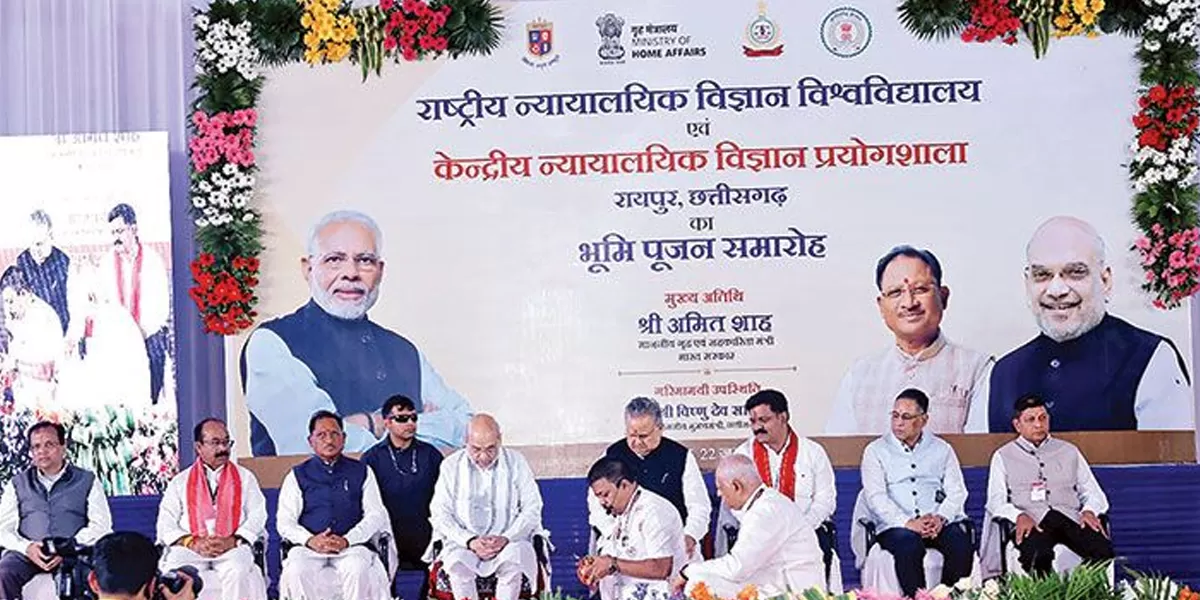
Union Home Minister and Minister of Cooperation Shri Amit Shah laid the foundation stone of the National Forensic Sciences University (NFSU) and Central Forensic Science Laboratory (CFSL) campus in Raipur, Chhattisgarh. He also virtually inaugurated the temporary NFSU campus. The event was attended by Chief Minister Shri Vishnu Deo Sai, the Union Home Secretary, and the Director of the Intelligence Bureau.

Calling it a landmark day for Chhattisgarh’s justice system, Shri Shah said the three new initiatives—NFSU, CFSL, and the i-HUB—will lay the groundwork for a modern, efficient, and evidence-based criminal justice system not only for the state but for central India.

The NFSU and CFSL facilities are being established with a combined investment of Rs 2.68 billion, including Rs 1.45 billion for the NFSU campus and Rs 1.23 billion for CFSL. Shri Shah highlighted that an NFSU degree guarantees employment and will aid in enhancing both educational and employment prospects in the state. He also inaugurated i-HUB to support start-ups and MSMEs in Chhattisgarh, promoting entrepreneurship and innovation.

The Home Minister recalled that this year marks the centenary of former Prime Minister Atal Bihari Vajpayee, attributing the creation of Chhattisgarh to his vision. With 2025 also marking the state's 25th foundation year, the state has declared it the Atal Nirman Varsh. Shri Shah affirmed that New Raipur is on its way to becoming one of India’s most modern and environmentally friendly capitals.

He praised the Chhattisgarh government for swift implementation of the new criminal laws, noting that justice from the FIR stage to Supreme Court judgement will now be delivered within three years. He said these laws will make India’s justice system one of the most modern and scientific in the world, with mandatory forensic involvement in all serious crimes.

Shri Shah outlined that since the inception of NFSU, 16 campuses have been launched—7 operational and 9 approved—with plans to expand to 26 across India. These campuses are expected to produce 32,000 forensic experts annually. The global forensic technology market, currently valued at USD 20 billion, is projected to grow to USD 55 billion by 2036, with India expected to capture a 9 per cent share.

By investing in high-quality forensic infrastructure and education, the government aims to raise conviction rates and transform the justice delivery ecosystem, aligning with the Prime Minister’s vision of a developed India by 2047.

Union Home Minister and Minister of Cooperation Shri Amit Shah laid the foundation stone of the National Forensic Sciences University (NFSU) and Central Forensic Science Laboratory (CFSL) campus in Raipur, Chhattisgarh. He also virtually inaugurated the temporary NFSU campus. The event was attended by Chief Minister Shri Vishnu Deo Sai, the Union Home Secretary, and the Director of the Intelligence Bureau.Calling it a landmark day for Chhattisgarh’s justice system, Shri Shah said the three new initiatives—NFSU, CFSL, and the i-HUB—will lay the groundwork for a modern, efficient, and evidence-based criminal justice system not only for the state but for central India.The NFSU and CFSL facilities are being established with a combined investment of Rs 2.68 billion, including Rs 1.45 billion for the NFSU campus and Rs 1.23 billion for CFSL. Shri Shah highlighted that an NFSU degree guarantees employment and will aid in enhancing both educational and employment prospects in the state. He also inaugurated i-HUB to support start-ups and MSMEs in Chhattisgarh, promoting entrepreneurship and innovation.The Home Minister recalled that this year marks the centenary of former Prime Minister Atal Bihari Vajpayee, attributing the creation of Chhattisgarh to his vision. With 2025 also marking the state's 25th foundation year, the state has declared it the Atal Nirman Varsh. Shri Shah affirmed that New Raipur is on its way to becoming one of India’s most modern and environmentally friendly capitals.He praised the Chhattisgarh government for swift implementation of the new criminal laws, noting that justice from the FIR stage to Supreme Court judgement will now be delivered within three years. He said these laws will make India’s justice system one of the most modern and scientific in the world, with mandatory forensic involvement in all serious crimes.Shri Shah outlined that since the inception of NFSU, 16 campuses have been launched—7 operational and 9 approved—with plans to expand to 26 across India. These campuses are expected to produce 32,000 forensic experts annually. The global forensic technology market, currently valued at USD 20 billion, is projected to grow to USD 55 billion by 2036, with India expected to capture a 9 per cent share.By investing in high-quality forensic infrastructure and education, the government aims to raise conviction rates and transform the justice delivery ecosystem, aligning with the Prime Minister’s vision of a developed India by 2047.

Next Story
Technology

AI-Enabled Workflows Lift Profitability and Productivity

Organisations modernising frontline workflows with artificial intelligence, automation and real-time data are reporting stronger financial performance, higher productivity and improved employee engagement, according to a global study by Zebra Technologies and Oxford Economics.The research covered 1,000 senior leaders across retail, manufacturing, transportation and logistics in the US, Mexico, the UK, Germany, India, Japan, Australia and New Zealand.In transportation and logistics, 54 per cent of companies that improved picking and packing operations reported faster operational performance, wh..

Next Story
Real Estate

India Leads Global AI Readiness but Implementation Lags

Indian companies lead global averages across all eight artificial intelligence readiness indicators tracked by JLL, but only 19 per cent have started making changes to their workplaces, according to the JLL 2026 Future of Work Survey.The study found that 77 per cent of Indian business leaders expect AI to change their office requirements, creating a 58-percentage-point gap between awareness and implementation. The survey covered more than 2,200 CEOs, CFOs and real estate leaders across 21 countries during the first quarter of 2026.Despite concerns over automation, 58 per cent of Indian leaders..

Next Story
Equipment

Three WOLFF Cranes Build Riyadh Cable-Stayed Bridges

Three WOLFF 180 B luffing jib cranes are supporting the construction of two cable-stayed bridges alongside the existing Wadi Laban Bridge in Riyadh, Saudi Arabia. The project is being developed for the Royal Commission for Riyadh City and executed by the ICRC joint venture comprising IC Ictas and Al Rashid Trading & Contracting Company.The cranes are handling lifting operations including formwork, reinforcement, concrete placement, work platforms, surveying equipment and other construction materials. Each crane is fitted with a 40 m jib, reaches a hook height of 157 m and offers a maximum ..

Advertisement

Subscribe to Our Newsletter

Get daily newsletters around different themes from Construction world.

STAY CONNECTED

Advertisement

Advertisement

Advertisement















