+
Balkrishna Enters Consumer Tyre Market, Eyes Rs 230 bn By FY30
ECONOMY & POLICY

Balkrishna Enters Consumer Tyre Market, Eyes Rs 230 bn By FY30

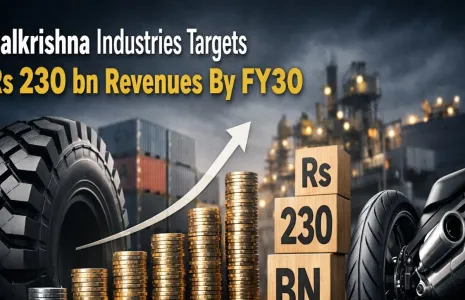
Balkrishna Industries is shifting from its niche off?highway tyre business into the consumer tyre market and expects group revenues to reach Rs 230 bn by FY30. The company has allocated Rs 35 bn for new product lines, capacity expansion and brand building, and the investment includes a national advertising campaign. The move marks its first sustained attempt to develop a domestic consumer franchise after decades of export-led growth in agricultural, mining and construction tyres.

BKT will target two?wheelers, passenger cars and medium and heavy commercial vehicles, entering segments characterised by high volumes and intense price competition. Management said the strategy is designed to diversify risk amid shifting global trade patterns and uneven demand in some overseas markets. Product engineering and distribution execution were identified as core strengths to be leveraged in the consumer push.

Chairman and managing director Arvind Poddar explained that the company studied the domestic market before entering and would apply the same playbook of differentiated product development and a distributor-led route to market. The company aims for a five per cent share in domestic on?highway segments by 2028–29, indicating an ambition to gain traction within a few years. Joint managing director Rajiv Poddar outlined that the Rs 35 bn capex is being deployed over three years, with most of the investment scheduled for the next 15 to 18 months.

The manufacturing backbone comprises a capacity of around 360,000 tonnes (t), with expansion under way at the Bhuj facility to support both off?highway and on?highway portfolios and a planned launch of commercial vehicle radial tyres in FY27. Under Vision 2030 the company expects roughly 20 per cent of revenue from on?highway products, about 70 per cent from off?highway items and the balance from carbon black, while separating BKT Tyres and BKT Carbon to distinguish consumer ambitions from industrial legacy. Management said the current investment cycle should complete planned expansions and begin delivering returns before another major capex phase is contemplated.

Balkrishna Industries is shifting from its niche off?highway tyre business into the consumer tyre market and expects group revenues to reach Rs 230 bn by FY30. The company has allocated Rs 35 bn for new product lines, capacity expansion and brand building, and the investment includes a national advertising campaign. The move marks its first sustained attempt to develop a domestic consumer franchise after decades of export-led growth in agricultural, mining and construction tyres. BKT will target two?wheelers, passenger cars and medium and heavy commercial vehicles, entering segments characterised by high volumes and intense price competition. Management said the strategy is designed to diversify risk amid shifting global trade patterns and uneven demand in some overseas markets. Product engineering and distribution execution were identified as core strengths to be leveraged in the consumer push. Chairman and managing director Arvind Poddar explained that the company studied the domestic market before entering and would apply the same playbook of differentiated product development and a distributor-led route to market. The company aims for a five per cent share in domestic on?highway segments by 2028–29, indicating an ambition to gain traction within a few years. Joint managing director Rajiv Poddar outlined that the Rs 35 bn capex is being deployed over three years, with most of the investment scheduled for the next 15 to 18 months. The manufacturing backbone comprises a capacity of around 360,000 tonnes (t), with expansion under way at the Bhuj facility to support both off?highway and on?highway portfolios and a planned launch of commercial vehicle radial tyres in FY27. Under Vision 2030 the company expects roughly 20 per cent of revenue from on?highway products, about 70 per cent from off?highway items and the balance from carbon black, while separating BKT Tyres and BKT Carbon to distinguish consumer ambitions from industrial legacy. Management said the current investment cycle should complete planned expansions and begin delivering returns before another major capex phase is contemplated.

Next Story
Infrastructure Urban

Implementation Status of Jal Jeevan Mission

Since August 2019 the Government has implemented Jal Jeevan Mission to provide assured potable water through household tap connections in rural India. At the start of the mission only 32.3 million (mn) rural households, representing 16.7 per cent, were reported to have tap water connections. States and union territories have reported that 125.8 mn additional rural households have since been provided with tap connections. As a result, of about 193.6 mn rural households roughly 158.2 mn, or 81.71 per cent, are reported to have tap water supply at home.\n\nThe State, district and village level st..

Next Story
Infrastructure Urban

Jal Jeevan Mission Reaches Eighty One Per Cent Rural Coverage

The Government reported substantial progress under the Jal Jeevan Mission, launched in August 2019 to provide tap water to every rural household. At launch only 32.3 million (mn) rural households had tap connections and states and Union territories reported provision of 125.8 mn additional households by March 2026. Consequently, out of about 193.6 mn rural households around 158.2 mn, or 81.71 per cent, are reported to have tap water at home. The Finance Minister announced extension of the mission until 2028 in the 2025-26 budget speech. The Swachh Bharat Mission Grameen, launched in October 20..

Next Story
Infrastructure Urban

Empowering Local Governance for Sustainable Rural Water Supply

The Ministry of Jal Shakti has aligned the Jal Jeevan Mission (JJM) with the 73rd Amendment to strengthen village level planning and community ownership of water supply. Gram Panchayats, village water and sanitation committees and Pani Samitis are to plan, implement, manage and maintain piped water systems, with gram sabha processes formalising handover and oversight. Implementation support agencies including non government organisations, community based organisations and self help groups have been empanelled to train local committees and promote women participation. Under JJM, the department ..

Advertisement

Subscribe to Our Newsletter

Get daily newsletters around different themes from Construction world.

STAY CONNECTED

Advertisement

Advertisement

Advertisement